
HOME >> BUSINESS
Huawei crisis boosts industry
By Chen Qingqing in Shenzhen and Li Xuanmin in Beijing Source:Global Times Published: 2019/5/21 21:48:41
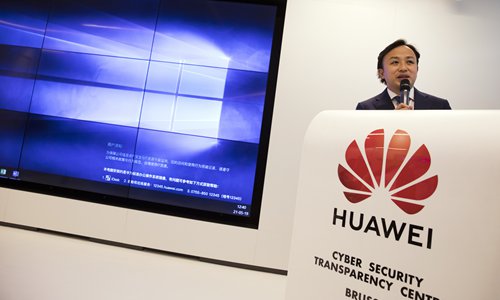
Abraham Liu, Chief Representative of Huawei to the European Institutions speaks during a DigitALL lunch talk in Brussels on Tuesday. Photo: AP
While the Huawei crisis has given a boost to the domestic semiconductor industry and made technology self-reliance much more urgent, Chinese industry executives have called for broader global collaboration to guarantee major technological breakthroughs.
Huawei has been preparing for the worst-case scenario if the US completely cuts off supply, and US officials might have underestimated our capabilities, as our advanced sector will not be affected by US sanctions, Huawei founder and CEO Ren Zhengfei told a group interview on Tuesday at the company's headquarters in Shenzhen.
Ren made the remarks just hours after the US Department of Commerce issued a 90-day temporary license granting operators to make other arrangements and allowing operations to continue for existing Huawei mobile phone users and rural broadband networks.
"This temporary license is not that meaningful… as we've been well prepared and have kept our core technologies intact," Ren said.
Faced with a US blacklisting, Huawei had activated its backup chipsets, developed by semiconductor
subsidiary HiSilicon, in case the US government curbs the company's access to American suppliers.
Huawei's Plan B also boosted the domestic semiconductor industry, which still lags behind foreign competitors in core technologies and relies heavily on imported chipsets and components.
Shares of domestic chipmakers surged on Tuesday with investors betting on finding alternative Chinese suppliers.
Chinese chipmaker Ziguang Guowei said on Monday that the Field-Programmable Gate Array, an electronic component used to build reconfigurable digital circuits manufactured by its subsidiary, can be used in the telecoms industry.
The product could also satisfy part of the requirements of its target telecommunication equipment-maker customers, such as Huawei.
"We have shipped the products in small amounts and its prospects are very bright," the company said, noting that Ziguang has built core competitive advantages in certain industries that could replace imports.
If the ZTE incident was a milestone in China's homegrown chip industry, then the US ban on Huawei is a watershed, after which industry players and officials are determined to boost self-supply and the industry's development could be fast-tracked, analysts said.
"The Huawei crisis reflects the long-term struggle of China's semiconductor sector, as we lack some core technologies, for example the electronic design automation [EDA] tool," a veteran industry representative surnamed Liu told the Global Times.
Huawei might have made major breakthroughs in some core technologies, including software licensing and neural processing unit. Some markets, such as radio frequency chipset, are still dominated by American players.
Collaboration needed
Ren noted that his company always needs American suppliers. When it faces a supply shortage, the company will have a backup.
But in "peaceful times," half of Huawei's chipsets will come from the US, and the other half are self-developed, he said.
"At such a critical moment, the Huawei issue will stimulate the domestic industry to grow," he said.
However, Ren advocates a self-dependent innovation spirit, but not a self-dependent innovation campaign that excludes foreign companies by encouraging more support for domestic ones.
"HiSilicon has developed thanks to global cooperation. Innovation and technology breakthroughs can't be achieved by a single company," he said.
China is heavily dependent on foreign suppliers for advanced chips, reflecting a growing deficit in the semiconductor trade.
In 2018, the country imported $312.1 billion in chipsets, up about 20.8 percent year-on-year, while recording exports of $84.6 billion, official data shows.
It is still unknown how far Huawei can go with its proprietary technologies. However, the Huawei founder reiterated that major breakthroughs in advanced technology can only be done by working together on a broader scale.
Role of talents
Developing a self-sufficient semiconductor industry that could compete with US companies cannot be achieved overnight. "It is a long-term process that calls for the input of time, capital and talent," Fu Liang, a veteran telecom industry observer in Beijing, told the Global Times.
"If we compare the US chip industry to a tree that has deep roots and luxuriant leaves, China's industry is a sapling about to take root," Fu said.
While investors see more opportunities in the homegrown semiconductor sector as China's central and local governments encourage chipmakers to ramp up production capacity, a talent shortage is cited as the key problem hindering the chip industry's growth.
"The industry can't be driven by money. It can only grow with the greater participation of talent," Ren said.
China should come up with concrete measures to attract talent, especially global talent, into the sector, he said.
RELATED ARTICLES: