
HOME >> WORLD
World eyes Chinese investment
By Xie Wenting and Bai Yunyi Source:Global Times Published: 2019/5/22 21:43:40
China will continue to grow despite trade war
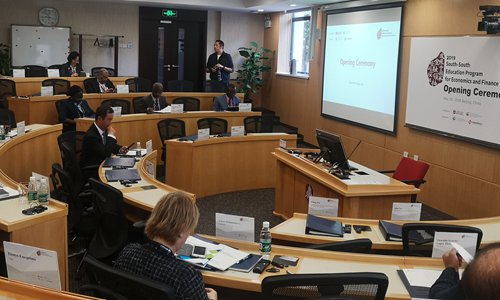
Foreign officials attend the 2019 South-South Education Program for Economics and Finance in Beijing on Monday. Photo: Xie Wenting/GT
While US President Donald Trump threatened that China would lose a lot if the trade deal is not reached, foreign economists expressed great optimism in China's future development to the Global Times.
Dr. Arnab Banerji, board member of the Qatar Financial Center Authority, told the Global Times that he has "great faith" that China will "continue to grow and be a success."
What China has done in the last 40 years is one of the greatest achievements in history. The current dispute with the US is a temporary stumble, and there is no reason that China could not sustain growth, he said.
"My belief is that China has demonstrated that it knows the right economic policies," he stressed.
Banerji is in Beijing for the 2019 South-South Education Program for Economics and Finance, a week-long program started on Monday. The program, organized by the Finance Center for South-South Cooperation and PBC School of Finance at Tsinghua University, aims to strengthen financial and economic exchanges between China and developing countries along the Belt and Road.
Banerji said China has many useful lessons in economics and finance for others to learn, so he came to participate in the program.
According to Banerji, China will sustain a fast growth partly because it has mastered the new techniques and can apply new technology to grow.
Cristian Juarez Godinze, deputy general director of financial analysis and international liaison at the Banking, Securities and Savings Unit of Mexico's Ministry of Finance, also noted to the Global times that he is "optimistic" in China's financial situation and sustainable development despite the trade war.
"China has been doing pretty well during the last 40 years. The input that China can give to the world is huge," he noted. He praised the way China efficiently implements things.
Yelena Bakhmutova, chairman of the Council of The Association of Financial Organization of Kazakhstan, shares this optimism.
She told the Global Times that China's development history and the fact that the Chinese have escaped the big financial crisis in the past provide optimism for the country's future development.
"China also has human capital. I think this is the big basis for this optimism," she said.
She added that she has witnessed the great improvement in the living standards of the Chinese people, which she said gives her greater optimism.
Eyeing more cooperation
With Qatar hosting the 2022 World Cup, Banerji said there is an opportunity for Chinese companies and financial institutions to play a part.
"We have some Chinese construction companies, and we welcome more because this is a very large development project," Banerji told the Global Times. "Companies that can help provide finance and construction are welcome to these world class projects."
As for opening up China's financial sector, he suggested that China should not rush.
"I think that in the long run, the renminbi [yuan] will become a major world currency. The final goal [of becoming] a major currency alongside the US dollar and the euro is inevitable," he said.
Qatar has already gotten involved in this process. In 2015, ICBC founded an RMB clearing center in Doha, the first of this kind in the Middle East.
Switzerland formally endorsed the Belt and Road Initiative (BRI) last month, aiming to support economic development, especially in central Asia, Reuters reported.
Bakhmutova said that investment from Switzerland under the BRI is welcome. Kazakhstan tries to create a good relationship among all investors. "If there is some interest from the third party to participate, then it is good. But this needs to be good for all participants' interests," she told the Global Times.
She said that Kazakhstan is interested in direct investment, especially in manufacturing.
In 2017, Kazakhstan launched the Astana International Exchange (AIX) in an effort to help create conditions for further economic growth. Bakhmutova said they expected more cooperation between China and Kazakhstan in the financial sector.
"There is some participation from the Chinese companies in our financial center," she said.
The AIX also recently announced plans to align with the Green Investment Principles (GIP) under the BRI. The GIP intends to build an international network to better manage the environmental risks for investments under the BRI.
Kazakhstan is also eyeing more trade opportunities with China. Bakhmutova believes that despite the trade war between the US and China, economic cooperation between China and Kazakhstan will grow stronger.
According to Bakhmutova, China is the second trade partner of Kazakhstan.
The total trade volume was $19.88 billion in 2018. Under the BRI, China and Kazakhstan have a plan involving 51 projects worth $27 billion covering various fields, which will add about 200,000 new jobs in Kazakhstan, according to media reports. Bakhmutova revealed that more projects will be created in the near future.
"That's why I remain very optimistic in our future cooperation. China's economic growth is very attractive," she said.
Foreign officials attend the 2019 South-South Education Program for Economics and Finance in Beijing on Monday. Photo: Xie Wenting/GT
Posted in: CROSS-BORDERS