
HOME >> WORLD
Intelligent partnership
By Sun Wei in London Source:Global Times Published: 2019/6/27 20:18:37
AI summit seeks to deepen China-Britain cooperation
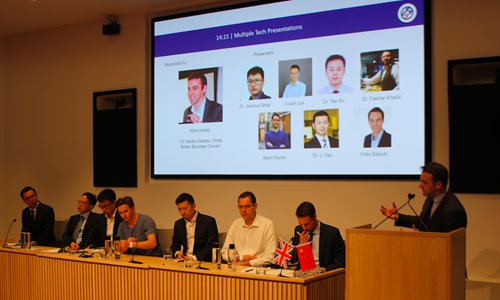
Chinese and British delegates at a presentation during the China-Britain AI Summit in London. Photo: Sun Wei/GT
The development of Artificial Intelligence (AI) in China and the UK is complementary, as spotlighted by a summit in London that brought together experts from both nations.
The second China-Britain AI Summit explored AI in both countries and took stock of opportunities and challenges.
Syrus Lohrasb, CEO of China-Britain Business Fusion, told the Global Times, "The demand for the China-Britain AI Summit arose from developments of AI in both countries." AI shall create lots of opportunities, from introduction of robots in assisting kids in education, helping the elderly fight loneliness, diagnosing diseases, slowing down carbon emission and climate change, facial recognition and cyber security, assistance in retail and ecommerce, etc. "These are just some examples that offer immense opportunities, improve productivity, ease our lives in the 21st century and lead us to a new era of Industry 5.0," said Lohrasb.
Organized by the China-Britain Business Fusion, the summit showcased seven AI tech presentations in cloud, infrastructure development, face recognition, healthcare, fintech, smart cities and autonomous driving. Panel discussions covered the investment framework, collaboration, AI ethics, and the role of AI and smart technologies in China-proposed Belt and Road Initiative (BRI).
China's AI sector has seen explosive growth in recent years with the rise of a string of unicorns like SenseTime, Megvii and Yitu. Along with this, venture capital in China's AI industry has ballooned. With its biggest tech companies driving significant investments in R&D, China is one of the leading global AI hubs.
AI is also important to BRI. Mimi Zhou, co-founder of Oxford Deep Tech Dispute Resolution Lab, said AI can serve as a tool to drive innovation and promote a greener BRI and it's already on the agenda of Chinese policymakers.
China has drawn plans to become the world leader in AI by 2030 by making the industry worth $150 billion. It is striving to introduce advanced technology in the Guangdong-Hong Kong-Macao Greater Bay Area, Beijing, Shanghai, Chongqing, Guizhou Province and other regions.
With its biggest tech companies driving significant investments in R&D, China is one of the leading global hubs of AI development. Its advantages include a large population and diverse industry mix that can generate huge volumes of data and provide an enormous market, according to a report by Mckinsey & Company.
Meanwhile, the UK, London in particular, is Europe's top hub for tech startups, with almost 30,000 tech startups funded and 2,300 tech meetups in the past five years, far more than other European countries, according to Atomico's State of European Tech Report.
AI has exciting potential to improve human life by contributing to better healthcare, environment, security and education. At the same time, with increased presence in society, AI raises complex ethical, legal, and security questions surrounding issues such as privacy, discrimination, liability and regulation. Governance should be tasked with encouraging more socially responsible and sustainable projects.
Sue Daley, Associate Director of TechUK's Technology and Innovation Department, noted it is important to identify common challenges in areas such as aging population, poverty, climate change and other wider social issues in both countries.
"The UK is placing greater emphasis on regulations and standards compared to China," Lohrasb said, noting that standardization and introduction of regulations can create more trusted brands and opportunities. "That's a perfect complement that can drive a new golden era," he said.
Posted in: CROSS-BORDERS,WORLD FOCUS