
HOME >> CHINA
Chinese Vice President vows to uphold multilateralism at forum
By Li Qiaoyi, Ma Jingjing and Song Lin Source:Global Times Published: 2019/11/22 0:13:39 Last Updated: 2019/11/22 0:48:14
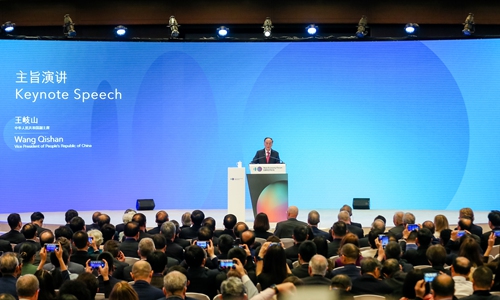
Chinese Vice President Wang Qishan addresses the opening ceremony of the 2019 New Economy Forum in Beijing on Thursday. Photo: Courtesy of New Economy Forum
The Chinese economy is in a robust state of health which derives from its unswerving pursuit of reformist goals and peaceful development, which have placed the nation at the forefront of efforts to pull the global economy out of ever-sprawling trade woes, high-ranking officials, top economists and senior business executives said Thursday at a gathering in Beijing.
In a keynote speech at the New Economy Forum (NEF), co-hosted by Bloomberg and the China Center for International Economic Exchanges Thursday, Vice President Wang Qishan noted multiple common threats facing mankind, including imbalanced and insufficient development, rising protectionism, unilateralism and populism while recognizing the unprecedented global economic and trade prosperity.
Historical experience has proven time and again that only reformers and innovators could survive the difficulties and challenges, he stressed.
Under the leadership of the Communist Party of China, the Chinese people have made great achievements and embarked on the path of socialism with Chinese characteristics that suits the country and its people, the vice president said.
China's institutional advantages have arguably underpinned its reformist drives and boosted the resilience of the economy, Wei Jianguo, a former vice commerce minister, told the Global Times on Thursday.
Under the leadership of the Party, the government can effectively coordinate efforts to reform the economy. Moreover, the system has resulted in concerted actions from both the leadership and average folks and from both the government and entrepreneurs, Wei said, adding that the joint moves resulting from the nation's system are set to allow for more progress in reform terms and more importantly, will strengthen China's governing capacity so as to push an open, innovative global economy.
The sober-mindedness and reformist mindset that prevails in the world's second-largest economy are believed to have amassed supporters among influential figures from across the globe, including former US Secretary of State Henry Kissinger and former US Treasury Secretary Henry Paulson, despite the prolonged China-US trade dispute.
"The conference is not just about technology. It's about geopolitics, about economy, about some of the social issues that are creating rising populism," Dambisa Moyo, founder and CEO of Mildstorm, a US-based financial and economics firm, told the Global Times on the sidelines of the forum.
"In terms of its standing, innovation, economic footprint, trade and foreign direct investment, [China is] a critical trading partner and investment partner globally, so it's not a surprise that people would come here," Moyo said.
China is representative of the new economy and its development reflects wider global economic trends, said Wang Huiyao, president of the Beijing-based think tank Center for China and Globalization.
That hundreds of multinational firms have chosen to come despite the lingering trade tensions clearly shows the importance these multinational firms attach to the Chinese market, Wang told the Global Times.
Peaceful development
China will always stay committed to the path of peaceful development, said Vice President Wang. He noted that the Chinese people are willing to join the people of the rest of the world in building a community with a shared future for humanity.
Wang urged upholding the international system with the United Nations at its core and building a more fair and reasonable global governance system.
Nobody wins as a result of protectionism, said Moyo, a former Goldman Sachs research economist.
There are many other issues beyond trade that have to be addressed, such as intellectual property and security and foreign exchange, she said, adding that "I'm optimistic that both the US and China understand that there has to be some kind of solution."
Zhang Yansheng, chief research fellow at the China Center for International Economic Exchanges, said he believes that phase one of a China-US trade deal is likely to be signed this year, as US President Trump, who is campaigning for reelection, needs a boost from imports to China.
Kissinger said Thursday that he hoped the trade talks between China and the US would succeed. The negotiations are of "a small beginning" which would lead to deeper-level discussions carried out by the two sides in the future, he said, according to the Xinhua News Agency.
Opposing tech decoupling
There is also a call against tech decoupling, one of the most-talked about issues of the trade frictions.
Innovation and application are supposedly borderless, former Vice Chinese Premier Zeng Peiyan said at the forum.
Tech decoupling and man-made restrictions do not comply with the trend of digital economic development and are set to pointlessly increase the cost of innovation, thereby going against the grain of innovation and benefiting nobody, Zeng stressed.
The US government's move to split the technology world includes adding several leading Chinese high-tech companies to its trade blacklist.
Technological protectionism has been accelerating in recent years, but it will not obstruct China's development and will not impact the opening-up attitude that China holds, Deng Qiang, secretary of the Party committee of the Suzhou Institute of Nano-Tech and Nano-Bionics under the Chinese Academy of Sciences, told the Global Times on Thursday.
Newspaper headline: China faces up to challenges
RELATED ARTICLES:
Posted in: DIPLOMACY