A minority report
The Xinjiang Uyghur Autonomous Region is a vast area of open plains, mountains, lakes and deserts. Shanghai is a metropolis of skyscrapers, crowds, fast-moving traffic and a frenetic modern international lifestyle. They are more than 4,000 kilometers apart but some young people are now drawing the radically different areas together.
Thousands of students and teachers from Xinjiang have been studying and training in Shanghai as part of a central government program. It has been an eye-opening experience for most, difficult for some and inspiring for others.
Sitting in a classroom on the outskirts of Shanghai, 18-year-old Muminbayi Aizibayi has been homesick for the past nine months in the city and he is looking forward to returning home shortly. In another part of the city, Haimiti Simayi, a Uyghur primary school teacher from Xinjiang is preparing his last study report after one year studying at the Shanghai Normal University. The last time he went back home was for the past winter holidays. Now he wants to stay.
The 26-year-old had never been outside Xinjiang before he came to Shanghai. Now he talks about missing the city terribly when he has to leave.
Xinjiang is a vast part of China's mainland - it accounts for a sixth of the entire country in area but has a population of about 22 million, slightly less than the 23 million or so, who call Shanghai home. From the 1990s, the central government launched a series of programs to boost Xinjiang's economy, education, health systems, welfare and infrastructure.
Education the key
Education has been a key part of these programs. The central government wants all the primary and junior high school teachers from Xinjiang to be trained in developed parts of China by 2020 to improve their language and professional skills. And a larger number of students will also be brought to study in developed cities for short periods, according to the Ministry of Education.
As part of this scheme Shanghai has a special role. Zeng Yong, the deputy director of the Xinjiang program at the Shanghai Municipal Government Cooperation and Exchange Office, told the Global Times that as part of the central government plan, Shanghai has been designated to help Kashi, one of the poorest areas in southern Xinjiang.
Every year Shanghai will spend 0.60 percent of its annual budget helping Kashi. This year some 2 billion yuan ($315 million) will be put into Kashi's urban infrastructure, education, health and industry development.
More than 2,000 teachers and principals from all over Xinjiang have come to Shanghai for training since 2002.
Most of the teachers come for specialist courses and teacher training in Putonghua, which can last from weeks to years. Some will return to Xinjiang to teach other teachers.
There are even more Xinjiang students here studying so that they can join the workforce or go on to higher education institutions.
These programs are aimed at confronting some of the problems that many of the ethnic minority students from Xinjiang now face in trying to find employment without a good education or language abilities.
According to the Xinjiang education authorities, some 80,000 graduates in Xinjiang have not been able to find work since 2002.
Last year about 2,000 college graduates, vocational school students and high school students from Xinjiang came to Shanghai to study here and more will follow. One of them was Muminbayi Aizibayi. Born into a Tajik ethic minority family in Kashi, Aizibayi came to Shanghai with another 149 Xinjiang students nearly a year ago, a mysterious destination which they reached after a three-day train journey.
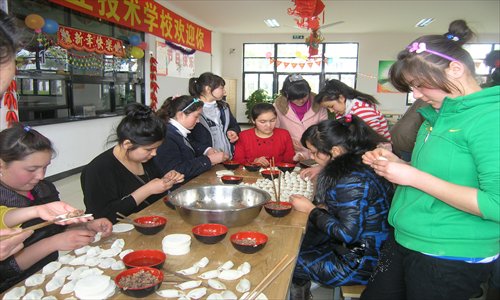
The students found themselves at the Shanghai Qunyi Vocational and Technical School in Minhang district in a program run by the Ministry of Education. All their education fees and their board and living expenses have been paid for by the government.
It was their first time away from Xinjiang and Shanghai had surprises around every corner for the youngsters. Bai Jing, a class teacher of some of the Xinjiang students at the Qunyi school said: "It was a totally new environment for them and when they got here, every day they found something different - things they had never encountered before."
Bai said that the students were a diverse collection - all had been randomly selected from schools in their hometowns a month previously and they were the first group in the program. "No teacher here had experience with this before," Bai said.
The students were aged from 14 to 22 years and 87 percent of them came from ethnic minorities. Only 60 percent had completed junior high school - the rest had dropped out.
For teacher Bai this motley group caused a few headaches at the start. "At first they seemed very different from city students. They spoke, ate and behaved differently. Some of the boys glared at me constantly."
Open their hearts
But Bai and his colleagues had no prejudices and opened their hearts to the students. The school set up a special oven to cook their naan bread, a staple food for Xinjiang ethic minorities and a separate dining room which served Muslim halal food for the students.
The group has been split into five classes for three courses: automobile repair, preschool education and real estate management. But the first and the foremost task for most students was learning Putonghua. It was not easy and sometimes teachers had to repeat sentences slowly word by word.
"Now they can understand almost everything. I have also learned their languages. Now we are like a family," Bai said.
Aizibayi has spent nine months or more learning to repair automobiles. "The teachers here have treated us very well and helped us a lot," he said in Putonghua.
To enrich their experiences and life in Shanghai, the school arranged trips for the Xinjiang students to visit some of the top tourist sites like the World Expo 2010 in Shanghai, the Shanghai Science and Technology Museum, the Bund and the Oriental Pearl TV Tower. The students also visited big industrial plants for practical experience.
Zhao Hongxiang, a Henan native, has been teaching in Xinjiang since 1974. He accompanied these students to Shanghai last year. He told the Global Times that they had a unique opportunity to learn Putonghua here, which would be immensely helpful for them to be able to communicate with people from other parts of China and to better understand the country.
"For a long time, language has been an obstacle for people from minority groups. A lack of education resulted in unemployment, which was the basic reason for social instability in the region," Zhao said.
Over the past decade, Xinjiang has been threatened by terrorist, separatist and extremist forces, said a white paper from the Information Office of the State Council in 2009 after a shocking incident on July 5 that year in the capital city Urumqi which claimed 197 lives and injured another 1,700 plus.
Lack of communication
The 39-year-old Uyghur teacher Arsene Kulban said that he believes the problems in Xinjiang are mainly due to a lack of communication and a lack of understanding of each other.
"We know too little about each other. Some of the people in Shanghai thought we came from grasslands and rode camels to work when they heard we came from Xinjiang," Kulban laughed.
As the deputy leader of the Xinjiang teachers' training team in Shanghai, Kulban has been to the city a few times and calls Shanghai his second hometown. Before he began the program he had been a chemistry teacher in a high school in Urumqi for 15 years.
Their team includes 120 Uyghur teachers from primary and junior high schools in Xinjiang. They have studied at Shanghai Normal University over the past year in another program organized by the Ministry of Education.
According to Wang Tao, the deputy director of the Shanghai Teachers' Training Center, Shanghai accepts many teachers, principals and management staff from Xinjiang for language, teaching skills and other professional courses.
After one semester of language study, Haimiti Simayi, a 26-year-old mathematics teacher from Xinjiang and roommate of Kulban in Shanghai, said, "I was very impressed by the advanced equipment that is found in Shanghai schools and the teachers here are very skilled." He is now at a city primary school gaining practical experience.
"Students here are really obedient and shine compared with the children in Xinjiang. Few children here want to go outside and play when class is over. That's unimaginable at our schools," he said.
Simayi said that the biggest difference he felt was that people in Shanghai had a much faster pace of life than in Xinjiang.
"People here even sleep when they are standing on the subway maybe because they never get enough rest. Having two or three extra part-time jobs is very common here. Compared with them, we are very lazy," Simayi laughed.
Understandable suspicion
Simayi admitted that sometimes Shanghai people keep a close eye on him because he looks like one of the Xinjiang minority people.
"I understand their concerns because I have seen thieves from Xinjiang picking pockets. But I must say they do not represent all Xinjiang people," Simayi said.
"The best way to handle hostility and distrust is through honest communication. And up to now we have lacked this," he said.
Hu Zhongze, the deputy director of the National Association of Vocational Education of China, told the Global Times that supporting people in remote areas in Xinjiang should not just focus on material help but also on improving communication.
"Despite the different cultures and languages, China has always been a country full of diversity. We can only be one family by respecting each other with honesty. And it is never too late to start," Hu said.