HOME >> ARTS
Web music shifts keys
Source:Global Times Published: 2012-6-10 19:40:03
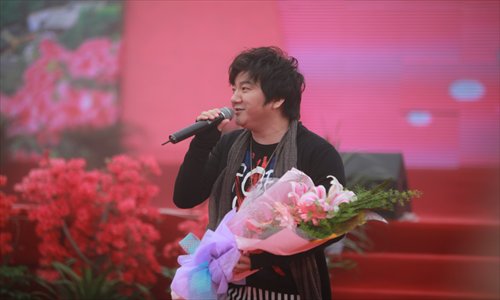
Yang Chengang

Phoenix Legend
In July, a concert celebrating 10 years of original, award-winning Chinese online music will be held at Shanghai Gymnasium. The selection of songs was recommended by music websites, web portals and online media.
The concert chronicles a decade of development in China's original online music. However, promoters of the concert are avoiding using the word "Internet" in their advertisements. At a press release conference on Tuesday, Zhong Xiongbing from Chinese Musician Association said that the appeal behind an "original Internet song" is no longer a selling point.
"Liangzhi Hudie" (two butterflies), "Laoshu Ai Dami" (mice love rice) and "Xiangshui Youdu" (poisonous perfume) were songs popular several years ago but no longer resonate today. Changing attitudes toward online music reflect the development of China's pop music industry over the past few years.
Notes from the past
The concept of an "original Internet song" in China has taken off in a different direction, compared to Western countries. In China, songs released and streamed online are usually written by amateurs, creating a new genre contrasting mainstream Chinese pop music made by professionals. With straightforward lyrics, simple and repetitive melodies, these songs are entertaining and catchy.
The first well-known song to hit the web was "All Northeasterners are Living Lei Fengs" by Xue Cun in 2002.
The year from 2004 to 2005 saw the rise of original Internet music, when singers like Yang Chengang (singer of "Laoshu Ai Dami") and Pang Long ("Liangzhi Hudie") became famous.
Since then, all songs released through the Internet were considered original online songs in China. Before 2002, the most popular Chinese songs originated from Taiwan or Hong Kong. Chinese mainland companies could hardly compete.
"With the rise of songs streaming on the Internet, we finally heard popular melodies from the Chinese mainland," said Zhong.
The popularity of original Internet music brought freedom to this industry. It also opened up a huge market of mobile ringtones. In 2011, the digital music market took in 2.78 billion yuan ($440 million), an increase of 20.8 percent from the previous year. The digitalization of the music industry is changing the way music is marketed and consumed.
However, in the last five years, only a few songs in the "original Internet" genre were acknowledged by the public, typically embraced only by those in small cities and villages.
As the Internet is now an important way of releasing and podcasting new songs, almost all music corporations and singers will include online downloading as part of their distributing strategy. Terms like "Internet" or "digital" no longer define music.
The lack of copyright protection also accounts for the decay of original songs found on the Internet.
Zhong compares China to the US: "American musicians can earn money from downloaded iTunes. Apple earns 30 percent of the profit while the other 70 percent goes to the copyright owners. In China, digital music downloading is dominated by the three telecom conglomerates. The operator takes over 90 percent of the profit, leaving only 4-5 percent for service providers and 1-2 percent for musicians."
Many singers who use the Internet as their main platform profit by participating in concerts and TV shows.
The musical duo, Phoenix Legend, released a number of songs online. But what propelled their rise to fame was their appearance on a TV program called Star Way, which airs on CCTV. Since their first appearance on the show, their rate increased from 20,000 yuan to 500,000 yuan.
In an interview with News Times, Yang Chengang describes his experience,"The most important function for music is its ability to be shareable. The value of music lies in commercial performances and other services."
Unknown Future
Musicians are often criticized for focusing on self-promotion while producers are shamed for unoriginal branding. Zhong, however, is confident about the future of Chinese pop music. He posted on his blog in February that the environment is favorable for the development of Chinese pop music.
First, the music industry is influenced by government policies. Changes in media law and downloading guidelines are ways to improve the protection of copyrights.
Second, Zhong said that content providers no longer rely entirely on distributors as they used to. Following the revolution of marketing and distributing methods, the music industry has been altered drastically.
Song Ke, the founder of Taihe Rye Music Co.,Ltd. said in an interview with ifeng.com that the increased utility of Internet will be an opportunity for Chinese music business to catch up with the West.
"We are at a crucial stage. We'll see how things change in the next three to five years, if the music industry will step up or vanish."
In July, a concert celebrating 10 years of original, award-winning Chinese online music will be held at Shanghai Gymnasium. The selection of songs was recommended by music websites, web portals and online media.
The concert chronicles a decade of development in China's original online music. However, promoters of the concert are avoiding using the word "Internet" in their advertisements. At a press release conference on Tuesday, Zhong Xiongbing from Chinese Musician Association said that the appeal behind an "original Internet song" is no longer a selling point.
"Liangzhi Hudie" (two butterflies), "Laoshu Ai Dami" (mice love rice) and "Xiangshui Youdu" (poisonous perfume) were songs popular several years ago but no longer resonate today. Changing attitudes toward online music reflect the development of China's pop music industry over the past few years.
Notes from the past
The concept of an "original Internet song" in China has taken off in a different direction, compared to Western countries. In China, songs released and streamed online are usually written by amateurs, creating a new genre contrasting mainstream Chinese pop music made by professionals. With straightforward lyrics, simple and repetitive melodies, these songs are entertaining and catchy.
The first well-known song to hit the web was "All Northeasterners are Living Lei Fengs" by Xue Cun in 2002.
The year from 2004 to 2005 saw the rise of original Internet music, when singers like Yang Chengang (singer of "Laoshu Ai Dami") and Pang Long ("Liangzhi Hudie") became famous.
Since then, all songs released through the Internet were considered original online songs in China. Before 2002, the most popular Chinese songs originated from Taiwan or Hong Kong. Chinese mainland companies could hardly compete.
"With the rise of songs streaming on the Internet, we finally heard popular melodies from the Chinese mainland," said Zhong.
The popularity of original Internet music brought freedom to this industry. It also opened up a huge market of mobile ringtones. In 2011, the digital music market took in 2.78 billion yuan ($440 million), an increase of 20.8 percent from the previous year. The digitalization of the music industry is changing the way music is marketed and consumed.
However, in the last five years, only a few songs in the "original Internet" genre were acknowledged by the public, typically embraced only by those in small cities and villages.
As the Internet is now an important way of releasing and podcasting new songs, almost all music corporations and singers will include online downloading as part of their distributing strategy. Terms like "Internet" or "digital" no longer define music.
The lack of copyright protection also accounts for the decay of original songs found on the Internet.
Zhong compares China to the US: "American musicians can earn money from downloaded iTunes. Apple earns 30 percent of the profit while the other 70 percent goes to the copyright owners. In China, digital music downloading is dominated by the three telecom conglomerates. The operator takes over 90 percent of the profit, leaving only 4-5 percent for service providers and 1-2 percent for musicians."
Many singers who use the Internet as their main platform profit by participating in concerts and TV shows.
The musical duo, Phoenix Legend, released a number of songs online. But what propelled their rise to fame was their appearance on a TV program called Star Way, which airs on CCTV. Since their first appearance on the show, their rate increased from 20,000 yuan to 500,000 yuan.
In an interview with News Times, Yang Chengang describes his experience,"The most important function for music is its ability to be shareable. The value of music lies in commercial performances and other services."
Unknown Future
Musicians are often criticized for focusing on self-promotion while producers are shamed for unoriginal branding. Zhong, however, is confident about the future of Chinese pop music. He posted on his blog in February that the environment is favorable for the development of Chinese pop music.
First, the music industry is influenced by government policies. Changes in media law and downloading guidelines are ways to improve the protection of copyrights.
Second, Zhong said that content providers no longer rely entirely on distributors as they used to. Following the revolution of marketing and distributing methods, the music industry has been altered drastically.
Song Ke, the founder of Taihe Rye Music Co.,Ltd. said in an interview with ifeng.com that the increased utility of Internet will be an opportunity for Chinese music business to catch up with the West.
"We are at a crucial stage. We'll see how things change in the next three to five years, if the music industry will step up or vanish."
Posted in: Music