Contrastling oils
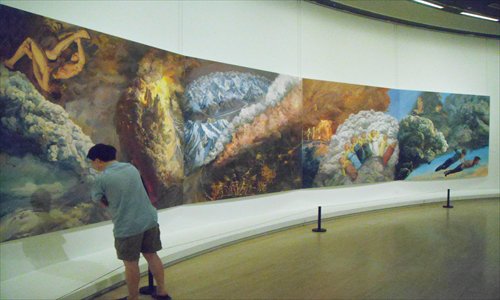
Is modern life bringing us closer together or putting barriers between us? Perhaps the answer can be found at the IN TIME: 2012 biennale which is now running at the National Art Museum of China (NAMOC). The exhibition draws together modern oil artworks from a number of Chinese artists to present artwork of a different nature. Typically, audiences associate Chinese art with ink paintings, partly due to the fact that it's only been in the last century-or-so that oil painting has become popular in China. One hundred years however, is more than enough time for artists to leave their imprint on a genre.
Jointly hosted by the Ministry of Culture, NAMOC and the China Oil Painting Society, the exhibition showcases altogether 121 oil paintings created by 32 artists. The exhibition's theme is contemporary art, and it's divided into three sections: "Strength of Representation", "Purity of Language" and "Depth of Thought."
As these names indicate, the exhibition focuses experimental styles rather than replicating Western art or copying traditional Chinese styles. Aside from the odd flirtation with controversy, the biennale also aims to emphasis modern, cutting edge art.
One example is 43-year-old Lü Shanchuan, whose interest lies in public interaction. Lü has created a series of oil paintings featuring public squares such as Berlin's Gendarmenmarkt Square, Cairo's Tahrir Square, and of course Tiananmen Square in his works. "The square is a public space for a country or region. In ancient Greece, the citizens of Athens first participated in public life by going to the square. Ever since, it's been a place to hear about what's going on," said Lü. "The square is where news is spread, just like the media platforms of our day. In addition, it is a contemporary temple where people worship, which also symbolizes the authority of the State."
Whilst public squares symbolize togetherness, 41-year-old artist Wang Fenghua has created artworks that symbolize the barriers between people. An icon repeated throughout his works is the iron segregation wall, an object which can be seen throughout China.
"In modern cities, these segregation walls have become part of life. They are not only involved in construction and demolition, but reflect the 'segregation' of two very different worlds. Look through these fences and you will discover peasant workers who live in a city, but are not accepted by it. Their life inside the walls belongs to simple huts, and their existence is completely cut off from the city," said Wang.
"These segregation walls are an integral part of modern China's urban landscape, and remind us that we are being cut off from the past."
Audience members embraced the varied aspects of the exhibition.
Luo Yikun, a 21-year-old college student who just came back from the US to spend his summer in Beijing, said he was surprised by the art on display.
"I'm delighted to discover Chinese oil paintings can have so much thoughtful content," said Luo. "In contrast to fancy pieces always trying to steal the spotlight, these are more honest, and I see the sincerity in them."
Retired doctor Hu Jian, 63, said these oil paintings deserve attention. "Aside from their purely aesthetic values, these paintings delve into serious issues. Though they present these concepts in a careful way, you can read their themes from the pictures," he said.
According to Xu Jiang, the President of the China Academy of Art, "representation, consciousness, and experimentation are what create modern paintings. Can these three words form a network to embody the world? Can they provide a clear outline for modern paintings? The answer to this question is not to be found in words, but in the intimate experience of the paintings themselves."
When: Until June 27
Where: National Art Museum of China, 1 Wusi Dajie, Dongcheng district
Tickets: Free
Contact: 6400-6326