Dreaming on water
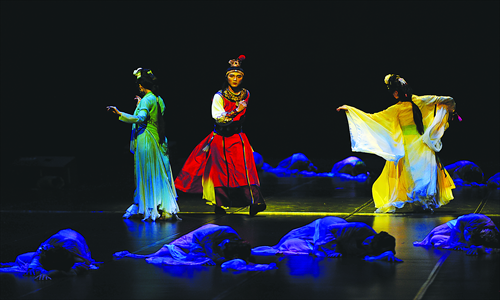
Perhaps you've read the print version of the classic Chinese novel, Dream of the Red Mansion by Cao Xueqin (1715-63), but you probably haven't seen it against a waterscape background. From June 22 to August 2, the Chinese classic will be staged at the Water Cube, the National Aquatics Center in Beijing, bringing audiences a lively, aquatic experience.
This rendition is directed by Chinese film director Li Shaohong, famed for her fine sensibility in displaying emotions. Previous representative works include Daming Palace and Oranges Turned Red.
Artistic show
After directing the most recent 2010 TV series Dream of the Red Mansion, Li explained where her motivation to produce an adaptation staged on water came from.
"My inspiration comes from the famous saying in the book," Li said, "Women are made of water." The quotation is said by Jia Baoyu, the leading male character in Dream of the Red Mansion.
This is not the first time that Li set the stage on water. In October 2009, Dream of the Red Mansion premiered in Shanghai's Changfeng Park on Yinchu Lake.
With the enclosed environment of the Water Cube, the director can make use of the water, light and other indoor facilities. Audiences experience the feeling of being part of the performance.
"Water is the highlight of the show but also the most difficult part [to manage]," she said. As the whole performance is set in the Water Cube, water is a resource and hindrance. "We try to give audiences a strong sense of space throughout the performance," said Li.
The stage is ring-shaped, modeled after the way the water flows and the architectural characteristics of the Water Cube.
With over 100 cameras and projectors, the light reflections and refractions of the water make the Water Cube a multi-colored, transcendent fairyland, Li said.
Projection screens created from yarn add to the show's soft, aesthetic effect. The surround sound is better than Shanghai's performance, Li stressed, thanks to the Water Cube's favorable acoustics.
All action, no talk
Li's show is composed of dances and movements, as there is no dialogue.
"There are nearly 100 actors, and most are professional dancers," she said.
In the show, important chapters from Red Mansion are performed. Scenes include Nüwa, a goddess in ancient Chinese mythology patching the sky, the birth of Jia Baoyu, and the death of Lin Daiyu, the leading female character. All parts are performed without dialogue.
The scene from the chapter "Luohong Chengzhen" is especially touching. In this chapter, Jia Baoyu and Lin Daiyu read the ancient Chinese novel, Romance of the West Chamber, written during the Yuan Dynasty (1279-1368).
The scene shows the two leading characters developing romantic feelings for each other. Performers playing Jia Baoyu and Lin Daiyu merrily chase each other while dangling from wires.
At the same time, petals of peach blossoms fall on the huge screen as well as the audiences' seats, bringing them an immersive experience.
But without any lines or narration, some may find the plotline difficult to follow. Audiences who have not read the classic may not pick up on the intricacies of the story.
In response to this, Li said she hopes audiences can interpret it by themselves using details and context clues from the show.
"We can't add more dialogue or narration, as it's not a TV series," she said.
"I hope to connect with audiences using body language, since the focus of the show is dancing," the actress who plays Lin Daiyu told China News Service.
Regardless, responses from audiences are generally positive.
"The fantastic scenes and heartwarming stories are really enchanting," Li Na, an employee at a technology company in Beijing posted on her Sina weibo.
As the show will run until August, director Li said they will weigh in feedback from the audience.
Cube conundrum
Originally built for the swimming competitions during the 2008 Olympic Games, the Water Cube is attempting to revamp its function and serve the public in both sports and other entertainment activities. After the Olympics, the Water Cube was renovated as a water park.
Li is not the first to stage a show at the Water Cube. Since the Beijing Olympic Games ended, 160 shows including music concerts and ballets like Swan Lake have been staged at this venue.
But in 2011, the Water Cube failed to make ends meet, acquiring a deficit of more than 10 million yuan ($1.6 million).
"With declining enthusiasm from visitors after the Olympic Games, the pressure for keeping the venue profitable is increasing," said Yang Qiyong at the national sports directors meeting in December 2011.
The total number of tourists for 2011 was 30 percent lower than in 2010, according to Yang.
"The Water Cube is looking for a way to be profitable," Yang said.
Innovations like Li's productions are welcomed by both the management and audiences.