Risky Business
Yu Zhijun, a 34-year-old full-time marketing executive in Hefei, Anhui Province, spends at least two hours a week managing his account with ppdai.com, China's largest peer-to-peer online lending platform. He earns what he calls "the most miraculous returns" - or 18.2 percent on an annualized basis in the last three months.
"I know the risk of lending online, but the returns are amazing," he told the Global Times. "I made over 40,000 yuan ($6,268.80) last year and that's half my annual salary as a marketing executive in an international firm."
As an amateur online loan manager, Yu manages his risks based on the credit records of the borrowers and he seldom asks about the purpose of the borrowed sums.
"I do not need to know what the money is for. People often say they need the money to pay emergency medical bills," he said. "All I need to do is make sure that I do not give money to people who will leave without paying it back."
Private lending is common in the Chinese mainland as a tradition among families and friends, but this unregulated "shadow banking" system moved online in 2007, creating a broader national platform. ANZ bank told the Financial Times in a 2011 report that the country has an estimated $2.4 trillion circulating in the shadow-banking sector.
China now has over 2,000 websites offering private lending activities. Loans brokered online saw an astonishing 300-fold increase to 6 billion yuan in the first half of 2011 from the full-year total of 2007, China National Radio reported in June.
No pain, no gain
Ppdai.com was established in 2007 amid the prime years of China's economic boom and it now has over 1 million registered users, the largest in the country for this kind of online model.
The website has a stated goal to create "an online community that brings borrowers and lenders together and provide them with a secure and efficient platform for conducting loans."
The website lets individuals lend a minimum of 50 yuan in projects ranging from emergency medical expenses to business plans, and offers interest rates of as much as 23 percent, almost six times the benchmark lending rate of the People's Bank of China.
Such lending channels attract individuals who want higher returns than they can get from saving their money in bank accounts, which only offer interest of some 3 percent.
An insider at ppdai.com, who asked not to be named, told the Global Times that as well as the promise of higher returns, the lenders also face risks.
"Everyone who is in the game knows the risk and some people can gross over 100 percent returns in the underground shadow-banking network," he said. "It is a fair game to play, a little less risky than gambling because you can credit-check their borrowing history."
The credit history on ppdai.com offers a limited profile of the borrower, providing the borrowing history of the individuals on the website. But it does not provide any credit profile of the individual's bank loans or mortgage history.
"Experienced online loan providers can distinguish a good borrower from a bad one, but it is almost based on a hunch," he said. "It is a business of goodwill."
Yu Zhijun tries to keep his eyes open for potential risks, but he lost 2,000 yuan last September when a borrower from Jiangsu Province merely absconded.
"No pain, no gain," he said. "At this rate, I will be able to buy my dream car - a BMW 3 series, in two years."
According to a report by Bloomberg, about 3.5 percent of ppdai's loans are not paid off on time and another 1.2 percent have been overdue for at least 90 days, the definition of a nonperforming loan at Chinese banks.
To attract loans, borrowers provide details of the purpose of the loan. Some ask for up to 250,000 yuan for their business plans.
Zhong Nan, a Changzhou-based garment production entrepreneur, told the Global Times he needs to find 250,000 yuan in order to pass the annual inspection by the local industrial and commerce bureau so that he can renew his business license.
"I do not need to provide any collateral for borrowing money on ppdai.com," Zhong said. "And I only need a short-term loan, so I don't mind the higher interest rates."
Zhong said he had tried to find funds through banks and State-run lending offices before going to the online platform. "All the doors were closed," he said. "I was left with no other choices."
Some regulation needed
Even though online lending is flourishing, substantial risks remain. China Business Network reported in June that taojindai.com, which launched on June 3, went offline after just five days. Around 80 users reported the case, claiming that they had lent a total of over 1 million yuan through the website.
Online lending flourished after bank credit started tightening in 2010, partly due to the global financial crisis. Small and medium-sized enterprises (SMEs) have become frequent borrowers on these underground lending channels.
Howard Lai, a private banking analyst with Ernst & Young in Shanghai, told the Global Times that government policies should allow such shadow-banking channels to survive, but regulatory measures also need to be in place to protect the public interests.
"The regulatory commissions should understand the logic behind such microfinance channels, and that there is a great need for loans even when borrowers have no collateral," Lai said. "Only 3 percent of China's 42 million SMEs are able to get loans from banks."
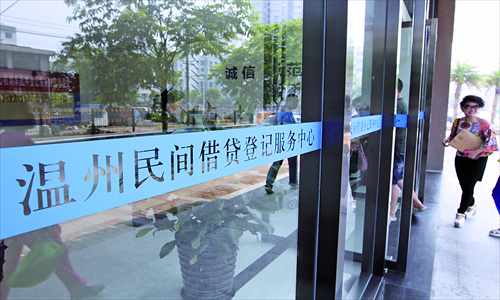
China recently rolled out a string of pilot reforms and one in particular in Wenzhou, Zhejiang Province, which has a large number of SMEs and is a hotspot for underground lending. The reform was launched last October following a visit to the city by Premier Wen Jiabao after 10 SME owners committed suicide and another 200 absconded overseas.
Under the pilot scheme to turn Wenzhou into a special finance zone, the government is allowing informal lending institutions to register as private lenders or become rural banks. The policy is aimed at curbing risks in underground lending.
Ppdai.com is among many lending institutes that obtained a formal lending license amid the recent financial reforms by the central government.
In May, the Shanghai Administration for Industry and Commerce granted the license to the website, meaning its lenders and borrowers are provided with limited protection from any financial fraud on the lending platform.