HOME >> OP-ED
HK's rough politics turns small quarrels into big protests
By Wang Di Source:Global Times Published: 2012-8-12 18:25:03
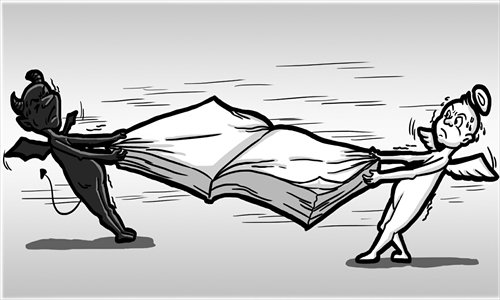
Illustration: Sun Ying
I stood speechlessly as I saw a handful of young girls and boys marching by and "leading" a crowd of protestors on July 29. In retrospect, how could the government of the Hong Kong Special Administrative Region have foreseen a year ago that one day its national education blueprint would be interpreted as communist brain-washing and would meet with such a fierce protest?
The recent protest in Hong Kong exemplifies the typical political pattern of the city: a dramatic result arising out from obscure reasons.
The catalyst that triggered the subsequent chain reaction is a booklet for teachers of a national education course, titled The China Model. Distributed to primary and secondary schools in June, it was compiled by the National Education Centre, sponsored by the Hong Kong government.
Such official presence fueled pan-democrats' anger when they discovered it was full of fulsome praise for the leadership of the CPC, and omitted any mention of controversial past events.
Given the absence of any "patriotic education" in the previous curriculum, the Hong Kong government should have realized that any initiation of such elements would be difficult.
Although many believe the China model is a new development pattern, Westerners, as well as many Hong Kong citizens, are reluctant to recognize the contributive role of the Party.
Government officials such as Secretary for Education Eddie Ng Hak-kim, admitted that the manual was inappropriate and would only serve as a tentative reference.
Hong Kong's chief executive, Leung Chun-ying, suggested that the government will not set national education as a compulsory course in September semester. However, it became clear soon that pan-democrats and other opposition groups actually demanded the withdrawal of the entire national education course, not just the above-mentioned handbook.
An important pillar of the protestors is the Professional Teachers' Union. Compared to parents' rather pluralistic opinions, their overwhelming opposition to the entire curriculum greatly shaped the trajectory of this event.
As a teachers' strike was possible, the government had to take teachers' opinions seriously.
Although most teachers take a neutral political stance in contemplating education policy, they dread the introduction of national education, because it will eat up a considerable amount of teaching time that they feel neither teachers nor students will benefit from.
In particular, the curriculum's grade, due to its non-academic nature, won't be part of students' academic assessment, which is what teachers really concerned about.
Furthermore, the lack of local staff that could actually teach this course perhaps implies future employment of mainland teachers. Teachers' reluctance to accept any kind of change is ubiquitous. This time, they were lucky to find political allies that also want to exploit it.
The pan-democrats want to take this opportunity to shake Leung's creditability and leadership. The new governor suffers from their mistrust, because he was elected by a 1,200-member committee rather than directly by the Hong Kong citizenry.
They thus reckon that political defeats for Leung could help with the early introduction of a general election, despite the instability and dysfunction of government that could also ensue.
Local governments often have to give in to popular demands, even those that contradict each other. The dismissal of even a small faction's request can be taken up by others as a symbol of absolutism and the lack of representation.
The inability to insist on its decided plan has impeded the government's functionality. And it is this precise problem that pan-democrats take advantage of, as they put as much pressure as possible on the governor.
To rescue the entire national education curriculum, the government has agreed that the booklet is inappropriate and poorly written.
With hindsight, I think the government should have predicted the complexity of the issue and likely resistance, and taken some preemptive measures beforehand.
For example, it should have asked a couple of institutions to compile various textbooks and give schools more alternatives. It should have also been more transparent in drafting the policy.
There isn't an opposition consensus that holds every group together. On the contrary, Hong Kong society is highly heterogeneous, and the inability of the government to persevere makes things particularly thorny.
The result is the stagnation that every Hongkonger can perceive in recent years, as well as a highly politicized society.
The baby girls and boys carrying banners footnoted the civil society that many Hongkongers have been longing for.
This was a debate during which one side mobilized young children who didn't know what their parents are arguing about, and where the other side felt victimized and unable to act. That is not a war against a looming Big Brother. That's just politics.
The author is a PhD student in Economics in the Chinese University of Hong Kong. di.w@live.co.uk
Posted in: Viewpoint