Sporting assets
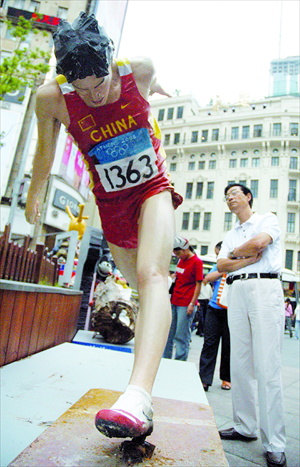
The family of Ye Shiwen, the 16-year-old swimmer from Hangzhou, Zhejiang Province, who won two gold medals in the Olympic Games, said they were overwhelmed by a recent government decision to build a statue of her in Hangzhou to commemorate her victory in London.
The victory has marked her as an attractive target for officials looking to boost their image, and raised questions as to how the government can seek dividends on their sporting investments.
Winning two gold medals in a field where China does not traditionally dominate has made Ye an instant national idol, leading to a media frenzy and concerns from her family that a statue might be too much.
"We appreciate the gesture but it seems to be a little bit over-the-top for a girl of her age," said Ye Shiwen's father Ye Qingsong.
In the spotlight
As the games wrapped up on Monday with China bagging 88 medals, public attention has shifted to the medal-winning athletes.
Chief of the Hangzhou sports bureau, Zhao Rongfu, said Saturday that they had decided to build statues for Ye and Sun Yang, two athletes from Hangzhou that have become superstars after winning two golds each in the London games.
The move has been the subject of heated debate online, with the sports bureau claiming it's tradition to congratulate extraordinary athletes and promote sporting spirit, while Web users argued that officials are exploiting the value of star athletes for their own benefit.
"We're just trying to encourage people to participate in sports by building statues for sports stars," an official with the Hangzhou sports bureau told the Global Times. Sun and Ye's statues will stand alongside four statues of gold medal-winning athletes in front of the Hangzhou Gymnasium, including Luo Xuejuan, China's breaststroke queen and gymnast Lou Yun, who won two gold medals in the men's vault in the 1984 and 1988 games.
The public might have misinterpreted their good intentions, said the official. "The government invested a lot of money in the training of Sun Yang and Ye Shiwen, and it's reasonable to ask for something in return when the athletes become famous," he added.
Public views
The majority in an online poll, however, apparently disagree.
Some 86 percent of more than 6,700 Sina Weibo users said they believed it is inappropriate to erect statues for Olympic Games athletes although they should be respected and congratulated on winning medals. Another 8 percent hailed the government's move, saying Olympic Games champions serve as icons to promote the city's image.
Building statues for public figures is common in China, especially for national heroes or pioneers in certain fields.
There have been previous cases of building statues for athletes, for example the Wuhan city government erected a bronze statue of Li Na, a local tennis player who wowed the world by winning the singles title in the 2011 French Open.
"Building statues or gymnasiums in the name of star athletes can inspire more young people to take part in competitive sports, which gives the government better chances when selecting potential stars," said Zheng Xueqin, a senior researcher with the China Branch Research Institute, which publishes reports on the value of Olympic Games winners and medals.
The intangible assets brought by medal winning athletes, including a positive public image, reputation and possible commercial opportunities, have been exploited by both government and enterprises and it's a normal phenomenon, said Zheng.
The sporting business
"Everybody wants a share. It's not a bad thing that both the government and companies are looking into sports for development prospects. Exploring and using star athletes' value helps promote national fitness and creates more business opportunities," Zheng told the Global Times.
Sun Yang, at 21 years old, already boasts several commercial contracts after having won his first gold medal in a world event at the Asian Swimming Championships in 2009. After winning the London Games, Sun became one of the most favored candidates for advertisements. A local real estate magnate in Hangzhou has promised a 3 million yuan ($476,190) villa for both Ye and Sun as a reward, according to local media reports.
"All this publicity and promotion of star athletes seems normal. After all, China is a country with few super star athletes and a less mature sports economy compared to some foreign countries," said Zhang Qing, a sports marketing analyst.
He suggested the Hangzhou government take a more rational approach to native sports champions, and suggested inviting them to public activities, teaching kids to swim, or establishing charitable foundations to help people with sporting dreams.
According to Zhang, China's so-called State-run competitive sports system has ensured China's elite athletes are competitive enough to win medals in world games, while improvements are urgently needed in the management of sports authorities in terms of exploring athletes' commercial opportunities.
At present, most of the time, it is China's sports authorities who have the final say when making decisions on commercial contracts between athletes and delegate teams.
Commercial uncertainty
"But the authorities don't have rules or regulations on signing business contracts, while a professional agency does a better job at this," Zhang said.
Some popular sports, such as football and basketball, have become market-oriented in China, with professional sports agents, but many others still wait to be tapped, he noted.
While experts said investigations into the commercial value of these athletes would benefit both the athletes and the government, Ye's father also expressed concerns as he doesn't want his daughter to be affected by the pressure and the distractions.
Ye Qingsong said, "I don't know how much money the government will offer as a reward for her gold medals, and her team administrators should be discussing commercial contracts for her as well," he said.
"But currently she needs to focus on training and prepare for future games. We hope the sports authorities can protect her from potential distractions."