HOME >> ARTS
Making the personal political
By Lu Qianwen Source:Global Times Published: 2012-8-19 19:35:03

Liu Zhenyun Photo:CFP
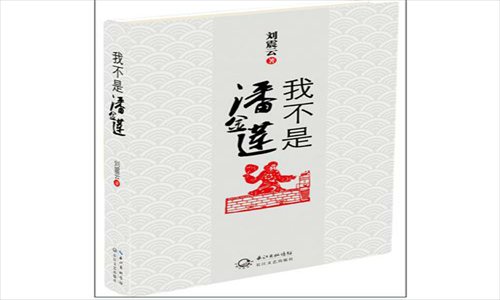
From Cell Phone, Ground Covered with Chicken Feathers, to My Name is Liu Yuejin and Remembering 1942 - the latter expected to premiere late this year - all these screen works have resonated with Chinese moviegoers.While these works enjoyed huge success, they also brought fame to Liu Zhenyun, the Chinese writer of the eponymous novels from which these works are adapted. With the release of his latest book, I'm Not Pan Jinlian, in late July, Liu is again stirring things up.
Liu's One Sentence Worth Thousands was the winner of the 8th Mao Dun Literature Prize in 2011, one of China's most prestigious literature prizes established in 1982 and currently awarded every four years. This solidified him as one of China's most talented and popular writers today.
"I was amazed when Liu give me the script of the novel," said An Boshun, one of the copy editors of the book, from Changjiang Literature and Art Publishing House (CJLAP). "The book touches upon sensitive societal problems, reflecting Liu's courage and sensitivity, rare among other authors today," said An.
Seeking justice
The novel tracks the efforts of Li Xuelian, a woman from a rural area, to petition an unfair ruling that ended her marriage and accused her of cheating on her husband.
To prove her innocence, Li persists for 20 years, taking her case from local courts to city and provincial government, and even to the National People's Congress, China's highest legislative house. She fails in her direct efforts, but as her case proceeds, dramatic things happen to officials involved in her case. Throughout, the book unfolds a larger story of China's various officials at different levels.
Though many government officials are characters in the book, Liu regards the book as non-political.
"It's not just about politics with a family case turned to the State," said Liu. "It's also a societal issue, a logical issue and the characteristic of a nation. We are living in an age of comedy, where it's harder to find where humor ends and where the line for morality is," he said at the press conference held for the book's release on August 7 in Beijing.
Written in a humorous tone, the book ridicules how unexpected fate can be, for some people.
"When facing ridiculous aspects of life, dealing with it seriously often ends in failure," said Liu. "The character Li Xuelian just wants somebody to take her case seriously and give a fair judgment, but because of absurd [circumstances] and logic, she fails."
When a person speaks the truth, results can be negative sometimes.
"Some of the officials are benevolent and duteous in serving the public, but also fall victim, like the character Shi Weimin in the book," said Liu. "It's the (unexpected) logic of life."
Satirical work
"Liu is capable of observing and writing the story from a different perspective than other writers," said Zhang Wei, a copy editor of I'm Not Pan Jinlian. "Anyone can write about issues like corruption, but Liu observes the warmth and the positive energy behind [being] wronged," Zhang told the Global Times.
From early works like Officialdom and Officials 20 years ago, to later ones like Ground Covered with Chicken Feathers and Cell Phone, Liu uses humor to tackle societal problems.
"I'm Not Pan Jinlian delivers the maximum [dose] of comedy and ridicule," said Zhang.
Implementing the same one track-minded personality of characters depicted in his previous works, this book has a wider outreach.
"Unlike his previous novels usually set in certain places and targeting certain groups of people, this book deals with a topic common in China," said Zhang.
"Many say that I'm the best at beating around the bush when telling a story in China," said Liu. "But I think this is necessary in order to tell a clear story, since many things in China are too complicated."
Contemporary concerns
"The story is close to people's life," said Lei Da, a cultural critic. "It's not appealing loudly against corruption, but reflecting on the lives of some government officials through [personal] experience."
For example, the county magistrate in Li's hometown ignores her case when she petitions in the office, and takes part in a cut-ribbon ceremony instead. Likewise, the judge of the local court disregards Li's petition in order to celebrate his mother's birthday.
"He writes about the lives of government officials in China, and this is related to reality," said Lei.
"People will feel a sense of duty and obligation after reading the book," said Zhang Yiwu, a cultural critic and professor in the Chinese department at Peking University.
"It brings out the complexity of China, how it is advancing after a five-thousand-year long history," said Zhang.
Zhang said that this is an optimal way for foreigners to learn about the problems concerning contemporary China today, as well as a way for Chinese people to understand domestic problems.
"Few popular Chinese writers born in the 1950s and 60s, some whom have won the Mao Dun Literature Prize, have the courage and ambition to write stories about contemporary issues," said An.
Many focus on history, the Cultural Revolution (1966-76), or their childhood, and younger writers often focus on love stories or fantasies, An added.
Thus far, the book has released 500,000 copies, higher than the initial release copies of 400,000 of Liu's One Sentence Worth Thousands, which up to now has sold nearly 1 million copies.
"We are confident about this book, it relates to people," said An.
Posted in: Books