Snapshot of a love story
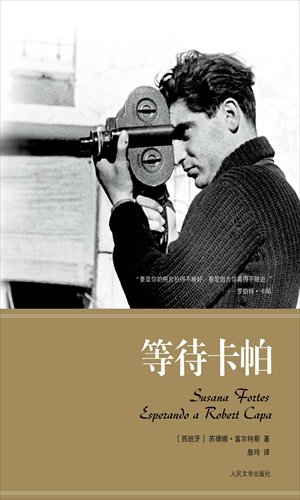
During the War of Resistance against Japanese Aggression (1937-45), the American magazine, Life, sent a photographer to China to record the conflict. But even before he was given this new assignment, Robert Capa was already one of the world's most noted war photographers.
Today, Capa is regarded as one of the greatest combat photographers of the 20th century. Born Endre Friedmann in Hungary, "Robert Capa" was a pseudonym given to him by Gerta Pohorylle, the woman he fell in love with in Paris in 1935.
The newly christened Capa and Pohorylle, who changed her name to Gerda Taro, set themselves up in a photography business - him taking the snaps and Taro selling them. Both, sadly, were to die on the battlefield in the course of their work as photojournalists - Taro during the Spanish Civil War in 1937, and Capa in the Vietnam War in 1954.
Legendary partnership
Their relationship has since become the stuff of legend, but very little is actually known about the short time they spent together between 1935 and 1937.
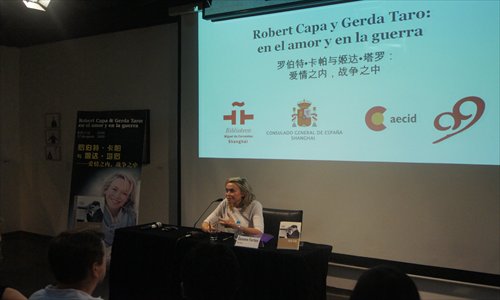
In 2009, Spanish novelist Susana Fortes published Waiting For Capa, a fictionalized account of the love affair between Capa and Taro. And last week, at the invitation of the Miguel de Cervantes Library in the cultural department of the Consulate of Spain in Shanghai and Shanghai 99 Readers' Culture Company, Fortes joined the 2012 Shanghai International Book Fair to promote the newly published Chinese-language version of the book.
"I have collected Capa's photography for many years, but I didn't even know who Gerda Taro was until I saw a photo published in the New York Times in 2008," Fortes told the Global Times.
"It is a picture of a young woman with short hair, sleeping on a small bed in a pair of men's pajamas. Artistically speaking, it isn't a great shot. But it is extremely tender, the kind of photo a man in love might take of his lover while she's sleeping," Fortes recalled.
Fortes said although she didn't know who Taro was, it was obvious that the woman must have had a very close relationship with Capa.
"After I realized who she was, I couldn't help imagining the relationship between them and the idea of creating a novel popped into my mind."
Before starting to write, Fortes read all of the existing books about Capa and Taro, mostly biographies. "These books provided plenty of historical material which meant that I could reasonably recreate their lives in Paris," said Fortes.
According to Fortes' research, their relationship would have been under constant pressure because of the turbulent social times they found themselves living in.
"It was a relationship of great passion, but one that was probably never going to have a happy ending. This is especially true given that Taro herself had a strong desire to pursue a career as a war journalist and photographer," she said.
Untimely death
In 1936, Capa and Taro went to Spain together to report the Spanish Civil War. In July 1937, at the age of 27, Taro was killed when a tank collided into a car she was traveling on the footboard of during the Battle of Brunete, 15 miles west of Madrid. She was the first female journalist fatality of the Spanish Civil War.
Fortes told the Global Times that after finishing the novel, she had a more comprehensive and realistic understanding of Capa's life and his job as a combat photographer.
"Before the novel, Capa was like the perfect legendary hero to me, but somebody who seemed very distant. However, through my research and creating this literary work he has become far more vivid and real," said Fortes.
Fortes said that Capa contemplated suicide after Taro's death and locked himself in a room for two weeks.
"He had prepared himself for the thought of dying in China after he accepted the task of coming here in 1937," she said. "But he recovered his will to live and what's more important, I believe that Capa became a more cautious and mature war photographer from then on. He was no longer the young man who rushed recklessly into the battlefield as he did before Taro's death."
In 1950, when the Korean War broke out, a young photographer from the Magnum Genan Photo Agency (which Capa had founded in 1946 with several other photographer friends) asked to go to the battlefield. Capa denied his request stating: "You are too young, too impulsive and also too fearless, which are not suitable qualities for becoming a war photographer."
The novel, Waiting For Capa has been adapted into a film directed by Michael Mann and will be released later this year.