Once warm Sino-Soviet relationship can be revived
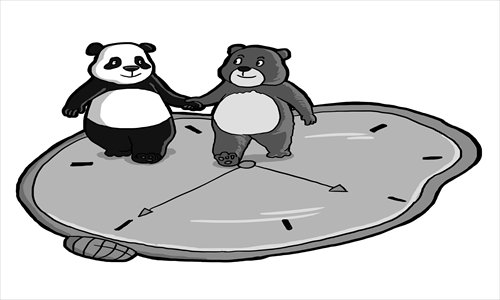
Several decades ago, when I was young, the relationship between China and the Soviet Union was very warm. Although there were few non-governmental contacts in those days, people from China and the Soviet Union forged profound friendships.
I was an English major who graduated from Taiwan Provincial Teachers College, which later became the National Taiwan Normal University. In order to oppose imperialist aggression and solve the national crisis, China chose the socialist road. To have a better understanding of socialism and learn a new development path, some friends and I began to learn Russian.
At that time, the CPC was a branch of the Third International. The Soviet Union was the general party branch of the CPC. This determined the positions of the two countries.
Then because of the deviation of the world revolutionary line, the Third International gradually became a tool of the Soviet Union's foreign policies. After that, problems occurred between China and the Soviet Union.
Later, the Soviet Union embarked on the road of revisionism [the abandonment of Stalinism, and Soviet Premier Nikita Khrushchev's reforms in the late 1950s.] For my part, it was the decisive factor in changing of the relationship between China and the Soviet Union.
Revisionists opposed Marxism under the cover of Marxism, which had a great influence in undermining socialism.
Many Chinese have compared China's reform and opening-up to the revisionism in Soviet time. However, this is far from the truth. China's reform and opening-up represents the views of the majority, while the Soviet path of revisionism didn't reflect public opinion.
I led a group working on the translation of some Soviet short stories written at the time of Khrushchev's rule. From them you can see how the Soviet leaders of that time deviated from socialism and misguided the people.
The Soviet Union sent many experts and advisors to China. Although most of the projects were finished by Chinese people, there is no denying the influence of these experts and advisors.
After embarking on the revisionist path, the Soviet Union recalled all experts since it needed them itself. They believed that China didn't trust these experts.
This action caused the cessation of production in many projects. This incident also taught us that China should rely on itself instead of others.
Although the relationship between China and Russia is not as intimate as before, older generations from the two sides still have warm relations. I have been to Russia three times. The first was before the disintegration of the Soviet Union. The others were after the collapse.
Although these three visits were paid in different time and organized by different departments, we were always received by the Russian people with very warm hearts.
During the last visit, two postgraduate students and I walked past Red Square, where a celebration was taking place.
One of the musicians was delighted to see us and began to play us a song. We were greatly touched by that.
Today young people from the two countries have less mutual understanding. However, in my opinion, with the increase of bilateral interaction and the strengthening of relations, people will become more and more friendly.
We can also dispatch more students to study in the other country. This will give more chances for communication, which can transmit the friendship from the older generations to the younger ones.
In the meantime, we should take a low-profile approach to handling the economic and trade frictions between China and Russia, and prevent them from escalating to the extent of negatively influencing public opinion in both countries.
The article was compiled by Global Times reporter Shu Meng based on an interview with Li Xiyin, former director of the School of China-Russia Studies at Heilongjiang University, and a deputy to the seventh and eighth National People's Congress. shumeng@globaltimes.com.cn