HOME >> CHINA
A legacy, at any cost
By Yuan Ren Source:Global Times Published: 2012-8-27 20:40:04
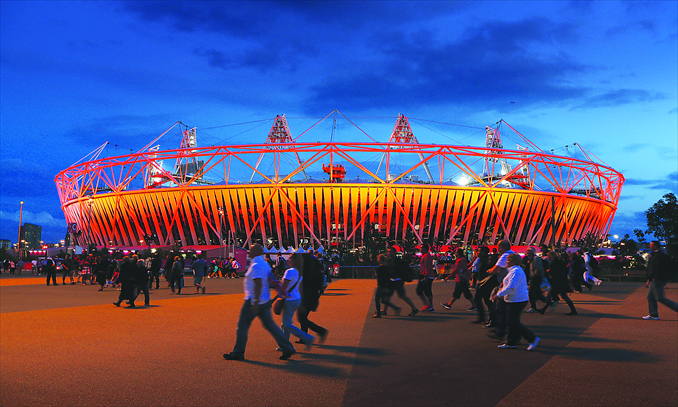
Visitors enjoy a night view of the Olympic Stadium, also known as the London Bowl, on August 2 at the Olympic Park in London. Photo: CFP
As the curtain falls on the triumphs, tears and jubilations of the 2012 Olympic Games, the real test is only just beginning for its host city, London. Success will not just be measured by Team GB's 29 gold medals, but by the legacy the Games leaves behind for the capital. The optimism that surrounds the curtain call of every Olympics still lingers in London. But will it become the long-term model of an Olympic host city it seeks to be?
Four years ago, in Beijing, the Games was in essence about China showcasing itself as a rising player on the world stage. The entire city was revamped in the years leading up to the Olympics, jolting an already in motion progress into a race to unveil its modern face of China. $1.1 billion was ploughed into the transport infrastructure, which alleviated the pressures of an expanding population, and included a new international airport terminal. The Beijing Olympic Park, however, has not outlived the dynamics of the Games and now stands as a costly monument to the glory of 2008.
For London, the stakes have been different. What helped it win its bid in 2005 were the commitments to "a sporting legacy, and to 'transform East London." Unlike any previous host, it began its legacy planning in 2009, three years before the Games. By 2012, plans were so far advanced that President of the International Olympics Committee (IOC) Jacques Rogge heralded it as a "legacy blueprint."
How to build a legacy
Located in Stratford, East London, the Olympic Park has been built on a site that was an industrial wasteland until a few years ago. About £7 billion ($11 billion) of Olympic investment has transformed it into a world-class sporting venue.
For London, legacy was "in the DNA," according to Ricky Burdett, professor of Urban Studies at the London School of Economics and Political Science. "Everything from day one was legacy first ... every single object, the park, a tree, was thought for what happens after 2012." And the London Legacy Delivery Corporation (LLDC), the government body led by London Mayor Boris Johnson, promises there "will be no white elephants."
Seeking to learn from Beijing's example, the future use for six of the eight permanent venues on the Olympic Park has already been secured, including the Aquatic Centre, where "90 percent will be for community use," says LLDC's Executive Director of Regeneration Paul Brickell. Though ongoing concerns about privatization remain, Brickell replies that the venues will be "open to the public" and that there is "no intention to sell it off to developers." However, these plans have been determined by the current administration. In the future, different political landscapes could see the plans for the Olympic Park changed. Former British prime minister Tony Blair's landmark Millennium Dome underwent several overhauls, even lying idle for a time, before finding a new lease of life as the O2 Arena.
The fates of the Beijing's and London's main stadiums remain closer. When the Paralympic Games are done, the future of the London Olympic Stadium remains uncertain, but plans are for it to host sport, cultural and community events once capacity is reduced from 80,000 to 60,000. The National Stadium in Beijing, also known as Bird's Nest, in contrast, does not have such flexibility, and is too big and costly for effective day-to-day use. Yet the original post-Games plans for the Bird's Nest were startlingly similar to those for the London Olympic Stadium.
Housing concerns
While the Olympic Park promises to build over 10,000 homes in the next 20 years, it will do little to ease London's housing shortage. East London is the most overcrowded part of the city, and the host boroughs have 100,000 households on waiting lists for subsidized "social" housing, where the rent is low and paid through state benefits for no or low-income households.
London will have to contend with several factors that all Olympic host cities have dealt with, skyrocketing rents and property values. Surveys have shown that housing prices more than doubled between 1996 and 2003 in Sydney which hosted Games in 2000. The Olympics also contributed to a massive boom in the Beijing property market, fueled by rapacious tactics by property developers. This reached such a height that in recent years, the central authorities in China have had to step in with heavy-handed policies to cool down the market.
East London is building more social housing, but the financial pressures of a double-dip recession and rising property prices means uncertainty remains as to what extent the government will continue to subsidize these. In addition,the amount of benefit households receive is being reduced, further exacerbating the issue of affordability.
This creates a "high risk" that the poorest families will be pushed out, according to a social worker in Tower Hamlets, something that won't help LLDC achieve the blend of residents it envisages for the area. "The fear is that socioeconomic improvement happens simply through altering the social mix of East London," says Professor Iain MacRury of University of East London, who specializes in Olympic legacy and regeneration. Sam Courtney, a graduate student living in East London for three years, thinks this would be detrimental. "Diversity has made the area what it is, its culture. I would absolutely not want to see that change."
This "gentrification" has been a frequent plague upon Olympic cities due to rapid city renewal. In Beijing, it began with housing evictions, and culminated in protests where residents clung to their homes against the noise of raging bulldozers. Villages were razed, and inner city neighborhoods, including historical hutong, were demolished in favor of modern high-rises. The Games was estimated to have displaced 1.5 million residents over the course of seven years, and the soaring property prices, together with lower-than-market-rate compensation, meant many could never return to areas they once called home.
For East London, Brickell says that job creation will define the outcome. "If you're in work, and you do better economically, it helps with the housing, more likely improve health and inspire your children." However, only 25 percent of jobs created went to the local workforce, a figure criticized as being too low.
LLDC says it wants future jobs in the Park for "local people," but numbers are in the region of 8,500 over 20 years, and Newham alone has 16,000 unemployed. The hope is that jobs will be spun out by inward business investments. "The Olympics is bringing in influential business leaders to showcase an area which otherwise would never have been on their list of destinations," says Macrury. "This area was unknown territory, but that's no longer the case."
Rushnara Ali, the political representative for Tower Hamlets, sees local employment initiatives as key. "We have a skilled workforce; we need to get them into jobs out there."
Beijing's workforce, and in a larger way China's, benefited directly from the Olympics. Their preparation generated around 430,000 construction jobs. Although these were temporary, Beijing has also benefited from the arrival of far more multi-national corporations. One concern that mirrors those in London is that given the international exposure Beijing received and the rapidly growing expatriate population, local Beijingers are having to fight harder than ever to find employment in their city.
Facing the future
For those involved in delivering the London legacy, there is realism that the Olympics "is not enough on its own." Ongoing efforts are equally imperative. "The Olympics has given us a physical opportunity, which we are seizing," says Robin Wales, the mayor of Newham. "Newham has set up a successful employment scheme named Work Place, which will get people into jobs created by the Olympics."
For Macrury, who is concerned that the "most ambitious" legacy objectives will not be achieved, what is crucial is "striking the right balance between continued public investment to maximize social returns, and recouping short term costs through commercial gain. The financial pressure not to do the former will be high, a mistake, but the latter is also necessary for job creation and economic redevelopment." In his view, leadership and governance are vital. "If the different levels of governance are able to collaborate, it's more likely to succeed."
When looking at Beijing, it is hard to say whether the legacy has been an unmitigated success. True, the capital's GDP soared by over 105.5 billion yuan between 2004 and 2008, according to the IOC. However, an Olympic legacy is also measured by intangibles. For many people living in Beijing, the arrival on the world stage also meant the end of an era for their city.
Across East London, though, locals are still buzzing from the Games, but there is uncertainty about the legacy.
The Games that promised to "inspire a generation" has at least given young people something to aspire to. Emmanuel Adebowale, 15, from Hackney who trains with a local football club, says "I find it unbelievable it's actually here, in our lifetime, it's inspired me to be more motivated, and reach my goals." The question of a lasting sporting legacy for young people remains to be seen, particularly as recent cuts were made to school sports funding.
For Beijing, the legacy will always be the breathtaking opening ceremony etched into memories of those around the world, but London is embarking on an entirely different journey that will take decades. To what extent the Olympic momentum can drive changes to deep-seated issues that successive governments have tried to tackle before, only time will tell.
Success will require nothing short of an Olympic delivery, but there has never been, and may never again be a more momentous opportunity for East London. "This is hard," Brickell admits to the reporter. "But the Olympics is a statement of confidence, hope and ambition to have wild dreams and set about achieving them. You've got to go for gold."
Posted in: In-Depth