Nationalism has no place in responsible media coverage
Editor's Note:
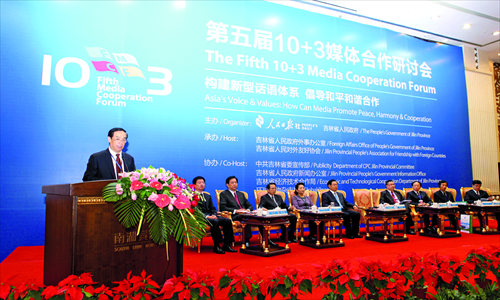
With tensions rising over territorial disputes across East Asia, media representatives from China, Japan, South Korea and 10 ASEAN countries on September 4 gave their thoughts on what kind of role the media should play at the Fifth 10+3 Media Cooperation Forum held in Changchun, Northeast China's Jilin Province.
Wu Hengquan, editor-in-chief of the People's Daily
Media workers record events, but they are by no means bystanders. They could be critics, but they should never be spoilers. The media should be responsible, and they should help stabilize society and forge peace. In order to better tell the stories of China, Japan, South Korea and ASEAN countries, we should recognize that cooperation and seeking mutual benefits are the mainstream in the region.
We don't have to deny the fact that there are territorial disputes in the region. The media should report such disputes and conflicts in a rational and objective manner. The coverage should help reinforce common understanding instead of misleading public opinion and stirring up antagonism.
It is extremely dangerous if a country's diplomatic policy is hijacked by parochial nationalism. Advocating peace, building a harmonious environment and pushing forward friendly cooperation should be the basic tone in Asian media's coverage of the region.
Crisis hits poor hardest
Zou Haoyu, deputy director-general of the Media Resource Center at China Radio International
The financial crisis has affected people in the middle and bottom of the society the most. And from a historical perspective, a financial crisis always triggers extreme nationalism and the rise of right-wing forces.
Meanwhile, new media such as the Internet have seen rapid growth in recent years. This has reinforced the speed, dimension and depth of the information flow, making media coverage of disputes more influential.
It goes without saying that media coverage on sovereignty and territorial integrity should serve national interests. But in the meantime, we should also take the region's common interests, long-term benefits and regional economic cooperation into consideration.
Is the dispute on the Diaoyu Islands the whole of Sino-Japanese relations? Are China's territorial disputes with Vietnam and the Philippines in the South China Sea the whole situation in China's relations with ASEAN? Of course not.
While reporting on issues involving national interests, the media should report with a global vision and the human dimension. We shouldn't let our reports mislead public opinion, which sometimes could even hijack a country's diplomatic policy and eventually damage common interests in the region.
Japan's bitter legacy
Yoshibumi Wakamiya, editor-in-chief of the Tokyo-based Asahi Shimbun
This summer, Japan had some disputes with South Korea and China. And the tensions have been continuing. The territorial disputes are related to wars and Japan's past colonialism, which could easily stir up nationalist emotions. For the media, this is a very good topic. They strongly criticize each other and uphold the stance of their own countries.
If our own countries were not involved in the disputes, I think we could have reported positions from both sides of the disputes fairly. But when one's own country is involved, most of the media would consider their own country's stance as legitimate from the very beginning. In Japan, some reports accuse the government of being soft.
Compared with newspapers, magazines and the Internet contain more extreme content that incites nationalism. Such emotional opinions on the Internet are a common challenge.
The Japanese media has had bitter wartime experiences. When Japan's militarism sought hegemony in Asia, the media should have resisted it. However, they supported colonial rule and invasion to please readers. The media shouldn't give into nationalism, as we have bitterly learnt.
Don't let conservatives seize media
Jung Suk-koo, chief editorial writer of the Seoul-based Hankyoreh Daily
China, Japan and South Korea are all facing leadership transition this year, and have territorial disputes. Meanwhile, the debt crisis in the eurozone has caused economic slowdown in the region. I think the political problems have intensified our economic difficulties. We should help reduce political disputes through media cooperation.
The media has a huge influence over public opinion, which could directly shape policymakers' decisions. Every outlet, despite stressing neutrality, has its own biases. It is particularly difficult to hold an objective and impartial position in the coverage of territorial disputes. I think if not handled properly, such media reports will lead to negative public opinion.
The media shouldn't be used by a small number of conservative groups or some people who are seeking political gains. In Japan and South Korea, we have seen the tendency for some media to be used by political groups. We should reflect on what kind of reports and what attitudes could benefit our countries. As journalists, we should prevent the political groups who take advantage of nationalism for political gains from using our platform.