Odds against lottery addicts
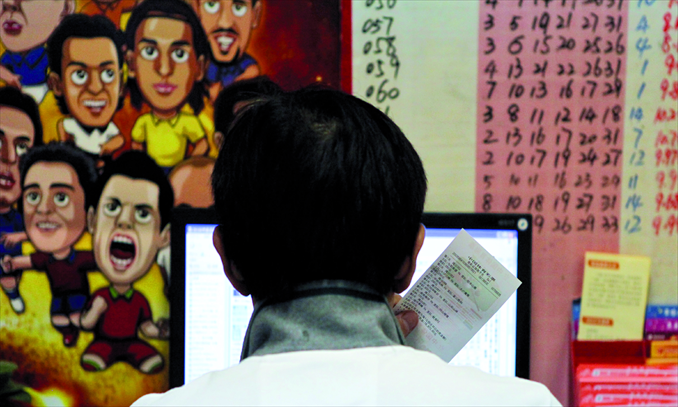
His desire to buy lottery tickets just cannot be brought under control. He can't stroll by a lottery store without going in.
He is Duan Bin, 22, a migrant worker, who quit his job in February and has devoted all his time to winning the lottery since then. Duan dreams that his life will change if he wins the jackpot, although he knows the chances are astronomical and that his hobby is burying him alive, reported the Beijing News in May.
Duan refuses to accept that he is addicted to the lottery, despite being a textbook case.
An online survey on the behavior of lottery players issued in March, which was conducted by the lottery research center under Beijing Normal University, estimates that 7 million lottery players are addicted, among whom about 6 percent suffer from a serious addiction.
Lottery addicts cannot control themselves and feel uncomfortable if they don't buy tickets, so that their business, study and daily life are harmed, Chen Haiping told the Global Times. Chen is a psychology researcher with the lottery research center and a leading architect of the survey.
According to the survey, the typical addicts are aged between 18 and 45, and most have relatively low monthly incomes, between 1,500 and 3,000 yuan ($476). They also usually see themselves as on the lower rungs of the social ladder.
Overnight fortunes
The survey was confirmed by later investigations in Beijing and Shanghai, carried out by the Beijing News and Xinmin Weekly.
Migrant workers have become the main clients of lottery stores and some stores resort to "fascinating" slogans to attract more customers. "Lottery prices won't go up though the prices of other goods are increasing," reads the slogan in one lottery store in Beijing's Dongcheng district.
Shopping malls become popular destinations when they are located in downtown areas, but lottery stores attract the less wealthy in villages and out of the way locations, one store owner in the capital's Fengtai district told the Beijing News.
In Shanghai, the most frequent visitors are also those with lower incomes, and one saying is popular among them, "The poor rely on a big prize to change their fate," reported Xinmin Weekly in July. Some of them even seem to view lottery as an investment.
The lottery is not defined as gambling in China, where gambling is strictly banned. But in reality, lottery addicts do share the mental status of gamblers, experts say.
Chen says they share the same psychological impulse to take risks for a big jackpot, which is naturally part of the business plan of lotteries in the first place.
Chen's opinion is shared by Wang Junbo, a professor with Jiangnan University in Wuxi, Jiangsu Province. Wang has studied lotteries for over 10 years.
"People have the urge to try their luck. If these people didn't buy lottery tickets, they would try their hand at other things with some gambling characteristics," Wang told the Global Times, pointing out the fact that many Chinese still choose to gamble abroad or join in online gambling sites run by foreign companies. He believes the money gambled in this fashion at least equals China's lottery turnover.
If the lottery prize is not big enough, the sensational effect would be reduced and player numbers would drop, said Wang. As it stands, statistics show that there are currently 200 million lottery players in China.
He said lottery addicts should be "cared" for by the country. "In the past, the public didn't understand the concept of lottery addiction, because all they had heard about was sensationalized news about winning big prize," said Wang.
News about lottery jackpots features prominently on newspapers or TV. A jackpot of 570 million yuan was claimed by a winner in a lottery store in June in Beijing's Sanlitun area, the largest prize in China so far. It beat out the previous record of 565 million yuan that was won in Shaoxing, Zhejiang Province.
"China's biggest lottery jackpot was won here," reads the slogan of the Sanlitun lottery store. Several visitors asked by the Global Times claimed they only spent less than a hundred yuan each month, but were unwilling to tell more.
This store sells both welfare lotteries and sports lotteries, the two kinds of lotteries issued in China, both of them being operated by the State.
It is not uncommon for the same store to sell both lotteries, since it is convenient for store owners, whose income is dependent on ticket sales. Besides, an increasing number of lottery stores are popping up, growing the player pool but also deepening addictions.
"There are rules stating the distance that two lottery stores must have between them, but they don't limit the total number of stores in a city, considering that cities are expanding," said Wang.
Five migrant workers from Gansu Province worked as a team for three years to buy lottery tickets until their dreams finally came true in mid-September, winning a 6.45 million yuan prize in Chuzhou, Anhui Province.
They are lucky compared with most others, especially migrant workers or those with lower incomes, who are still spending their money. Some of them have become lottery addicts, though they themselves may not realize the problem.
Lack of assistance
It is not easy to contact lottery addicts, because it is hard to tell them from regular players unless you are among them.
"Lottery addicts dodge the problem, and in general they can only be singled out by old lottery players who share their experience in lottery buying with each other," said Chen, adding that some addicts even sell their house to fuel their needs, while still denying the extent of their problems.
"Even if they realize they need help, they don't know where to go and whom to turn to," said Chen, adding that the current hotline, which is far from enough, is not of much help.
A lottery addiction hotline was set up in 2007 by China Center for Lottery Studies at Peking University. Fu Li, an employee at the center told China News Weekly that most addicts who called the center asked how to win a prize and stop their losing streaks, instead of seeking psychological assistance.
Fu still remembers clearly a call she took two years ago. A young woman begged Fu to tell her the winning numbers because the only thing she could do to change her fate was to buy lottery tickets. "If you don't tell me, I will jump off a building with my baby," said the woman, whose husband had died in a car accident, according to China News Weekly.
Another hotline was set up in Suzhou, Jiangsu Province, in March, but only one lottery addict has turned to it for help, according to an anonymous employee with the Suzhou Lottery Center.
"The lottery player called for help because he was buried under a mountain of debt after buying tickets," she said. Several players called the center, telling they had spent too much and were facing pressure. "I advised them to call the hotline to ask for help from psychiatrists, but they never did," she told the Global Times.
Hard to quit
For Wu Yadan, a lottery player in Yueqing, Zhejiang Province, buying tickets can be controlled.
"Before 2010, I kept spending any prize money I won on buying more tickets again, and ended up in debt again," said Wu to the Global Times, adding that she has broken this streak now, although she is still playing.
"After I win even a small prize, I'll tell myself to take a break for several days. When I feel I cannot help buying tickets, I'll limit myself to buying them only a few at a time," said Wu.
Her family is against this, but they have never known how much Wu has spent, and she simply temporarily complies with them when they tell her to stop.
Wu admits she cannot stop buying lottery tickets, and she is still down 50,000 yuan from when she started playing over 10 years ago.
Even for those who do win the jackpot, their lives can still be ruined by the lottery. Most players will spend their prize money on more tickets, thinking they can win an even bigger jackpot, an experienced lottery player surnamed Yuan told the Beijing News.
Yuan owns a lottery store and once won a big prize of 3 million yuan. Yuan said one of his friends once won 7 million yuan, but he frittered all the money away and plunged back into debt.
Zeng Fanrong, chief editor with zhcw.com, a website issuing news about welfare lotteries, told the Global Times that "lottery addicts are those who don't have the right mentality, but use the lottery as an investment."
For Zeng, it should be thought of as just a game, not necessarily as a means to riches.
Zeng said lottery is just a matter of luck and any rules or strategies are impossible to use. Lottery addicts disagree. They often only consider those who have won jackpots, without even noticing that the vast proportion of others are not that lucky.
"Now some people see it as an investment or gambling, and others think it is cheating," said Zeng, adding that a healthy lottery culture needs to be established in China.
China's lottery sales [welfare lottery and sports lottery] were over 200 billion yuan in 2011, over 30 percent more than the previous year, according to media reports. This came just four years after lottery sales exceeded 100 billion yuan in 2007.
Lotteries are a positive thing, because they are meant to collect money, to be used for charity, and to help the poor or people in real need, according to Chen.
He also emphasizes that the country should take responsibility for continuously increasing the circulation of lottery tickets.
"Lottery addicts are a side effect of the lottery industry, and they should be cared for," said Chen.