Indian subsidy move marks first step in fight against corruption
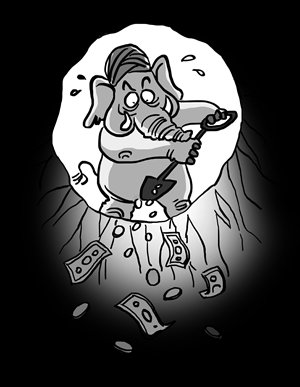
Illustration: Liu Rui
Ask any Indian citizen what the greatest problem facing India is today, and the overwhelming majority will quickly respond in unison: corruption.
But little is getting done about this. Rather, the menace of corruption is getting more and more gargantuan, both in scale and audacity. Millions of dollars is no longer a "respectable" figure for the corrupt leaders and officials as they have become more ambitious, and certainly more audacious, in perpetrating scams worth billions of dollars on the nation.
The United Progressive Alliance government led by Prime Minister Manmohan Singh, which has been accused of involvement in a number of scams totaling scores of billions of dollars, seems to have come up with an effective remedy for dealing with the menace of corruption.
One pilot project in Mysore, Karnataka is aimed at beneficiaries of cooking gas subsidies, while the Rajasthan project in Alwar district is aimed at providing succor to the beneficiaries of kerosene.
Instead of providing the subsidized commodities to the targeted poor population, the government is transferring the subsidy amount directly into the bank accounts of the beneficiaries, thus eliminating the role of the ubiquitous middlemen.
Before we examine the results and impact of the two pilot projects, the question arises: Why was such a simple solution not thought of before? At the same time, it would be unjust to dismiss the Indian government's latest anti-corruption measures as too little too late, simply because a beginning had to be made some day. It is better late than never.
The initial results thrown up by the two pilot projects give a picture of the gargantuan scam being perpetrated on taxpayers year after year for decades. They also provide a beacon of hope that the Indian economy, which has been leaking from thousands of spots, can be repaired.
When the state-run oil companies started the pilot project in Mysore for cooking gas subsidies, beneficiaries saw the number of gas connections suddenly drop by 40 percent from 35,000 cylinders to around 20,000 cylinders per month. Another similar pilot project for kerosene in Alwar saw consumption of the commodity plummet by as much as 80 percent from 80 kiloliters a month to around 14 kiloliters. The government idea of replacing subsidies with cash transfers seems to be the magic wand for checking corruption.
This clearly shows that the corrupt nexus had created thousands of ghost subsidy beneficiaries. Yet these are just two districts out of 612 nationwide. And there are many other subsidies, like food subsidy, and scores of other public dealing departments under the jurisdiction of the central government and the governments of 28 states and seven union territories.
Enthused by the grand success of the two pilot projects, the government has two immediate goals in the near future: to adopt a national policy on doing away with the current model of providing subsidies through physical transfers and replacing it with cash transfers that ensure subsidy amounts are deposited in the beneficiaries' bank accounts directly.
The government is all set to launch a similar reform for food subsidies. One major hallmark of this is digitization of the Public Distribution System, under which subsidized grains are provided to the people. The Manmohan Singh government has already initiated talks with 11 states to launch pilot projects covering 50 districts in this context.
Digitization of records is already a work in progress in the Congress-ruled southern state of Andhra Pradesh, where the campaign in Ranga Reddy and East Godavari districts has already shown 15 percent savings.
The baby steps being taken by the Indian government look very promising. But they depend on political will to be carried out. If they work, India's South Asian neighbors and even China can emulate the results.
The author is a New Delhi-based strategic analyst and a political commentator. bhootnath004@yahoo.com.