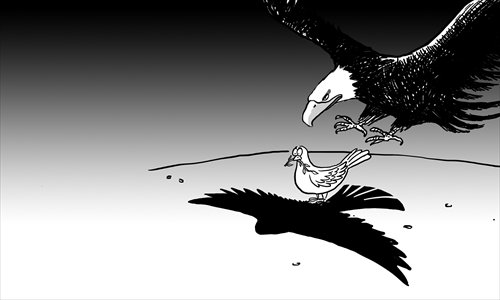
Dove of trade may be just another hopeful illusion
Editor's Note:
As tensions in East Asia grow, driven by conflicts over islands, China's rising power, and the renewed US role in the region, some find the situation disturbingly reminiscent of Europe in the 1910s. Could the region be drawn into a wider war? Or will trade and economic interdependence keep peace in place? The Global Times invited two writers to comment.
The recent squabbling between China and Japan over the Diaoyu Islands constitutes a serious threat to the region's peaceful development. It raises once more the question whether Asia's evolution toward a distinct regional state system will follow the path of peaceful intercourse or slide into interstate rivalry, and possibly, violent conflict.
Optimists argue that China and Japan are economically too interdependent to slip into war. While China is Japan's biggest trading partner, Japan is China's third-largest trading partner after the EU and the US.
Two way-trade between the two economies rose 11.7 percent in 2011 to a record $345 billion. Japan's outbound direct investment in China reached 1 trillion yen ($12.5 million) in 2011, up 60 percent from 2010. Although China's direct investment in Japan fell sharply to 8.9 billion yen in 2011 from 27.6 billion yen the year before, it remained well above the 2005 level of 1.3 billion yen.
Beijing and Tokyo certainly have good reasons to keep their win-win relationship afloat, and the latest squabble about a few clumps of rock will probably die down, just as others have in the past.
All this sounds reasonable, just like it did in Europe in the period before World War I.
Back then nobody in Europe had an economic interest in conflict. In 1909 the utopian liberal Norman Angell argued in his book The Great Illusion that it is a fantasy for statesman to believe that war can serve beneficial purposes, and that success in war benefits the winner.
His major argument was that exactly the opposite is the case. In modern times characterized by high interdependence, territorial conquest is extremely expensive and politically divisive, as it severely disrupts international commerce.
History decided otherwise, as Germany grew ever more frustrated over the lack of recognition of its status by the other great powers, and negative nationalism spread all around Europe.
With China's formidable reemergence, a major power transition is now also happening in Asia, while at the same time a wave of growing nationalism is making its way.
With each new squabble between China and Japan, attitudes on both sides appear to harden and trust tends to wear down.
Japan is afraid that if it does not stand firm now, China will interpret this as a sign of weakness and go for more and more demands, as it grows stronger. China fears that if it stands idle on this issue, the US and others in the region will feel free to team up against China's interests. Both sides run the danger of being taken hostage by their increasingly nationalistic constituents.
This is a dangerous equation. Beijing and Tokyo need to grasp how much damage their bickering over a few tiny islands is causing and how much more harm will result if they fail to find a reasonable way out of the crisis.
For the sake of the prosperity of both Asia and the world, they need to find constructive ways out of the present dilemma they have locked themselves into.
The author is director of the Brussels Institute of Contemporary China Studies. opinion@globaltimes.com.cn