HOME >> BUSINESS
Garbage into gold
By Ji Beibei Source:Global Times Published: 2012-12-10 12:45:00
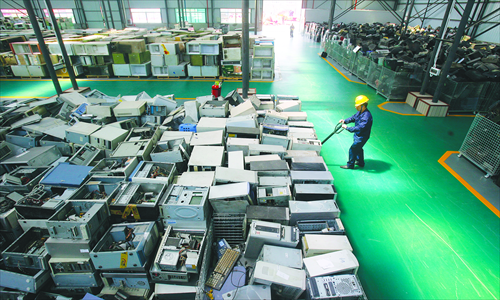
A man working at an e-waste recycling plant in Wuhan, Hubei Province in March 2011.Photo: CFP
The business of recycling electronics and home appliances is expected to grow quickly in China, with the quantity of discarded e-products mounting every year.
At least 15 million units of home appliances and tens of millions of mobile phones will be discarded annually in the coming years, the People's Daily quoted unnamed sources with the China Resource Recycling Association (CRRA) as saying on December 3.
Continuous technological upgrades and the convenience of buying online have resulted in a shortened life cycle for electronic products. This has also boosted the market for second-hand e-products.
"Our second-hand trade has doubled every year in terms of volume for the past three years," Yao Jinbo, CEO of Chinese classified website 58.com, told the Global Times on December 3.
Business benefits
Aihuishou.com, another company that sells second-hand e-products, said its business has grown by over 50 percent over the past year.
"Every time when Samsung or Apple releases new products, our second-hand mobile phone transactions surge," Yuan Guoquan, a spokesman for the Shanghai-based platform, told the Global Times on December 3.
After collecting second-hand gadgets from consumers at reasonable prices, the company sells them to firms whose business is selling second-hand gadgets or e-waste to treatment companies.
Residents in second- and third-tier cities like to buy these second-hand gadgets. Most of them in fact are quite new, Yuan said.
E-waste may be seen as useless to ordinary consumers but it is valuable to the recycling sector. Many valuable metals and materials can be obtained from these discarded products.
Lithium can be retrieved from batteries, for instance. Metals like copper, silver and aluminum can be retrieved from a computer's CPU, fan and hard disk while the shell contains copper and PVC, Wang Haijun, a staff member with Ningbo Minghui Recycling Resources Co, told the Global Times on December 4.
Even electric wires can be used for making furniture or pans, he noted.
In 2011, some 162 million tons of e-waste, including nonferrous metals and electronics, was recycled in China, double the amount in 2005, according to Gao Yanli, secretary-general of the CRRA, the People's Daily reported.
The total value of these recycled products was 571.5 billion yuan ($91.8 billion), up by 12.7 percent compared with 2010, Gao said.
The business of recycling electronics and home appliances is expected to grow quickly in China, with the quantity of discarded e-products mounting every year.
At least 15 million units of home appliances and tens of millions of mobile phones will be discarded annually in the coming years, the People's Daily quoted unnamed sources with the China Resource Recycling Association (CRRA) as saying on December 3.
Continuous technological upgrades and the convenience of buying online have resulted in a shortened life cycle for electronic products. This has also boosted the market for second-hand e-products.
"Our second-hand trade has doubled every year in terms of volume for the past three years," Yao Jinbo, CEO of Chinese classified website 58.com, told the Global Times on December 3.
Business benefits
Aihuishou.com, another company that sells second-hand e-products, said its business has grown by over 50 percent over the past year.
"Every time when Samsung or Apple releases new products, our second-hand mobile phone transactions surge," Yuan Guoquan, a spokesman for the Shanghai-based platform, told the Global Times on December 3.
After collecting second-hand gadgets from consumers at reasonable prices, the company sells them to firms whose business is selling second-hand gadgets or e-waste to treatment companies.
Residents in second- and third-tier cities like to buy these second-hand gadgets. Most of them in fact are quite new, Yuan said.
E-waste may be seen as useless to ordinary consumers but it is valuable to the recycling sector. Many valuable metals and materials can be obtained from these discarded products.
Lithium can be retrieved from batteries, for instance. Metals like copper, silver and aluminum can be retrieved from a computer's CPU, fan and hard disk while the shell contains copper and PVC, Wang Haijun, a staff member with Ningbo Minghui Recycling Resources Co, told the Global Times on December 4.
Even electric wires can be used for making furniture or pans, he noted.
In 2011, some 162 million tons of e-waste, including nonferrous metals and electronics, was recycled in China, double the amount in 2005, according to Gao Yanli, secretary-general of the CRRA, the People's Daily reported.
The total value of these recycled products was 571.5 billion yuan ($91.8 billion), up by 12.7 percent compared with 2010, Gao said.
Problems in the sector
China is the second largest e-waste producer worldwide, with an annual output exceeding 2.3 million tons, while the US produces 3 million tons a year, according to the 2010 report by the United Nations Environment Program.
Despite the huge demand for recycling e-products, a standard recycling chain has not yet been formed, industrial experts said.
Street-level garbage recyclers are the main force in collecting second-hand e-products. Individuals tend to sell their second-hand gadgets to these people as they usually offer higher prices than licensed e-waste treatment companies, Luo Qingqi, an electronic appliance expert and director of Pa Le Consulting Corporation, told the Global Times on December 3.
"Licensed e-waste treatment companies have to invest heavily in facilities including production lines and environmental protection, so the amount of money they offer is not very high," Luo said. As a result, some of the garbage recyclers choose to sell the second-hand gadgets to unlicensed treatment companies instead, Luo noted.
China began stimulus policies to encourage people to buy home appliances from 2009, but the policies have gradually been phased out since the end of 2011.
When the policies were in force, there were over 100 licensed enterprises engaged in e-waste treatment in China. But as the policies started to expire, purchases of home appliances fell and some e-waste treatment firms are facing a lack of supplies, China Economic Times reported in June.
Huaxin Green Spring Environmental Protection Development Co in Beijing, for instance, doubled its treatment ability over the past three years, but now it faces limited or even suspended operation, the report said.
The firm declined to comment when contacted by the Global Times.
China carried out a new regulation on July 1, offering subsidies to licensed e-waste treatment companies.
The subsidies may help some recycling firms to stay afloat, but they cannot address problems in the collecting and recycling of e-waste, analysts said.
"A processing bottleneck is still a core problem, as it is hard to extract and re-use many materials from e-waste," Luo said. "If these recovered materials are not useable, it is hard for recycling firms to make a profit."
Pollution concern
Coastal areas in East China have become the world's main center for treatment of e-waste. By 2020, 70 percent of the 500 million tons of e-waste produced globally every year will be processed in China, Communications Information News reported in June.
There are many disassembling and distribution centers, but many of them are still using old techniques, according to a report by China Circular Economy magazine in June.
Many of the techniques, like incineration or use of concentrated acid, are also seriously harmful to the environment, said Wang from Ningbo Minghui Recycling Resources Co.
One of the most sought-after materials in the shells of home appliances is PVC, but it's hard to extract and the process can involve emission of poisonous and carcinogenic fumes.
As the e-waste treatment industry is in its initial stages in China, many regulations are still in draft form only and have not yet been properly implemented.
For instance, a standard for preventing e-waste pollution is still being written, according to the China Circular Economy report.
In some advanced countries, consumers are willing to pay for the recycling of their discarded e-products. But in China, a similar approach is not feasible, the magazine quoted unnamed officials with Beijing Municipal Environmental Protection Bureau as saying.
But Wang said that some progress is still being made. "For instance, more details and information about imported e-waste is required by the customs authorities now," he said.
Posted in: Insight