Chinese media digest - Tuesday, December 11
Key words: Ex-official blasted for foreign-run charity remark, Mo belongs to literature, not politics , New holiday schedule offers little rest, says media
Ex-official blasted for foreign-run charity remark
A former high-level official accused a foreign-run charity sale in Guangzhou, Guangdong Province of shaming the Chinese people,sparking debate on the Internet.
About 30 consulate generals in Guangzhou took part in the sale, collecting about 330,000 yuan($52,833) for children with disability, among which 4,900 yuan($785) was found to be counterfeit, according to a report by the Yangcheng Evening News.
He Keng, former deputy director of the State Statistics Bureau of China, posted on his Weibo account that while he doubted the consulate generals donated fake money on purpose, "they collected money from Chinese people to help other Chinese, which is shameless."
Chinese media outlets expressed outrage toward He, urging society to respect charities regardless of their nation of origin.
Media personality Sheng Xiang expressed shock toward the former official's post on the Beijing News, saying that Chinese still lack self-confidence.
"We should realize that fake money in a charitable donation is just accidental. It is He's ridiculous words that make it become a public topic. In fact, we should pay more attention to the donation itself rather than the amount or the organizers," said Sheng.
"A nation with real self-confidence wouldn't be so easily ashamed when foreigners have a bad experience in their country or think that foreign-run charities are some kind of humiliation," Sheng added.
Hunan-based news website Rednet.cn criticized He for his narrow-minded patriotism in an opinion piece.
"Narrow-minded patriotism is not rare among Chinese today. We should rid ourselves of it, comment on such events objectively and show the true bearing of China and Chinese people," said the article.
Wu Yinghai, a contributor to Chengdu Business Daily, urged society to show respect for charities instead of abusing organizers for ridiculous reasons.
"I find it unimaginable that He was a high-level official in the past. In charity, we should not discriminate against foreigners but respect and love everyone. It is the person who donated counterfeit money that we should be blaming," said Wu.
Mo belongs to literature, not politics
Chinese media called for less focus on politics and more on writing after Chinese author Mo Yan accepted the 2012 Nobel Prize for Literature in Sweden on December 10.
The political leanings of Mo have dominated discussions online ever since he was announced the winner on October 11.
During his acceptance speech at the Stockholm Concert Hall, Mo described himself as "just a storyteller", avoiding any mention of politics. Commentator Hong Xinliang said that literature should not be measured by the political leanings of the author.
"Mo is a talented writer, and he insists on his literary individuality in his work, which shows more humanity and less politics. We should tolerate the literary individuality of Mo," wrote Hong in a Qianjiang Evening News editorial.
Qilu Evening News columnist Liao Baoping echoed this view, urging society to respect Mo without taking his politics into consideration.
"We should be looking at what he writes, not what he does," said Liao. "As an influential writer, he could criticize social injustice through his work. However, it is not his duty," said Liao.
A Global Times editorial praised Mo Yan for avoiding politics during his speech.
"Mo's behavior shows that he would like to minimize the political influence of his prize, which is a way of safeguarding and treasuring literature."
"It is not that Mo's victory has nothing to do with politics. However, it is unfair to force a literary idealist to comment on China's freedom of speech or human rights," added the paper.
Another Global Times editorial criticized Western media for expecting Mo to vent his opinions on freedom of speech and embarrass both himself and the Chinese government.
"Freedom of speech in China has been making progress in recent years, but without any revolutionary breakthroughs. However, asking a Chinese Nobel Prize winner, the focus of attention for millions of his compatriots, if his country has freedom of expression does nothing but seek to irritate," read the article.
New holiday schedule offers little rest, says media
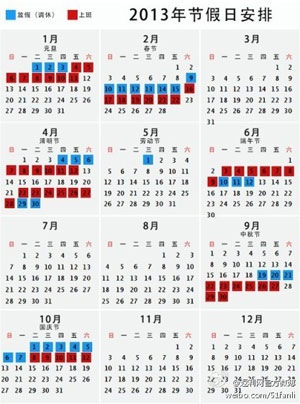
The newly released schedule for public holidays for 2013 already has people griping about having to change their New Year's Day plans.
The long-awaited schedule released by the State Council on December 10 failed to please workers everywhere not only because of its delayed announcement, but also because of the mandatory eight-day work week beginning January 4.
According to the State Council's 2013 holiday schedule, employees will have to work for eight consecutive days after a three day holiday from January 1 to 3. Similarly, workers will also return from their Spring Festival holiday in February to a seven day work week.
Although the council counts a total 29 days off over seven holidays, the rescheduling only translates to 11 days when weekends worked are taken into account.
Netizens criticized that the State Council was merely "moving holidays", while Chinese media voiced their dissatisfaction, particularly because outlets have to rearrange their programming and publication schedules.
Li Wei, a commentator of Phoenix TV, criticized that using weekends to replace holidays goes against the purpose of the system, because people lose motivation after working weekends without a rest.
News portal Qianlong.com echoed that the current holiday system "lacks rhythm."
"Moving holidays will likely result in a super-long work week, which doesn't help productivity," according to Qianlong.com.
"When people have to work two or three more days after a full work week, they'll only be in a bad mood and less motivated," said the site, adding that work weeks should be limited to five days.
The Legal Daily offered its criticisms in an opinion piece, saying that the current "Chinese-style" vacations are not only low in quantity but also in quality, taking into account how so many people have their holidays at the same time. The article also warned that such vacations will soon be followed by "Chinese-style" suffering.
The Youth Times acknowledged in an editorial that while "moving holidays" comes with some side effects, scrapping the system altogether is not practical.
The article suggests instating a flexible paid vacation system to solve the problem. "People's right to have holidays should also come with the freedom to choose when they rest," read the article.