Catching gene thieves
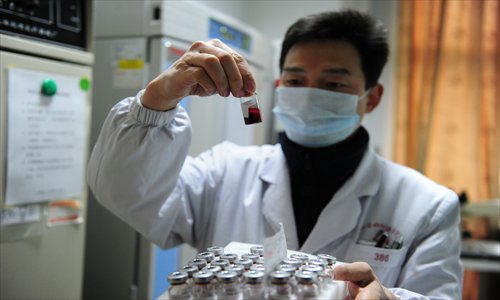
She Jinxiong, the dean of the School of Pharmaceutical Sciences at Nanjing University, has been accused online of going from hospital to hospital illegally collecting human blood and tissue samples to construct his own private database.
His accuser, Liu An, who claimed on his Sina Blog to be a doctor with the oncology department of a hospital in Nanjing, Jiangsu Province, said that since 2010 She had visited many hospitals throughout Nanjing asking doctors to provide samples from patients.
Whilst the ethics of the case are being debated online, it has highlighted a gray area in China's laws. The government is moving to address the problem in a draft regulation on the management of human genetic resources, which finished collecting public opinions in November.
According to the State Council's website, the draft aims to "regulate and promote protection and utilization of China's human genetic resources, push research and development of the country's biological and pharmaceutical sciences and technology, and ensure the people's health."
More ominously, the website points out that companies and overseas institutions have been collecting and smuggling genetic resources illegally, in an effort to get an edge in the fiercely competitive biotechnology industry. In some cases, related information has been transmitted over the Internet, posing further challenges for authorities.
The fine print
The draft defines human genetic resources as including human genomes, genes and organs, cells and nucleic acid, as well as some kinds of related information.
These resources are essential to genetic research. China's resources are based on a population of over 1.3 billion including 56 ethnic minority groups, Xie Huiding, a former director with the Legislative Affairs Office of the State Council and a current partner with the Beijing Jurisino Law Group, told the Global Times.
The website also said some overseas institutions and companies have illegally collected such resources from the country in recent years, adding that the means by which they get the resources from individuals has transformed into cooperation with domestic scientific institutions and experts who smuggle them.
China began protecting these resources later than other countries, partly due to a lack of awareness and partly due to the fact that the country's biological sciences industries and organizations are less developed than their international counterparts, Xie said.
In June 1998, the State Council published Interim Measures for the Administration of Human Genetic Resources, the country's first paper on the management of human genetic resources, which was formulated by the ministries of science and technology, and health.
It outlines the human genetic resources management system, international cooperation on the country's human genetic resources and approval procedures on exporting them.
These measures came out not long after a Harvard University project sponsored by the US National Institute of Health and the US-based Millennium Pharmaceuticals, in which researchers were alleged to be involved in the collection of genes from asthma patients in Anhui Province.
More than $100 million was invested and some 6 million people in Anhui were covered by the project, a Southern Weekly revealed. Project participants in the province's rural areas were only told that they would have a free check-up in which their blood samples would be taken away.
Xu Xiping, an associate professor with Harvard University who chaired the project, admitted that he received 16,400 blood samples from asthma patients, but said it was with their assent, the newspaper reported.
In March 2002, an office under the US Department of Health and Human Services, said in a report that 12 projects that had been chaired by Xu in China were allegedly illegal, citing ethical concerns, supervision management and the security of participants, the Xinhua News Agency reported.
Experts say that the loss of human genetic resources is a severe problem in China. This is a pressing issue, given the fact that intellectual property rights go to those who unravel genetic codes first, Wang Zhenyu, a law researcher with China University of Political Science and Law, told the Global Times.
Chinese authorities have gradually stepped up laws on the protection of genetic samples. During the SARS outburst in 2003, the Ministry of Health issued a circular to manage the collection, preservation, transportation and application of SARS samples.
But instances of whistle-blowing over theft and the improper use of genetic resources are often found online.
Following the money
The potential for high profit has lured many institutions and individuals toward genetic resources, Xie said.
"Many medical and biological research projects are based on these resources. Patents and products follow once trials are successful," Xie said, adding that some results are even used in military applications or medical experiments, involving the security of a nation and its health.
The illegal collection or use of human genetic resources don't involve heavy punishments, according to the former measures published by the State Council in 1998, which also lack specific terms relating to legal responsibilities.
The State Council's website said the draft regulation was written after referring to international standards, with clauses on getting the approval of participants providing human genetic donations, as well as clauses relating to privacy protection, international cooperation, the sharing of mutual benefits and limiting the flows of human genetic resources between countries.
According to the draft, any organization or individual is not allowed to collect and save materials on the country's human genetic resources without approval. Overseas institutions and their branches in China should cooperate with the local organizations in the research of such resources.
However, Fang Zhouzi, an expert who has been studying human molecular genetics, believes the limits in the new draft are too harsh for overseas institutions who want to do research in China's human genetic resources field.
"China has lagged behind in research on human genetic resources compared to some developed countries. The country is now incapable of doing certain research projects," Fang told the Global Times, adding that with some invaluable resources fading and disappearing as time goes by, it would be a loss to humankind if China set too high a threshold for institutions from other countries.
As long as the overseas parties inform all the participants of the project of its details, get patents through legal means and share the benefits mutually, there is no big risk that China will lose these resources, said Fang.