North to south at 300km/h
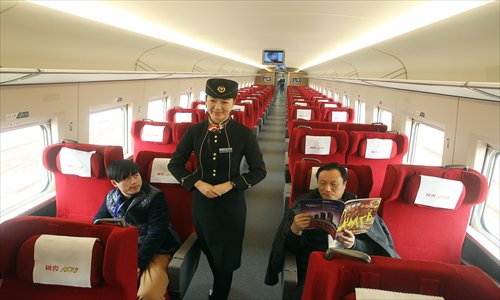
The high speed railway linking Beijing to Zhengzhou, Henan Province, officially commences operations on Wednesday, marking the full completion of the 2,298-kilometer-long high speed service from Beijing to Guangzhou, Guangdong Province.
The completion of the north-south section is very significant to the country's continually expanding high speed railway network because it links all the eastward and westward lines.
But what is it really like to travel on high speed trains and will it become a popular transport choice?
A Global Times reporter joined the trial run Saturday from Beijing to Zhengzhou with 259 other reporters from both domestic and overseas news outlets to report on the line. With the addition of this section, the entire network is now the world's longest high speed railway.
All aboard
The one-way trial run, which took two and half hours, ended at Zhengzhou East station, a newly built hub that was opened to the public in September 2012. The train ride saves passengers at least three hours in transit, sometimes much more as the slowest train connecting Beijing and Zhengzhou can take up to 10 hours.
The fastest train from Beijing to Guangzhou now takes eight hours.
There are 35 stops along the full line, including Shijiazhuang, Hebei Province; Wuhan, Hubei Province and Changsha, Hunan Province. The sections linking Zhengzhou to Wuhan and Wuhan to Guangzhou were put into service in September 2012 and December 2009, respectively.
Via Guangzhou, passengers can then get to Shenzhen by taking the high speed train, and in the future they will be able to continue to Hong Kong, after the Guangzhou-Shenzhen-Hong Kong Express Rail Link is completed in 2015.
The country's high speed railway project started in 2008, when the State Council approved the long-term railway transportation plan, aiming to construct 16,000 kilometers of high speed lines by 2020.
The interior design of this train is no different to the other common trains in terms of color and layout. The Ministry of Railways said the line from Beijing to Guangzhou has adopted the highest design standard, which enables the running train to reach a maximum speed of 350 kilometers per hour.
However, the speed will be kept at 300 kilometers per hour during its preliminary phase of operation.
Other than the camera flashes from reporters and photographers when a train attendant served passengers, those on board during the trial run did not feel any sense of dislocation and the noise from the new train was quieter than other high speed trains when it quickly accelerated to a speed of 300 kilometers per hour within 15 minutes.
Wifi service is also provided in train carriages but Web pages could not be opened despite the fact that electronic devices showed it as being connected. Signals from 2G or 3G networks on cellphones were shaky especially when the train passed through tunnels.
Only first and second classes are available on the train. Unlike previous train carriage models that have little by way of leg room, seats in these new trains are spacious enough. Six-seat deluxe rooms can offer passengers privacy and separate spaces are also available in first class.
Snacks and drinks are free for first class passengers. The expiration date for hot meals is between 24 hours to 72 hours, Li Lihua, the head of the train's restaurant carriage, told the Global Times.
"We offer grinded coffee on the train and our hot dishes include famous cuisines from cities along the line. We also provide chicken wings and bread to serve the preferences of foreign passengers," Li said, adding that the menu is in both English and Chinese.
Safety concerns
After a 30-minute ride, the train stopped for 24 minutes at Gaobeidian station. When asked about the delay, the crew gave an uncertain explanation saying that the signal system was having problems.
Later this explanation was changed, with problems caused by track adjustments being cited.
Problems with signals were also blamed for the tragedy that killed 40 passengers in a train crash in July 2011 in Wenzhou, Zhejiang Province.
"The ministry is trying to find out all potential problems during the trial runs to prevent malfunctions from occurring. We can't make sure it's error-proof in the future, and we have been subject to a lot of pressure from the public," Zhao Chunlei, deputy chief of the ministry's transportation department, told the Global Times.
"We'll report malfunctions as soon as possible to passengers as part of our efforts to improve services," Zhao said, adding that backup plans are being prepared to cope with emergencies, but he didn't reveal details.
Tang Liping, deputy head of the train crew, told the Global Times that the train is equipped with a safety net and emergency stairs in carriage number four, to assist in evacuations in the event of an electricity malfunction or air conditioning failure.
A quality control system has also been established to enhance the maintenance and inspection of the equipment.
Also, disaster prevention and safety monitoring systems are also being applied during daily operation to ensure the safety of trains running at 300 kilometers per hour.
Despite controversy over the safety of high speed rail and the exorbitant ticket prices for the new line, over 30,000 tickets were sold in three days after sales of the tickets from Beijing to destinations including Guangzhou, Shenzhen, Wuhan, Changsha, Zhengzhou and Shijiazhuang were made available on December 20.
The train will be in service for China's Lunar New Year holiday period, which falls in mid-February, when hundreds of millions of people will travel across the country in the world's largest annual migration.