Eyeing equal opportunity
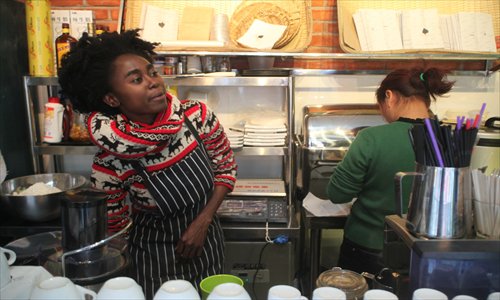
In bustling Che'niandian Hutong close to the well-known tourist street of Nanluoguxiang, a restaurant with the Jamaican national flag hanging from its door stands out among neighboring stores that sell duck necks and fruits. Loud reggae music blares from inside the 14-square-meter Afro-Caribbean restaurant, appropriately named Jamaica Me Crazy.
"I play music loudly everyday, but none of my neighbors complain. They are actually very friendly," said Rose Lin Zamoa, the restaurant's Ghana-born owner. Business has been steady for the only Jamaican restaurant in town since it opened last September.
"Jamaican food is quite similar to Ghanaian food, which is why I'm offering it. I've adjusted it to cater for locals' taste," said Zamoa, 33, who came to China in 2009 to study Chinese at Beijing International Studies University.
Over the past decade, China's investment in Africa has led to around 1 million Chinese moving to the continent for work. However, growing economic and cultural exchanges between China and Africa have also paved the way for scores of African entrepreneurs to chase their business dreams in the Middle Kingdom.
Common hurdles in business
Zamoa moved to the UK with her family when she was 14 and trained as a chef after finishing high school. Cooking remained a passion of hers when she first came to Beijing, often treating her classmates to home style fare such as jerk chicken.
She opened her catering business Private Kitchen in 2009 near Chaoyang Park, juggling her studies with cooking lessons and catering services she provided from her apartment.
It didn't take long for Zamoa to settle on the location of hutong hipster neighborhood Gulou for her restaurant, but there were many headaches in registering her business and acquiring a work visa through an agent. One of the biggest problems, she found, was her African identity.
"I was talking to an agent about registering my business. The man looked at me and simply told me it was impossible [because of my race]," she recalled.
"I told him I wouldn't use my Ghanaian passport, but my British one. The man then said it would not be a big problem and asked why I hadn't told him earlier," said Zamoa, noting she paid the agent 30,000 yuan ($4,823) for his services - almost 10 times the price she heard it cost Chinese.
More hassles lay ahead for the ambitious restaurateur. Local administrative departments presented countless hurdles, making Zamoa apprehensive about ever opening another business in China.
"The real hassles are from the local bureaus, such as the gongshang (Industry and Commerce Bureau) and chengguan (urban management officers) of Dongcheng district," noted Zamoa.
Not long after the business opened, a representative from the Industry and Commerce Bureau came to inspect her restaurant. He told Zamoa an oven near the door should be moved, but didn't explain why.
"I was told by my landlord to avoid any confrontation because that would only make things worse, but that is not how we do things in the UK or even Ghana," she said. Last week, another representative from the bureau paid an unexpected visit to her restaurant. He looked around and left without saying a word, Zamoa recalled.
"Chinese and foreigners should be given equal opportunities. I don't see my neighbors having the same hassles. I wish I had a Chinese partner to deal with the local bureaus," she said.
Dealing with prejudice
Although there are no concrete statistics on China's African population, the majority lives in South China's manufacturing hub Guangdong Province, where most are engaged in private business or international trade. The Guangzhou Academy of Social Sciences estimated there were around 30,000 legal African migrants in the city in 2010. In Beijing, the African community comprises mostly of diplomats and students.
Chinese investment in Africa has fueled reverse migration, leading an increasing number of Africans to Beijing to study or work over the past decade. However, arrests of Africans who stay in China illegally or work as drug mules has fueled suspicion among some locals.
China is still quite closed to Africans and trust must be built to facilitate future exchanges and encourage entrepreneurs to pursue their business dreams, Zamoa said.
"Almost every African I know has problems with their visa in China," said Zamoa, noting she still must endure Chinese commenting on her being "so black" and children calling her hei ayi ("black aunt"). "I don't mind children calling me that, but for adults I don't like it."
Discrimination toward Africans in China is more from ignorance than malice, Zamoa noted. "Sometimes people peep in through the glass of the [restaurant] door because they are curious about my appearance, and some just walk in and want to talk to me," she said.
"Some customers ask really funny questions, like if my skin color will lighten if I stay in China longer."
At first Zamoa would entertain such questions with lighthearted answers, but later she found it an annoyance. "Now, I've pasted wallpaper over the glass on the door to keep people from peeping in," she said.
Gradually building trust
Opting to run a wholly foreign-owned enterprise is not the only pathway for African entrepreneurs in China. Mohamed Abdelrahim opened his trading company Hadalia For Projects Promotion in his native Sudan in 2004.
Abdelrahim, who previously worked for a decade at the Sudanese embassy in Beijing, was always intent on running his business in Beijing rather than other cities favored by African entrepreneurs, such as Guangzhou and Yiwu, Zhejiang Province.
"As a trading company, what we do mostly is liaise - helping Sudanese companies find Chinese manufacturers. As we have our company [headquartered] in Khartoum, it was easier to set up an office in Beijing," said Abdelrahim, 45, who speaks fluent Chinese.
"The major problems for me are communicating with [Chinese] from different regions, speaking with different dialects. Meanwhile, some companies seem large and reputable when you view them online, but it is not the same when you visit them," he noted.
Abdelrahim's company has three offices in China, and has helped Chinese enterprises export everything from heavy asphalt to clothing. Nevertheless, many Chinese companies tend to purchase African products from other countries or regions even though prices are higher.
For example, one of Sudan's major agricultural exports is sesame. Most Chinese companies purchase this product after it has been exported to Hong Kong or India, said Abdelrahim.
"Sometimes we quote prices from Sudanese companies to Chinese counterparts, but they often hesitate and take one or two weeks to decide. After such time, prices usually go up," he noted. The major reason for not buying directly from Sudanese companies is the lack of trust, Abdelrahim claimed.
The Forum on China-Africa Cooperation, held every summer in either China or an African country, aims to facilitate business on both sides. Last year in Beijing, both sides agreed that around 100 agricultural products from African countries could be imported to China duty-free.
"Hopefully, this will help boost exports from African countries," Abdelrahim said of the measure.