Chinese investors, Russia would both benefit from playing by rules
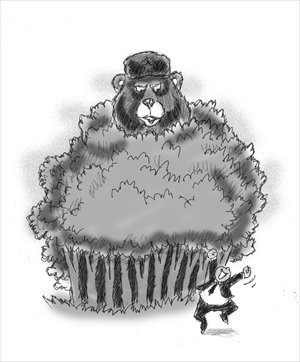
Among other rich natural resources, Russia is known as being the largest forest country in the world. The country boasts one-fifth of the world's total. But this considerable potential has yet to be fully tapped, as the country's share of global trade in timber products is less than 4 percent.
That potential can be fully exploited by selling timber to China, the world's biggest wood importer. China's appetite for timber is growing as the country's economy continues to forge ahead unabated.
Russia and China share a long land border, which makes bilateral trade in the timber industry easy to conduct.
The two countries are a perfect match when it comes to supply and demand of wood, unless something unexpected takes place, such as the seizure of Chinese businessman Fu Jianzhong's Muxing Timber Co. by the local government in Khabarovsk, the second largest city in the Russian Far East.
Fu's company bought the local timber farm in 2003 with the exclusive rights to 247,000 hectares of forest for 49 years in Khabarovsk, which is close to the Chinese border. He then invested more than 200 million yuan ($32 million) developing the project in the next few years until early 2007, when his business suffered a sudden setback.
The local procuratorate in Khabarovsk closed down Muxing Timberland in March 2007 on suspicion that a driver's ID was fake. Other charges then followed, including failure to pay resource fees. Eventually, the forest was auctioned off by the procuratorate, and the business was seized by the local government in Khabarovsk.
Since then, Fu has been fighting to have the dispute settled through legal means, including an international arbitration, in the hope of seeing justice done. The case caught public attention only recently when Fu resorted to Chinese Ministry of Commerce last month. Moscow has not responded to Chinese media's inquiries about the case.
Details of the case remain unknown. Still, it's glaringly obvious that some moves taken by the local procuratorate are, to say the least, improper, such as the auction of the company's assets, which was carried out without a court ruling.
The steady rise of wood prices and the growth of timberland thanks to the cultivation under Fu's watch had seen the value of the forest almost double that of 2003.
Also, according to Fu, Khabarovsk tried a couple of times to buy back the forest, but was rejected.
The story sounds similar to what happened to Shell in its business operation in Russia in 2006. The Anglo-Dutch company was forced to cut its stake in the $20-billion Sakhalin-2 scheme in the Far East of Russia in favor of a Russian energy group, allegedly after months of political pressure from Moscow.
The incident was widely seen as an attempt to take back assets granted to foreign companies when energy prices were high.
If we take a look at the big picture of bilateral trade between China and Russia, we should say Chinese companies are not entirely free of bad practices. In 2009, Chinese businesses were raided by law enforcement officials in a market in Moscow and contraband goods worth about $2 billion were seized.
Another big obstacle to Sino-Russian trade is the so-called Gray Customs Clearance, in which well-connected Russian "clearance" companies bring imported goods into the Russian market at a low tax rate but often without proper customs documentation.
Activities like these have damaged the reputation of Chinese products as well as Chinese businesspeople.
If we expect the Russian side to behave and follow the law, then Chinese businesspeople should also think about what they do and how this affects the image of Chinese investors.
The year 2012 saw Russia joining the WTO after 18 years of tough negotiations. People have reason to believe Moscow will respect and observe international law and regulations.
Russian President Vladimir Putin hinted at last year's APEC summit in the Far Eastern city of Vladivostok that Moscow would pay more attention to Asia and that priority would be given to developing Russia's Far East region. Many link that to the strength of Chinese investment and richness in labor.
Putin also promised to raise Russia's ranking in the Ease of Doing Business index, compiled by the World Bank, to 20 by 2018, the end of his current presidential term, from last year's 112th place. One of the sub-indexes is the protection of foreign investors.
All of these gestures are positive and encouraging. The handling of Fu Jianzhong's grievances will be a test of whether Russia will become a better destination for foreign direct investment.
The author is a commentator on current affairs with China Radio International. opinion@globaltimes.com.cn