Obama should establish lasting legacy of peace
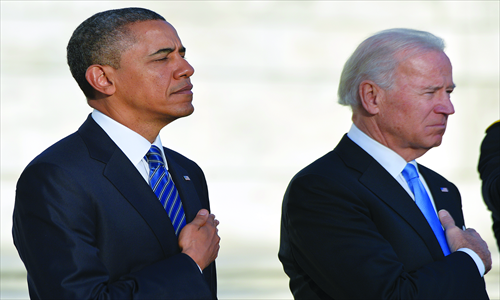
Re-elected US President Barack Obama took the oath of office for his second term in a private, small ceremony on Sunday and will be sworn in publicly Monday.
Now attention has turned to whether or not Obama will fall victim to the "second-term curse." The history of US second-term presidents shows that many presidents went off track during their second term, like Richard Nixon who resigned due to the Watergate scandal and George W. Bush, whose war time presidency gradually lost its halo in the financial crisis.
The road ahead of Obama's new presidency looks challenging. A political war of attrition with Republicans and strong lobby groups constrain Obama's actions on a series of issues like gun control and the government's debt ceiling. To avoid the "second-term curse," some analysts suggest Obama score political points through foreign policy by making accomplishments overseas.
As two major powers, the US and China's interactions will represent a large and important part of Obama's diplomacy during his second term. In this sense, the Sino-US relationship could be a key element in terms of deciding the president's legacy.
The high-profile pivot by the US to the Asia-Pacific region has given some countries in the region hopes of depending on the US to check China. However, some elite voices in the US have pointed out that the smart power diplomacy advocated by US Secretary of State Hillary Clinton hasn't been beneficial for the US.
The candidates for key positions including secretary of state and defense secretary are widely considered to be more moderate in terms of diplomacy, indicating that the Obama administration may adopt more pragmatic foreign policies in his second term.
But a deep sense of distrust is still hanging over the Pacific despite decades of interaction. US aircraft carriers periodically participate in military drills alongside countries involved in disputes with China, and a missile shield system targeting China is being planned. It is inevitable that many Chinese will conclude that China is being suppressed and contained by the US.
It's almost a cliché to state that managing the Sino-US relationship represents an unprecedented challenge, especially given the resistance of conservative forces within the US and powerful defense industry circles.
But Obama can also refer to some of his predecessors for clues, such as President Bill Clinton who delinked the Most Favorable Nation status with human rights issues, providing impetus to economic cooperation between the two countries and mutually beneficial relations.
Historically, the relationship between the established global power and the rising power has often contained the risk of conflict. Obama can establish a great legacy if he can lead the US to avoid this age-old trap.