CSRC protects low-income investors
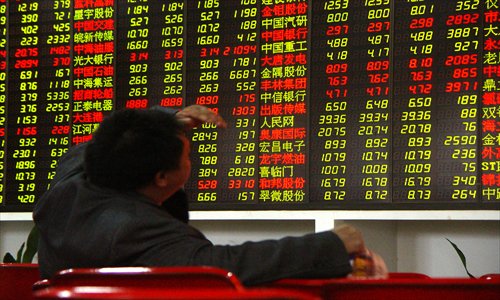
A top official from China's securities regulatory commission said Tuesday it is important to intervene at key moments in the stock market, which is still undeveloped, and it is good to see that some low-income investors who can't bear the financial risks are moving away from the market.
"The regulator should regulate China's stock market, or the market will be in disorder," China Securities Regulatory Commission (CSRC) Chairman Guo Shuqing, speaking at a national securities and futures regulatory meeting, was quoted as saying by Xinhua News Agency on Tuesday.
"China is still a developing country, and the Chinese stock market is undeveloped with a performance that usually fluctuates," Guo said. "We suggest that low-income investors choose other investment products with lower financial risks."
Among the measures taken by the CSRC, the regulator suspended approval of new IPOs in the second half of last year and are now proceeding slowly with new listing approvals in an effort to revive the sagging stock market. An oversupply of new stocks in a sluggish market was believed to be one cause of the poor performance. Currently over 800 enterprises are in line for the regulator's review and approval procedures.
"Chairman Guo's speech at the meeting discussed measures that will protect low-income investors' interests. The administrative intervention Guo described is necessary under China's financing and investment environment," Li Daxiao, a director of research with Yingda Securities, told the Global Times Tuesday.
Around 89 percent of China's stock investors lost money last year, with most of them complaining that the worst thing they did was investing in the stock market, according to a November survey of 62,000 individual investors across the country conducted by news portal sina.com.
At the national securities and futures regulatory meeting, which established the CSRC's working targets for the year, Guo announced 10 guidelines with the major theme of initial public offering (IPO) reforms and modifications on securities laws. They were published in the Securities Times Tuesday.
"The 10 guidelines are a continuation of Guo's reform measures since he assumed office," Li said.
Li predicted that the stock market will perform better this year than last year if all the reforms are strictly carried out, adding that the slight recovery of the macroeconomy in the fourth quarter of 2012 will be another boost of the stock market this year.
Guo has released a batch of reforms, including rules to fight insider trading and improved examination and approval mechanisms for IPOs, since he took up the official post of CSRC chairman in October 2011.
Education of investors is also one of the 10 guidelines, which Li said is necessary because many Chinese investors currently lack investment experience.
Some experienced individual investors didn't suffer heavy losses last year, as they became more cautious.
"I earned a little last year, because I reduced the total amount of my investments, and I am good at researching the financial reports of listed companies," Shen Jiawang, a 30-year-old water conservancy project engineer with a salary of around 12,000 yuan per month who entered the Chinese stock market in 2007, told the Global Times.
Shen is optimistic about market performance this year, and felt that regulatory reforms would be helpful.
Commission’s working targets for 2013
1. Diversify types of investment and investment products
The regulator will improve rules on companies' credit bonds, innovate new types of credit bonds, and expand the pilot of a Beijing-based national share transfer system for non-listed small and medium-sized enterprises (SMEs).
2. Reform issuance of new shares and delisting mechanisms
The regulator will improve regulations on IPOs and the pricing system for new shares, as well as the delisting mechanism. It will strictly carry out examinations of IPO applicants and their listing sponsors and accounting partners.
3. Grant IPO reviews to companies with strong profit potential and solid business performance
Strict sanctions will apply to any enterprises, listing sponsors or accounting partners that manipulate their profit data or fake their balance sheets in order to get listed.
4. Improve the current regulations on futures to boost the real economy
The regulator will strictly execute regulations on futures trading and modify related rules.
5. Cultivate institutional investors
The regulator will cultivate institutional investors such as equity investment funds and investment management companies. Foreign pension funds, charity funds and sovereign-wealth funds will be encouraged to invest in the domestic stock market.
6. Improve regulations on brokerage firms
The regulator will strictly supervise brokerage firms including securities brokerages, credit rating agencies, and accounting firms, and offer better services for them.
7. Make the domestic market more open to foreign investors
Quotas will enlarge for Qualified Foreign Institutional Investors (QFII) and RMB Qualified Foreign Institutional Investors (RQFII).
8. Offer education and related services to investors
The regulator will set up a mechanism to interact with investors, and require wealth management agencies to offer diversified investment products to investors.
9. Improve self-regulation
The regulator will set up a more flexible and efficient nationwide monitoring and regulatory system.
10. Modify and launch related regulations and rules
The CSRC will modify securities laws and launch futures laws and supervision rules for listed companies.