Heartfelt gifts of life
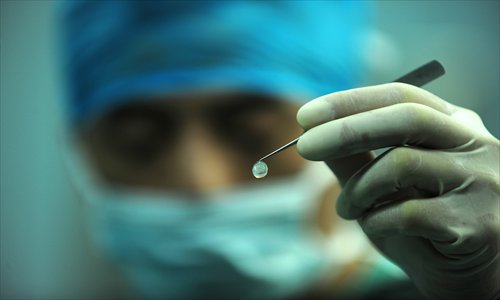
It was a heartbreaking tragedy for 9-year-old Yin Jialin and her parents. The bright young girl, who had a congenital heart disease, fell seriously ill last year and died in December, just after her birthday. But while her death broke her parents' hearts, it brought a special gift to someone else in Shanghai. A year before the little girl had decided to donate her corneas and these were transplanted to two young blind children, giving them sight.
Yin's mother was a doctor and knew well that her daughter had a little chance of living a full life when she was born, but she wanted her daughter to enjoy as much of life as possible.
"We sent her to kindergarten and school for a month because we wanted her to have the experience of school friends and teachers," the mother said. Yin loved the experience and in 2008, when she saw the children who had lost families and schools in the Sichuan earthquake, she donated what she could. When she learned that blind children could see again if people donated their corneas, she told her parents that was what she wanted to do.
She pushed her parents until eventually they went to the Shanghai Branch of the Red Cross Society of China to get cornea donation application forms. They filled in the forms but were reluctant to actually forward these until Yin became seriously ill late last year. Yin's mother has also decided to become a donor.
Cornea transplants can cure blindness. The cornea bank run by the Shanghai Red Cross said that in recent years, around 1,200 blind people register hoping for a transplant every year, but less than 2 percent of those waiting will actually receive a new cornea.
Slim chances
According to Shanghai Red Cross, by September 2012, there had been 4,751 registered cornea donors in Shanghai and a total 63 have died and had their corneas transplanted to others. But there are thousands of dying patients waiting for other organ transplants to save their lives. The chances for most are very slim.
In 2007, the Ministry of Health (MOH) revealed that there were some 1.5 million patients in China awaiting organs every year but only 10,000 will get transplants. It's a yawning gap - China has more people than any other country in the world waiting for organ transplants but there are few donors.
There are two types of organ transplants that can be carried out. Living people can donate a kidney or part of the liver, lung, intestine, pancreas, bone marrow, or blood. Other organs can be harvested from the dead.
Beijing's Century Weekly magazine has reported that China is the only country in the world that regularly transplants organs from executed prisoners. According to the 2009 figures from the MOH, up to 90 percent of the organs used in transplants in China were taken from executed prisoners.
In Shanghai, 95 percent of the transplant organs come from hospitals and prisons in other provinces. The situation is far from sustainable, the Shanghai Municipal Health Bureau notes.
Shanghai first established a body donation system in 1982 and by September 2012 there had been 28,381 registered donors. But in the early days Shanghai laws only allowed donated bodies to be used for medical research and teaching.
Most patients who need live organ transplants can only seek help from their families. The shortage of available organs has become a major problem.
Expensive treatment
Chen Nan is the director of the Renal Department at Ruijin Hospital, one of the leading hospitals in Shanghai. Every year her department sees thousands of patients seeking kidney and other organ transplants.
She told the Global Times that many of the patients she treats are dying or enduring expensive dialysis treatment because of the lack of available organs.
"Every year in Shanghai some 4,000 new patients need new kidneys, either transplants or dialysis. Each of them will pay 100,000 yuan ($16,082) a year for the treatment and hospitals have to invest in more expensive equipment which puts more of a burden on both sides," Chen said, adding that it was way past time for a proper organ donor system to be established.
Chen said that at present so far most patients with kidney diseases obtain transplant organs from living relatives. But from the medical perspective, this can harm the health of the donors and puts a huge amount of stress on both the patients and the donors.
"It is just the only choice we have today," Chen said.
In 2009, she proposed to the local health authorities that Shanghai establish a donation system using organs from the victims of fatal traffic accidents. She wanted the chance to collect organs from the victims after medical experts had assessed the cases and family members had signed agreements.
"If just one tenth of the victims of traffic accidents could donate organs, it would ease the current organ shortage in China," Chen said. But to date, Chen hasn't had a reply from the authorities.
Lack of a law
Another major obstacle for organ donation in China is the lack of a law on brain death, according to experts. Brain death is defined as the irreversible loss of the brain function necessary to sustain life. Although the concept of brain death has been established in some 90 countries and regions in the world, at present the law in China defines death as when the heart ceases to function.
Chen said that even if there was just a short time between the brain ceasing to function and the heart stopping, some organs could be seriously damaged and would be unsuitable for use in transplants.
In her 2009 proposal, Chen also asked for the brain death standard to be introduced as soon as possible.
However, Huang Jiefu, the vice minister of health, told the Xinhua News Agency in November 2012 that it was not yet a good time to widely introduce the concept of brain death in China. Many people cannot accept this yet.
In fact, in practice, organ donors and their families could still select brain death, heart death or both as a standard for the doctors.
By September 2012, there had been 465 organ transplants carried out in China since the MOH and the Red Cross Society of China launched the organ transplant pilot program in March 2010. Of these, 47.5 percent of the transplant organs came from people who had been assessed as heart dead, 43.5 percent were from people assessed as heart and brain dead and just 9 percent came from people assessed as only brain dead.
Reform program
The MOH launched a series of reforms for organ donations and transplants and the State Council published its Regulation on Human Organ Transplant in 2007. In 2012, the organ transplant pilot project had expanded to 19 provinces and municipalities. Last September, the MOH and the Red Cross Society of China met in Tianjin discussing how to further expand the pilot program.
"It is important to establish an organ donation system which conforms to social ethics and the sustainable development of China's society," the vice minister of health, Huang Jiefu, said at the meeting.
On December 11, 2012, the Shanghai Municipal Health Bureau and the Shanghai Branch of the Red Cross Society of China launched a pilot organ donation program at 17 major city hospitals. Previously, only cornea transplants could be performed and donated bodies could only be left for medical research.
Since the program was launched, around 1,100 people had completed organ donation forms, said Li Minglei, the director of the Organ Donation Office at the Shanghai Red Cross.
Fair distribution
Zhu Tongyu is the vice president of Zhongshan Hospital and a transplant expert. He believes that the key to the reform is to establish a transparent and fair organ distribution system as soon as possible.
As a doctor who carries out hundreds of transplants every year, Zhu is very aware of the possibility of profit-mongering if the system leaves any room for this. "It is important to ensure that all patients have equal opportunities and that we exclude any other factors that might affect the fair distribution of organs."
Red Cross director Li said that Shanghai has now set up a comprehensive system from organ donation to distribution and this is managed by the Shanghai Municipal Health Bureau and the Shanghai Red Cross.
Now patients seeking transplant organs have to be registered and assessed at set centers to decide whether they are suitable recipients. Their names then go into a database in Shanghai and they will wait their turn. The system, designed by the University of Hong Kong in 2009 and introduced to the country in 2011, guarantees that transplant organs are given to patients deemed medically most in need.
The system also ensures that neither the donors nor the doctors who perform the transplants can decide on the order of recipients, making it impossible for unscrupulous people to profit.
"We still have many obstacles to overcome. Many people don't accept organ donations and some family members change their minds at the last moment," Li said. "It is a work that needs understanding and involvement from everyone. We have a long way to go."