Setting sun
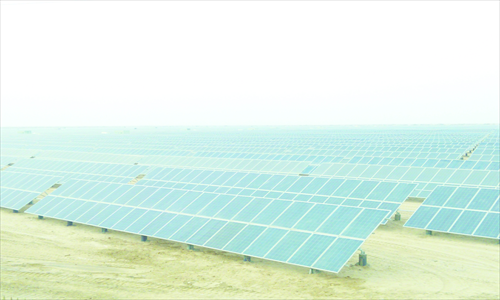
On the north edge of the Taklimakan Desert, near the border between China and Kyrgyzstan, sit 126,000 newly set up solar panels with 30 megawatts of generating capacity in total.
Though it looks impressively modern, it's also a sign of the overcapacity problems in the Chinese solar industry, which accounted for 80 percent of the world's output capacity in 2012.
The project, which started to supply electricity to a local grid on January 18, is only the first phase of a 200 megawatt solar farm to be built this year in Alaer, Northwest China's Xinjiang Uyghur Autonomous Region by a joint venture between Shanghai-based Sky Solar Holdings Co and a power company under the First Agricultural Division of Xinjiang Production and Construction Corps (XPCC).
"The total project investment (for the first phase) is over 300 million yuan ($48.2 million), and it has an expected annual output of 41.4 million kilowatt-hours," Su Weili, chairman of Sky Solar, told a press conference in Alaer on January 18.
"It also marks the first solar farm asset to be operated and managed by Sky Solar in China," said Su, noting that the company has additional photovoltaic (PV) parks under construction in Xinjiang and adjacent Qinghai Province.
The company initially concentrated on projects in Europe, but shifted its focus to Asia and South America after the EU initiated probes in 2012 into allegations by some European firms about solar panel dumping by Chinese companies.
"The malaise in the (Chinese) solar industry was caused by anti-dumping measures in the US and Europe. The only way for upstream manufacturers to improve their fortunes is to develop the end-market (i.e. solar farms in China)," said Su.
Sky's the limit
The National Energy Administration (NEA), the country's energy regulator, released the Solar Industry 12th Five-Year Plan (2011-15) in September 2012 to counteract the negative impact on the Chinese PV industry of the US and EU investigations.
According to the plan, the country's total installed solar power generation capacity will reach 21 gigawatts by the end of 2015, equivalent to a sixfold increase in the PV farm market.
In the final quarter of 2012, panel makers shipped about 2.74 gigawatts of solar PV panels to the Chinese end-market, which provided a dominant share of global end-market demand, according to research released Tuesday by industry research firm NPD Solarbuzz.
"Just two years ago, the Chinese end-market accounted for less than 10 percent of global PV demand," Michael Barker, a senior analyst at NPD Solarbuzz, said in a press release sent to the Global Times Tuesday.
"However, during the fourth quarter of 2012, a third of all global PV panel shipments ended up in China. This is the start of a new chapter for the solar industry, with China potentially taking center stage in both the upstream and downstream channels," Barker said.
During a national energy work conference earlier this month, the NEA said that the country plans to install 10 gigawatts of PV capacity this year, up from 7 gigawatts in 2012.
Although Su said that building the solar farms in China does not generate as much profit as in overseas markets, such as Bulgaria, Japan and Chile, he said that China would take up a significant portion of Sky Solar's asset portfolio, given the current downturn in major overseas markets.
Su said that Sky Solar made healthy profits in 2012, and that international investors including Warren Buffet are considering investing in it or buying some of its PV assets.
He also said that the company is aiming for an overseas IPO in 2013, but he stopped short of saying where, or how much the company would expect to raise.
Downstream risks
In an effort to find a new source of revenue, many Chinese solar panel makers are also joining the solar farm market, either by themselves or by teaming up with solar farm operators.
"Manufacturers that succeed in broadening their end-market coverage should achieve a healthy balance between quarterly production and shipment levels in 2013," said Barker.
But it is not a risk-free solution. Shenzhen-listed Shanghai Chaori Solar Energy Science & Technology Co has made ambitious efforts to explore downstream opportunities, setting up joint ventures with Sky Solar and also investing in solar farms.
But the company has also used about 90 percent of its panel making capacity for its own solar farms and those co-built with its partners, which has led to cash flow problems, Zhang Yuxin, the company's general manager, admitted to the Economic Observer on January 3.
Although the PV parks offer a 12 to 14 percent return on investment, the return period is six to eight years, Zeng Weiqiang, chief analyst at Rising Securities, told the newspaper.
Su, who is the fourth biggest shareholder in Shanghai Chaori, said that the maximum level for a panel maker when participating in the end-market should be kept at about 25 percent of its production capacity.
The cash flow problems have caused concerns among Shanghai Chaori's creditors, including China Development Bank (CDB), which is why the CDB recently halted lending to the firm's solar park project in Greece, Su said.
Su suggested that Shanghai Chaori's chairman Ni Kailu might be replaced in a company restructuring plan to be implemented soon.
Meanwhile, the PV park operators also have their own headaches, the biggest being the difficulty of connecting to the national power grid.
Sky Solar's cooperation with the local power company in Alaer can help it sell its first 100 megawatts of electricity to local industries via XPCC First Agricultural Division's own grid. But the remaining 100 megawatts will need to be connected to the State Grid, Liu Ming, chairman of the First Agricultural Division's power company, told the Global Times on January 18.
The difficulty in selling the power to the State Grid, especially power generated by distributed PV sites, is due to a lack of subsidies to support the process, Lin Boqiang, director of the China Center for Energy Economics Research at Xiamen University, told the Global Times Tuesday.
Because of the inherent volatility of renewable energy, the grid needs to invest in facilities to stabilize the solar power supply, Lin noted.