Carrying on traditions
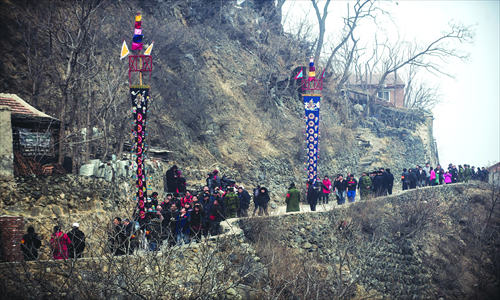
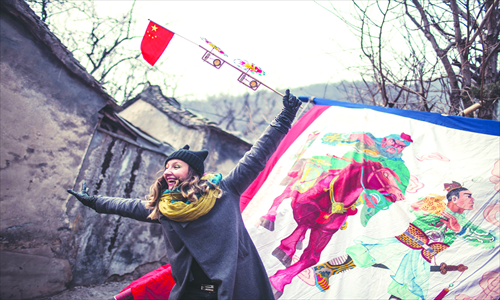
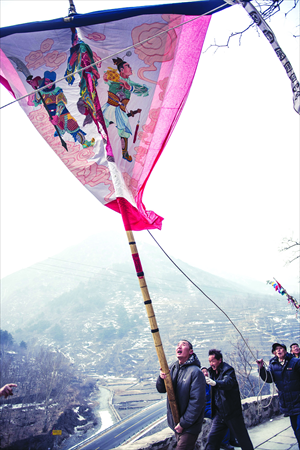
Liu Zheng took a deep breath and held on to the flagpole with both hands, as the crowd watched in silence. Without a pause, he picked up the 6.7-meter tall black flag, which had the name sanguandadi (three Taoist gods) stitched on it, and walked on.
The top of the flag was attached to a long rope, which someone behind Liu held tightly. Even so, he staggered with the weight and the tall flag swayed in the air like a drunkard.
Liu, 36, gazed up at the flag, which weighs about 50 kilograms, mouth open. He carefully adjusted his posture. The flag became balanced and still.
"Forward!" he roared, as the music started playing and about 20 more flag bearers like him walked in a straight line.
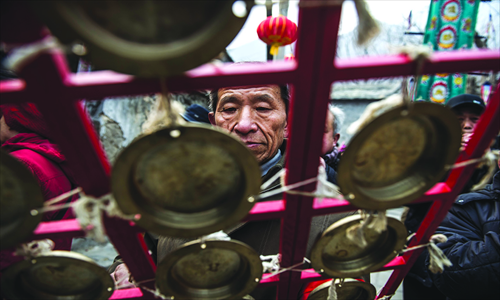
Liu and about 300 others from Qianjuntai village and Zhuanghu village, Mentougou district, who nearly all bear the family name Liu, were participating in the 500-year-old tradition of fanhui, or the meeting of ancient flags, which was started in the Ming Dynasty (1368-1644). Every year, the festival draws a huge crowd. To the villagers, it serves the purpose of a family gathering, and they are happy to see their children inherit this tradition.
The festival falls on the 15th and 16th days of the first month of the lunar calendar - which this year was Sunday and Monday. Preparation, though, started Saturday night, when the seniors mended the flags and burned incense for the gods, said Liu Shicun, an 84-year-old native of Qianjuntai village.
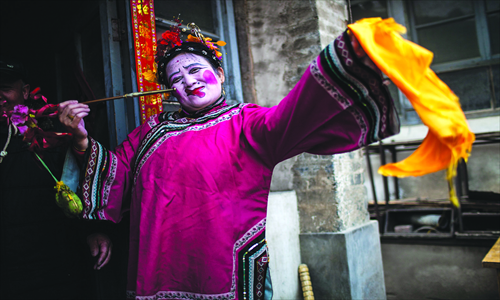
Every year, on the morning of the 15th day, the men in the village carry the flags outside and line them up, while the women put on dresses and makeup for the parade.
The flag parade starts around 3 pm, when Liu said they welcome and then see off the gods. At the same time, there are performances such as yangko dances and dynamic drummers.
Liu Xiang, 54, has been in the performance for as long as she can remember. Dressed in a red top and green pants, flowers in her hair, startlingly red lips and crooked eyebrows, she's acting as an ugly matchmaker in the yangko dance.
"The tradition stopped for a while during the Cultural Revolution (1966-1976) and came alive again around 1979," she said. "It's the tradition that nobody comes home for Spring Festival, but everybody comes back for the festival on the 15th."
She has married into a family in another village, but still comes back every year to perform on the 15th.
This is the case for many, Liu Zheng said. Qianjuntai village has about 1,000 people, but most have moved into the city for jobs and only come back for the performance. The population doubles during the holidays, he said.
Kids also take part in the performance. About 10 children dressed in yellow or pink hold small flags and walk among the adults in the group. They've all been participating for as long as they can remember, and that's how the tradition is carried on, said Li Ying, a 15-year-old girl in the performance.
Liu Zheng said it's a chance to see family members and for children to learn to carry on traditions. He'll keep performing in the future.