Nowhere to wed
Editor's Note:
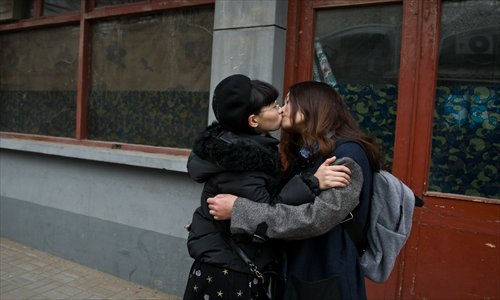
The story Lesbian couple attempt to wed appeared on February 26 in Metro Beijing. It was about a lesbian couple who failed in their attempt to register at the marriage registration office in the Dongcheng district Civil Affairs Bureau on February 25.
The couple, Ma Yuyu, 27, and Elsie, 21, are also volunteers at the Beijing LGBT (Lesbian, Gay, Bisexual and Transgender) Center, who wanted to express their support for a recent statement by Li Yinhe, one of China's most prominent sexologists, who said she wishes to find deputies from the National People's Congress (NPC) to deliver her proposal to legalize gay marriage at China's annual legislative meeting, also known as the two sessions, a meeting of China's top political advisory and legislative bodies, in March.
Experts welcomed the action and said it was about time such legislation was passed, after 24 countries had done the same.
The story:
On 10 am, February 25, two young women stood hand-in-hand in front of the Dongcheng district Civil Affairs Bureau in Dongsi Shisantiao.
One of the women, Ma Yuyu, said that they had known each other for about six months, and so far the only people who knew about their sexual orientation were their mothers. "We wanted to stand up to express our voices for the gay community to let the public understand that we also need to have gay marriage," she said.
Ma noted that although they knew they would be rejected, they still wanted to give it a try.
Li said that prejudice from the public and government meant legalizing gay marriage is not just about marriage itself, but fighting for more social recognition.
The back story:
The lesbian couple's attempt at marriage was not the first of its kind in Beijing. Metro Beijing had run a previous story on February 14, 2012 about two gay couples who failed in their bid to register for marriage at the Chaoyang district registration office.
While their action drew limited public attention, the lesbian couple's attempt came just ahead of the two sessions, lending it more meaning and urgency.
When I arrived at 10 am on Monday, the girls were already there and were surrounded by several photographers. They seemed a bit nervous about how they would be treated at the registration office.
Later, we followed Ma and Elsie to the registration office. The clerk there was initially kind, but seemed stunned when he was told by the couple that they were lesbians. "There is no legislation for gay marriage, as you know," he said. The reporters holding cameras in his office soon got on his nerves. "Turn off your camera first," he said to one reporter.
Unwilling to take any responsibility, he suggested they go to the Beijing Municipal Civil Affairs Bureau for any questions. Then he stood up and left, leaving the two girls behind without saying a word.
Amid their disappointment, the couple began collecting signatures from passers-by. By chance, they saw Pu Cunxin, a famous Chinese actor and activist who has produced several public service advertisements on AIDS prevention, cycling near the office.
The couple stopped Pu, hoping that he could use his celebrity to help spread news of their failed bid. After learning about their action, Pu said that although everyone has a right to choose their own lifestyle, it will take time for China to accept it. He also showed his support by signing their self-made marriage certificate and took photos with them before leaving.
A week after this story appeared in our paper, I got in touch with the couple out of concern that their new exposure might have affected their lives.
Elsie said that no one knew she was a lesbian apart from her mother, who had accepted it. "But I won't tell other relatives unless I have to," she said.
But for Ma, things were a bit trickier. Some relatives confronted her after finding about their actions. "They angrily asked me what I thought I was doing and warned me not to do anything like that again," Ma said.
Ma had been concerned that her mother would be affected by pressure from family members. "But my mom said that as long as I am fine then she's fine," said Ma.
Ma's case was not an isolated one. On February 26, a lesbian couple was also rejected after attempting to marry in Guangzhou, Guangdong Province.
As early as 2000, there was a debate on the legalization of gay marriage during the discussion of an amendment to the Chinese Marriage Law, but with no result.
Case after case indicated that real change could only come from the top, and that the gay community's efforts would be better spent on lobbying lawmakers rather than on civil affairs bureau staff who could do nothing to bring about change.
Fan Popo, executive chairman of the Beijing LGBT Center, has his own views on this matter. "In terms of influencing the deputies of the NPC, we don't have many options since we can't talk with them directly," he said. Fan also noted that the couple had not expected to successfully register at the marriage office since gay marriage is not legal yet. "Nevertheless, their purpose was to influence the media and draw public attention to this case," he said.
Fan said that legalizing gay marriage is not just about marriage itself, but also about giving gay people rights to adopt children, inherit property and buy houses. "All these things can only be done by married couples at the current stage in China," Fan added.
In late February, hundreds of parents of gays and lesbians nationwide wrote a letter to the deputies of the NPC expressing their wish to amend the Chinese Marriage Law to make gay marriage legal. The 600-word letter was written by the director of the organization Parents, Families and Friends of Lesbians and Gays China named A Qiang on behalf of all the parents, Xinmin Evening News reported.