Educational rebels
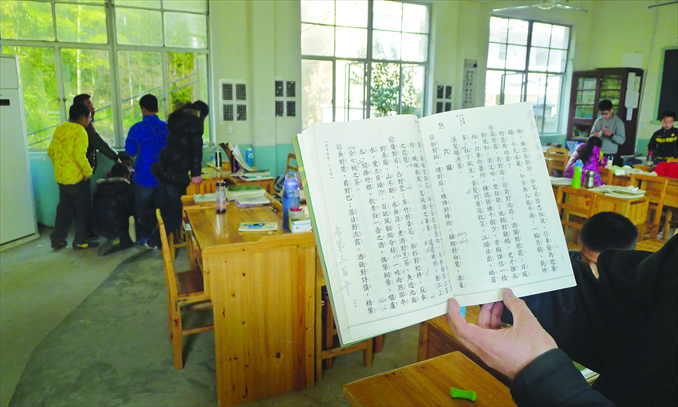
It might be hard to understand why Zhang Xizhi sent his only 9-year-old son to a school in a remote mountainous area of Zhejiang Province, 4,000 kilometers away from their home in Xinjiang Uyghur Autonomous Region. Zhang simply believes his son will receive a better moral education there.
"I don't care if my son will have a university degree or make a lot of money in the future. What I care about most is whether he is an upright man which today's schools don't teach," Zhang told the Global Times, while sitting in the school's playground.
Yet Zhang is not alone in feeling this way. Hundreds of parents across the country share his fears and have sent their children to this special school – Wangcaigui Classical School in a small village of Suichang, Zhejiang Province ahead of the new semester which kicked off last Friday.
22-year-old Huang Yulin might be the oldest student in this school. In 2006, Huang and his parents made a decision which stunned their friends and relatives. He dropped out of a top high school in his hometown in Jiangxi Province. Instead he went to an unknown school thousands of kilometers away in Wangcaigui's former base of Laizhou, Shandong Province to study classical Chinese culture.
"Until now, many people don't understand me and blame me for gambling away my kid's future. They worry that if he doesn't have a degree, he won't achieve anything in this society," Huang's father said, "Actually they never know how happy I was when my son made this choice. I believe no matter what happens to him in the future, it would be no worse than if he followed the old path."
Huang's father was only able to receive two years of middle school education but, through hard work, rose to become a senior manager in a large company.
"When I was in the previous school, I was just like my fellow classmates, I was naughty, I caused trouble for teachers and I didn't study at all. I felt so empty," Huang told the Global Times.
At that time, Huang's father suggested for him to try the classical school. After one-year studying in Shandong, Huang dropped out and returned home, complaining he didn't understand what he was learning. But one year later, he came back again and has never left.
"I felt puzzled by many things before I got here but then I began to reflect on myself. I found many things were going wrong in my life and decided to renew my education. What I learned here is how to be a man first, then to learn knowledge," the 22-year-old man said. After seven years of study, he has now become a teaching assistant at the school.
This is probably one of the reasons why more and more parents are sending their children here. This year, Ming Yue and 16 other families from Shanghai sent their kids to Wangcaigui Classical School. Ming, a professor at Shanghai Jiao Tong University, told the Global Times that she didn't want her son to be assessed only by the standard of examination scores but by more important values.
Learning the tradition
Six hours drive from Shanghai, in the deep mountainous area of Zhejiang Province, is the Wangcaigui Classical School. When the school opened in 2009, it only had a dozen students. But now it counts more than 200 students from across China and even from overseas. All students are divided into a dozen classes, not by age group, but by their experience and understanding of what they learn.
Although the school defines itself as an elementary-like school, its students range from 3 to 20 years old with yearly tuition fees of 26,000 yuan ($4,176). Half the students had never received formal education before starting at Wangcaigui while others moved here after varying amounts of time in traditional school. Unlike other graduation-oriented schools, there is no mandatory length of study here. Some former students have now returned to normal schooling while others, like Huang, stay on.
The school has no weekends and students study all year round, except for 45 days a year of winter and summer holidays. Family visits can only take place once a month, in order to allow the students to focus on studying the classics of Chinese culture, including works about Confucianism, Taoism and Buddhism. Western works are also on the agenda, with William Shakespeare and the Bible featuring prominently. Mathematics and science subjects are learned by the students on their own as no teaching is provided for these courses. The school also places an onus on music, calligraphy, drama and martial arts.
It's a blast
15-year-old Xiao Rongrong from Jiaxing, Zhejiang Province told the Global Times she came to Wangcaigui after one year in middle school and had no intention of going back.
"I like the environment here which makes me feel less pressure instead of endless tests and competition," she explained. Xiao added that even the boys behave than in her other school, saying they never fight.
"It all began with a reflection on our education system, especially at a time of cultural conflict with the West," principal Yu Weiquan told the Global Times.
"Over the past 300 years, China has constantly been studying the West. However, the core culture and values of the West today are no longer those of the 15th century. They are full of consumerism and pragmatism which has deeply impacted Chinese society today and caused many problems," Yu said.
"In traditional Chinese education theory, character and virtue education always come first as we think that a person who knows how to conduct themselves will benefit society, whether they are a politician, businessman, farmer or worker, " Yu said.
According to Yu, the purpose of the school is to restore the good legacy of Chinese traditional education and to cultivate children to have high moral ethics through reading and learning classical Chinese literary works.
Yu said these great works of the past have stood the test of time and are the best textbooks to cultivate children, and prevent them from being polluted from the outside world.
Yu has two daughters, one is 12 and studying in Wangcaigui while the other, 17, is at a similar school in Shanghai.
"We set a different study plan for each student. We don't have compulsive requirements for them. What we care about is the kids' willingness to learn and giving them the ability to do so."
Historical origins
An increasing number of such schools have been emerging nationwide since late 1990s. Wangcaigui Classical School is just one of the most famous ones among hundreds.
In 1922, the government introduced a reform of China's public education system, based on Western education, and stopped almost all courses based on traditional Chinese culture.
After over 70 years, in 1995, nine members of the Chinese People's Political Consultative Conference proposed the establishment of classical schools focusing on traditional Chinese cultural education. These suggestions met with a warm public response and the fate of such schools was revived.
However, since this revival began, doubts and questions have never stopped. The main arguments revolve around two main issues: is it really worth encouraging children to read and recite classic works today and are they simply being used as propaganda tools for Chinese cultural renaissance.
Professor Liu Xiaodong fron Nanjing Normal University is one of those opposing such classical teachings. He believes reading and reciting classical works flies in the face of the accepted modern concepts of children's education.
"It's a historical regression. We shouldn't impose something that adults think is important and valuable on children instead than respecting what they are really interested in," Liu said.
Liu said such a movement would not be helpful for a China seeking to face the challenges of modernization and globalization.
"The reason why such schools are welcomed in China is the country's culture has not yet fundamentally accepted modern education concepts," Liu said.
Arguments between education authorities and classical schools have never stopped. In 2006, a private home school that taught Chinese classical texts in the Songjiang district of Shanghai was deemed illegal and ordered to close.
The Shanghai Municipal Education Committee said that students should learn Ministry of Education-set curriculums and ensure certain standards of physical and mental development.
However, the school owner denied the charge and claimed they were not seeking to replace public schools but were simply a private education institution. The school remains open today.
In 2009, Wangcaigui school was also forced to move from Laizhou, Shandong Province to Zhejiang Province because of pressure from the local education authority. But Yu said the school will not waver from teaching students in its own way.
"We can't guarantee each of our graduates will succeed after they leave here. But we believe something deep in their hearts will change and they won't be the same people anymore," Yu said.