Pancaking into spring
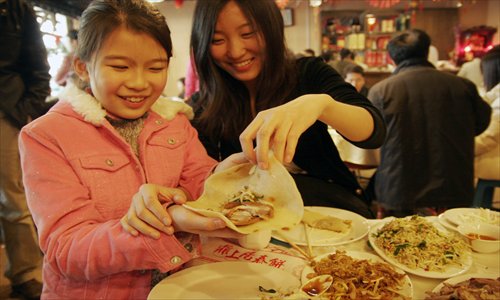
In the megacities of today's China, the arrival of spring merely means a change of wardrobe. For most of China's history, though, it has signified a return to working the fields and feasting on fresh meals after a long winter. In the countryside of northern China you can still see people following those ancient patterns. For them, nothing starts the new season off better than a meal of spring pancakes, known as chun bing to locals.
From a simple union of flour pancakes, sweet flour sauce, and numerous choose-your-own fillings, these wraps have built a fierce popularity. There are even two days on the Chinese lunar calendar devoted to its consumption (Li Chun, usually in early February, and Er Yue Er, typically in early March). In Beijing's outer district of Changping there is an entire village called Kangling that's dedicated to serving up banquets of spring pancakes to hungry visitors. No matter what day it is or where you happen to be, this simple dish is the perfect way to celebrate the brighter days of spring.
If its name rings familiar to you, that's probably because of the spring rolls that so many Westerners grew up eating at their local "Chinese" joint. While both the pancake and roll renditions are based around a wrapper encasing a filling, there are some fundamental differences. Spring rolls hail from the lighter cuisines of southern China, and get deep-fried to a crackly crisp and served up with neon-hued sweet sauces.
The spring pancake has a much more natural and healthy approach. So, gone is the deep fryer and in its place is a steamer basket for the thin pancakes and a wok to turn out fillings. Even the Chinese can't settle the debate on whether they are from the same branch of the culinary tree or if someone just got lazy naming dishes.
This being a very traditional Chinese dish, there are historically some basic guidelines for what to wrap up inside. To keep the body's yin and yang balance in check this time of year it's best to eat more sweet foods and less sour. However, the definitions of those two flavors are slightly different here. This sweet, or gan in Chinese, means that light and natural sort of sweetness found in vegetables. So load up on ingredients like radish, ginger, scallions, spinach, yams, mung beans and pork. It's best to avoid the sour flavors of ingredients like lamb, shrimp, and crab.
Today, people are much more open about what can go inside. Generally a proper spring pancake meal will include four to five different types of fillings that are largely based on personal preference. In Kangling they're known to offer up more than 20 different options for less than 50 yuan ($8) per person. Most often, fillings are simple home-style staples that include several meat and vegetarian options (see recipes below).
At the table all you have to do to start off the Spring Pancake Feast is slather the sweet flour sauce onto a pancake. Add whatever fillings you like, and get creative and combine different ones together. Roll it up like you would a burrito. Repeat until you feel full enough to sleep through the rest of a spring afternoon.
Spring pancake basics
Ingredients:
20-30 store-bought spring pancakes
100 milliliters sweet flour sauce
Process:
Pancakes
-Steamer option: Stack pancakes inside an already warm bamboo steamer on the stove for two to three minutes. Cover to keep warm.
-Microwave option: On a plate covered with a slightly damp paper towel, cook pancakes on low for 90 seconds.
Sauce
-Put sweet flour sauce into a low-sided bowl for dipping.
The vegetarian option
Ingredients:
-1 large carrot
-100 g mung bean sprouts
-50 g dried fensi (glass noodles, i.e., made from mung beans)
-Half a leek
-Salt
-Oil
-Dark vinegar
-Sesame seed oil
Process:
1. Soak the glass noodles in water until they have become soft.
2. Peel carrot and wash. Using the biggest knife you have, first cut the carrot into thin planks about 2-3 millimeters thick. Lay the planks roughly on top of one another and finely chop them lengthwise into matchstick-sized pieces while you hold the stack with your other hand.
3. Clean leek and then chop into thin rounds.
4. Toss a small pour of oil into a large nonstick wok over medium heat.
5. When oil begins to slightly shimmer, toss carrots into the wok.
6. Using a spatula, turn pieces until they start to soften, around 5-7 minutes.
7. Add in mung bean sprouts and glass noodles to the wok, and cook for 2 minutes.
8. When it's all soft and fragrant, add leeks and a dash of salt to taste.
9. Splash about 25 milliliters of dark vinegar into the pan.
10. Stir to combine.
11. Right before turning off the flame add in three drops of sesame seed oil. Serve.
The simple carnivore option
Ingredients:
-200 g store-bought roasted pork shoulder
-3 cloves garlic
-Sesame seed oil
Process:
1. Put pork into an oven at 150 C for five to seven minutes to bring meat up to temperature.
2. Pull from the oven. Carefully slice the pork into thin sheets (slightly thicker than a piece of sandwich meat), and put on a plate.
3. Mince garlic and sprinkle on top of the plate of meat.
4. Lightly toss with a few drops of sesame seed oil. Serve.