Want to take a tour of the wild, open and pure? In Kenya, it's no problem!


My father said that I would feed on nothing but fat, juicy ants. My mother said that I would suffer from diarrhea. My relatives said that I would end up losing my valuables there. I said they were all wrong.
After packing some instant noodle snacks, medicine and a perturbed heart, I took my leave. We landed in Nairobi in the evening after a 15-hour flight, and I soon fell in love with Kenya. The people were unendingly friendly and welcoming, and their love for the wildlife surrounding their communities was easily contagious.
On our first morning, Mwenda Bethwk, 33, our driver and tour guide, showed us around Nairobi, and it was a good thing we were with someone who knew the city. This capital is roughly 680 square kilometers with a population of 2 million. Free from the worry of studying maps and planning routes, we sat back and enjoyed the perfect weather. With an average temperature of about 18 C, it feels like spring all year round.
Sights of the city
Our first stop was the Kenyatta International Conference Center (KICC) and its 7,000-square-meter courtyard where events and activities are held. In the center of the square stands a bronze statue of Kenya's first president, Jomo Kenyatta, who led Kenyans out of British colonial rule. For a fee, visitors can take an elevator to the top of the center's tower to get a beautiful view of the modern capital. However, at the nearby intersection of Ngong Road and Cathedral Road lies the free viewing point for the public that offers the same view without demanding any money.
I love going to museums when I visit a new place - it's the perfect way to learn a lot about your destination in a short period of time. Nairobi National Museum was our second stop. Soon after we entered, a young man introduced himself as Dennis and asked if we would like to hire a docent to take us on a tour. After we nodded, he grinned and told us he had been learning Chinese for three days. We were guided through the first floor's collection of artwork from Kenya's 42 tribes, followed by specimen of its most famous animals including the "Big Five": the lion, the African elephant, the rhinoceros, the African buffalo and the leopard. Visitors can also learn about early man through the exhibition of skulls of prehistoric humans, as well as marvel at specimens of various Kenyan birds on the second floor. Dennis was a very knowledgable guide, and he escorted us through the museum, pointing out details and explaining aspects of the pieces to us.
After we finished our tour, we stayed and chatted with our friendly guide for a while and learned he was unemployed. "I have been volunteering at the museum for one year, and providing services for visitors is my only source of income," he said. When we asked why he could not find a job, Dennis forced a smile and said that in Kenya, it doesn't matter what you know but who you know. "I know all the birds, all the plants, all the snakes, all the culture in Kenya but that won't guarantee a job since four out of 10 people here are between jobs. I am learning Chinese right now in the hope of finding a place in a Chinese company one day," he said.
Between tourist sites, we had lunch with Mwenda at a local restaurant. After passing through security at the entrance, I ordered Swahili chicken to sample the local cuisine. The other people in the restaurant were very kind and warmly greeted us. Several wore suits and ties - real gentlemen. As soon as the meal arrived at our table, I knew that all the instant noodles I packed were unnecessary. The dish, piles of meat with a dome of rice, agreed with me, and I topped it off with a glass of passion fruit juice.
Lake Nakuru National Park
Lake Nakuru, which means waterbuck haven in Swahili, is known for its huge flocks of flamingos. Sadly, our visit fell in a season that is not the best time to view these bright pink birds, but the lake still looked tremendous, almost like an oil painting come true. Flamingos were scattered throughout the lake, many of them busy combing their feathers with their beaks or flying in pairs, making the surface half-pink, while pelicans stood still like statues, caring nothing about the activity surrounding them.
But Nakuru is more than just birds - here you can see three of the Big Five: the lion, the rhinoceros and the buffalo. Zebras, baboons and giraffes popped out on the road from time to time as we rode through the park. Mwenda tried very hard to find lions for us, which was not easy. "It is noontime, it's hot, and the lions are all hiding and sleeping." When we were about to give up after an hour of searching, a vehicle suddenly stopped in front of us and the people inside started snapping photos. A lioness was blocking the road, her back to us, and to her left were three other lions, taking a nap in a pile together. They looked like enormous house cats; it was hard to imagine how fierce these creatures really are.
Seeing a Maasai village
About 40 kilometers from Nairobi, there is a village named Kitengela where a Maasai clan of about 40 people live. These families moved there two decades ago in search of water and grass.
This Maasai village did not reflect all that I had been led to expect from my Kenya guidebook, which said that Maasai wear bright red to scare away lions and other wild beasts they share the prairie with, are well known for their warriors' jumping dance, and drink animal blood. On our visit, we saw neither the jumping nor the bloody beverages.
Local chief Joshuah Mokope acted as our interpreter. He wore a gray suit and spoke good English.
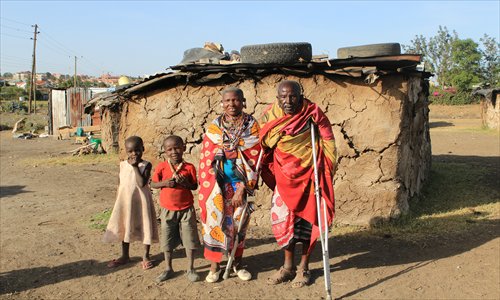
Before Mokope introduced us to the clan elder of Kitengela, we were allowed to take some photos of Maasai children - a rare opportunity as most in the community believe that pictures steal their souls. At first, they didn't know what was happening due to the language barrier (they speak Maa), but when we took out our cameras, they gathered in front of the lenses, posed and grinned. There were only three kids at first, which became six, and by the end of the session, almost all the kids in the village had come out to model. Despite having grown up without cameras in their homes, these Maasai kids were naturals in front of the lens, eager to express themselves and posing differently for each picture, after which they'd trot up to us to see the digital image.
Meters away from the children, an old man stood alone, leaning on a pair of crutches in front of a traditional manyatta (Maasai hut) made from cow dung, mud, sticks and grass. At age 70, Sentero Ole Ntiaki is the eldest person in the clan, and he has two wives, 60-year-old Sirintai Ene Saitet and 40-year-old Ireri Ene Saitet, with 11 children in total.
Ntiaki wore a shuka (traditional Maasai robe) and had finely chiseled features that suggested he was very handsome in his youth. His first wife, a lady with short grey hair and full lips, matched him well with her elegance. Sirintai smiled at me and observed me carefully as she listened to me talk with Mokope.
Maasai people eat meat, maize and rice, and drink milk and blood. They also eat herbs to cure illnesses. Daily work is divided between men and women. Women take care of the household, build the huts, fetch water, and do the cooking and cleaning, while males take care of cattle and provide security. Sirintai said that it can take a month for them to build a manyatta, and men usually take the animals to graze by 6 am, only to return around sunset after wandering far in search of water and grass.
The whole Maasai tribe lives in a patriarchy. "Boys inherit from their father and become head of household, taking care of the girls when the father is old. When a woman is mistreated by her husband, she turns to this head of household to resolve the matter," Mokope said. Once an area's water dries up, it is the men's job to find another place to settle down.
Mokope also said that Maasai people sell their cattle for money, but they are still very poor judging from their living conditions. Several huts were scattered on the bare earth, candles provide the only source of light, and they burn cow dung to keep warm on cold nights.
From the place where I stood in the village, I could see the high buildings and hear the horns of cars in nearby Nairobi, making this community stand in stark contrast to modern civilization. Maasai people know that the world is racing past them, so they send their children to school. When they come back, they bring changes to the village. The clan has begun to raise a different breed of cattle that yields higher profits, and many Maasai dress in Western clothes and learn English.
Mokope told me that this village does not attract many tourists, but the clan still live according to Maasai tradition and are happy to share their customs with visitors. Maasai people lead a simple life and I could feel the purity and simplicity of their ways. Sirintai gave me a pair of earrings while we talked, but I did not expect that, as I prepared to leave, she would run to me with a green and white beaded necklace and put it on me. I have always loved colorful Maasai accessories and I kissed the necklace she placed around my neck. The move touched Sirintai, who took my right hand and kissed the palm. I told her that I will come back to her village, but I don't know if that's true. The clan will likely pick up and move again in about a year when the water dries up.
Rules of thumb
Before you go: Get a 90-day tourist visa before heading to Kenya, and get vaccinated against yellow fever one month before you leave. Both Kenyan shillings and US dollars are acceptable in Kenya. Learn as much as you can about Kenyan tribes, especially Maasai people.
Don't forget: Sun block, a good hat, long-sleeved clothing, mosquito repellent, and basic medicines. Learn some Swahili phrases such as jambo (hello), karibi (welcome), asante (thank you) and the well-known phrase hakuna matata (no problem).
While you're there: It's strongly advised that you hire a local as your driver, as it can be bewildering to get around on one's own. Be sure to eat plenty of fruit here since most Kenyan dishes don't offer vegetables. When you meet someone, shake their hand. If you want to take a photo of someone, ask their permission first. Be careful not to buy products made from wild animals as poaching is a problem.