Controlling the purse strings
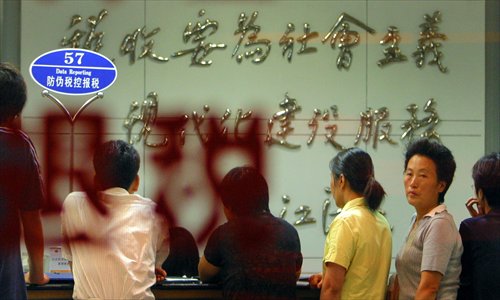
The government has driven Wang Yongsheng to divorce his wife, after they lived happily together for 25 years. More specifically, taxes have driven him to this point.
The 47-year-old went to a marriage registration center in Shanghai's Pudong New Area with his wife, Zhao Yanchen, for a divorce on Tuesday morning.
"We are getting divorced to sell our property, as the new policy stipulates that we are among those being levied a 20 percent tax on the gains," Wang said, pointing out that the recent change in taxation policy would result in 400,000 yuan ($64,320) in tax for the expected 2 million yuan in profit.
"We will surely remarry after the property sale is done," Zhao said, cursing policymakers for not thinking carefully before rushing the tax into place.
This was the most recent tax implemented by the State Council, which involves imposing a 20 percent tax on secondhand homes. It's only applicable to families that own more than one property, prompting many families to divorce and split assets.
The speed with which the tax was implemented, as well as the resulting public backlash, has raised questions about who should control tax policy in China.
Taking the power back
Zhao Dongling, a famous scriptwriter and National People's Congress (NPC) deputy from Shandong Province, never thought that her proposal for the NPC to take back its power to levy taxes from the State Council would find such widespread support.
"This proposal demanding the top legislature take back its power tops all the others during this year's two sessions," Xu Xiaonian, a well-known professor of economics and finance at the China Europe International Business School, said on his verified Sina Weibo.
In the proposal, submitted with 32 signatures by deputies from Shandong, Hunan and Shanghai, Zhao suggested the NPC take back these tax powers by the end of the year, and take on the responsibility of explaining tax laws, which have been substantially delegated to the State Council since 1985.
"From the date the new tax policy on property transactions was announced, it took me fewer than 10 days from starting to pay attention to this to submitting the proposal," Zhao said, adding that the proposal requires further polishing.
Still, Xin Chunying, a deputy director of the Legislative Affairs Commission of the NPC Standing Committee, said there is no current plan or timeline for the NPC to take back this power.
"What we are doing is responding to public attention," Xin said, adding that China's Legislation Law stipulates that the NPC has the power to impose taxes; however, the power can be delegated.
The NPC delegated the power to make administrative regulations concerning taxes, the reform and opening up and economic reform in the mid 80s. Some on taxes have been repealed, but those concerning economics remain on the books.
"We will carefully research and analyze this, and consider taking back this power at an appropriate time," said Lang Sheng, another deputy director of the Legislative Affairs Commission.
However, Huang Kaiping, a researcher from the Beijing-based Transition on Socio-Economic Consultants, said the authorization given to the State Council was actually almost limitless, as nearly everything is related to the reform and opening up and economic reform.
Lang hinted that in the next five years, the NPC would possibly take back tax powers. "The Standing Committee will conclude accumulating experience for taxation reform these years, and gradually upgrade provisional or interim regulations to laws," he said.
According to the China Business Journal, in China, among the 18 forms of taxes being levied, only three passed the legislative process of the NPC, while the remainder were established through interim regulations by the State Council.
Divided taxes, divided opinions
Any revisions to taxation rules should be decided by the legislature, or else the market will be hit by rising unpredictability as a result of administrative disorder, said Zhang Qianlin, a real estate lawyer with Debund Law Offices.
Li Lianning, deputy secretary-general of the NPC Standing Committee, suggested that in the future whenever there is a new tax it should have to pass NPC legislative procedures.
"Based on our experiences during the past 30 years, the time is ripe," Li added.
Jiang Hong, a member of the Chinese People's Political Consultative Conference and a professor of fiscal science at Shanghai University of Finance and Economics, said he believes the NPC should "indisputably" retain the right to levy taxes.
"The NPC gave this authority to the State Council given the need to open up the country, but the authorization should have time and other limits, without those, it would be equal to a total abrogation of authority," Jiang, who had made a proposal regarding the NPC taking back legislative powers in 2009, told the Global Times.
Jiang speculated that some government agencies that are short of money would come up with excuses to add taxes without seeking public advice.
Zhang told the Global Times that he concluded that "such an authorization per se is unreasonable, as it gives too much leeway to administrative organs to make changes."
However Li Daokui, a professor at the School of Economics and Management under Tsinghua University, who is also a CPPCC member, disagreed with Jiang.
Li said it is not practical to take all the legislation power back, even though it is right in principle. "With so many economic discrepancies across the country, empowering one certain organization with this legislation will be impractical."
"It would be better to let the Standing Committee of the NPC set up rough outlines first and then entrust the State Council to implement various policies through trial programs nationwide. From which, experiences in pilot programs could be collected and regulations could be gradually introduced into law-making," Li said.