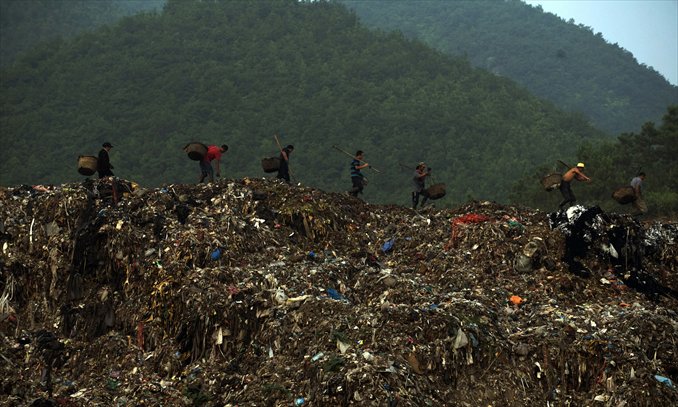
Burying their head in the ground
While awareness about air and water pollution has been growing in China, public consciousness about soil pollution remains lacking. The situation of this underground pollution has been labeled as serious by authorities and experts alike, but the full extent of the problem remains unknown and relevant data is not being made accessible to the public.
Information about a sweeping national survey on soil contamination was even labeled a "State secret" by the Ministry of Environmental Protection in late February. This was in response to a request by Dong Zhengwei, a Beijing lawyer who is urging the ministry to release the survey data.
As the first major effort of its kind, the survey was meant to "get a full picture" of soil pollution nationwide and was launched in 2006 jointly with the Ministry of Land and Resources.
The survey cost 1 billion yuan ($160.9 million) and over 150 scientists took part in the data collection, reported Southern Weekly last December.
Before 2010, the ministry promised publicly that it would release the data as soon as the research was completed but it has remained tight-lipped ever since.
By the end of 2010, over 210,000 samples of soil and farm products had been collected and tested nationwide.
No secret at all
"The ministry's statement is unfounded," Dong Zhengwei told the Global Times in a telephone interview, explaining that soil pollution can affect people's health, and that the public has the right to know about the real situation.
It is a livelihood issue, which is not linked to the country's military or diplomatic affairs, and thus the data has no reason to be a State secret, he added.
Keeping this kind of information secret will only anger people and allow rumors to spread. Without official statistics being released, speculation will run riot about how serious the country is tackling soil pollution, with foreign media likely to stoke the flames, said Dong.
Dismissing the "State secret excuse," Dong thinks it is unwise for the ministry to say this, especially given a later admission in which the ministry said it was waiting on permission from the State Council to release the information.
Unlike air pollution or water pollution which people can feel or see, soil contamination is invisible but equally harmful, jeopardizing crops, food supplies, drinking water and soil quality.
Without knowing about soil contamination, people will not develop the appropriate levels of vigilance and take actions to protect the soil condition around them, lamented Dong.
Uncertain data
Only when serious accidents occur will the media report about the impending disaster, finally grabbing public attention.
Since 2004, emergencies in which construction workers were poisoned by toxic pollutants have often been reported, including in the cities of Beijing, Suzhou and Wuhan, Caijing Magazine reported in June.
Wan Hongfu, a researcher in Guangdong Province, is doubtful as to how accurate the survey would prove to be anyway. The scope of soil tested and the number of samples collected directly affects the final conclusion, said Wan to Southern Weekly, adding that he feels the samples may not have been varied enough.
Another expert, speaking on condition of anonymity, revealed that the total funding for the survey was cut to below the reported 1 billion yuan, affecting the number of samples taken. For example, said Guo, a researcher who took part in the survey, the number of sample sites in Guangdong Province was reduced from the arranged 4,800 to 3,000.
Dong is echoed by Chen Nengchang, a researcher with Guangdong Institute of Eco-environment and Soil Sciences.
"It's just the ministry's excuse, it has nothing to do with secrecy," he told the Global Times. However, Chen recognized the issue was sensitive and was proving challenging for the ministry to tackle.
Once the data is released, it could possibly be misunderstood by the public, Chen pointed out, adding that it is the ministry's job to not only inform the public, but also explain matters well and prevent misunderstandings.
For his part, Chen refuted doubts that the research, having taken five years, was unscientific, and that its results could not represent the real general condition of soil in Chinese mainland.
"It is necessary to know about the overall condition of the mainland's soil. Similar investigations were also practiced in Taiwan as well as in Japan," he added.
Due to its industrialization kick in the 20th century, Japan was bothered by the consequences of polluted soil and took remedial measures to improve soil quality.
As to how seriously polluted Chinese soil could potentially be, Chen declined to comment, explaining that such a conclusion must be made only when in possession of all the facts, and that a wide range of experts have a wide range of estimations.
Chen's vigilance is shared by Song Jing, researcher at the Institute of Soil Science,Chinese Academy of Sciences. He was involved in the survey from 2006 to 2008.
Song also highlights the meaning of the survey, the first one nationwide in the Chinese mainland.
China conducted national soil surveys twice last century, in the late 1950s and the early 1980s, but both were from the perspective of soil resources and agricultural production.
Investigations specific to soil pollution were initiated in the early 1980s, but were limited to certain regions and were not carried out nationwide. Besides, all this research has focused on heavy metals, excluding organic pollutants, pesticides and plasticizers, which have contributed widely to soil pollution due to the speeding-up of industrial development, according to Pan Xiangliang, researcher with Xinjiang Institute of Ecology and Geography under Chinese Academy of Sciences.
"Different surveys have different purposes, and it is these purposes that determine the methods of any specific investigation," said Song. He added that elements of past surveys could still shine a light on soil problems, but that the complete picture provided by the larger survey would be more valuable.
Soil solutions
Currently, the only official statistics available come from Zhou Shengxian, Minister of Environmental Protection.
Generally, the overall outlook for soil quality in China is gloomy. Polluted farmland across the country has reached about 10 million hectares, accounting for 8.3 percent of the total, 120 million hectares, said Zhou in a work report on October 25, 2011, during a session of the Standing Committee of the 11th National People's Congress.
"The data is too out-dated as it has been used since the 1990s," an expert who has access to the ministry told the 21st Century Business Herald.
Investigation results show that farmlands polluted by heavy metals had reached 20 million hectares, accounting for one-sixth of the country's total farmland area, pointed out Luo Xiwen, academician with Chinese Academy of Engineering, according to the report.
The condition is already bad for farmlands but at least the public is already somewhat aware of this. But sadly, this level of awareness does not extend to soil pollution in urban areas.
"Almost all the studies that have been conducted are about farmland pollution, while there has almost nothing released by the government about pollution of urban land," Gao Shengda, editor-in-chief of the China Environmental Remediation website, told the 21st Century Business Herald
At last year's two sessions, the urgent situation was emphasized by Zhou Yikai, an expert on environmental studies.
He warned about the spread of heavy metals, particularly near mines or factories. Zhou advised that a national database of soil quality should be set up, and strategies be elaborated to prevent soil from being further polluted.
A new detailed investigation on soil pollution has been launched, targeting areas presenting high risks to human health and more samples are being collected, according to media reports.
But Song suggests that for agricultural soil, only collecting soil samples is not enough to fully know about the real risks. The properties of soil and crop samples should also be analyzed.
"In some places, soil test results seems fine, but heavy metals such as cadmium can be found in excess amounts in foodstuffs," he said.
He added that the current soil environmental quality standard needs to be revised, taking into consideration the great variety of soil properties and climactic conditions across China.
The Ministry of Environmental Protection did not respond to the Global Times' interview request.
"Information about China's soil contamination has never been exposed before, and once it is, people will inevitably have questions such as if they live within the polluted areas or whether crops are grown on toxic soil," Ma Jun, director with the Institute of Public and Environmental Affairs, told the Legal Daily.
This will prove to be a major challenge for the ministry, but it is still no excuse to refuse to release the survey results, he added.
He even suggested a two-step process where the ministry would disclose basic levels of soil pollution and provide a full explanation about sensitive data which might otherwise trigger widespread concern. "After three to five years of treatment efforts on the soil, the ministry could then expose other information," said Ma.
The General Office of the State Council issued a notice in January about soil condition protection and comprehensive treatment. Their aim is to set up new rules to protect farmland and drinking water sources, aiming to keep the soil condition from worsening until 2015. Then, by 2020, an overall soil environment protection system is expected to be built.