Change at the top
Ambitious reformer Guo Shuqing has stepped down as chairman of the China Securities Regulatory Commission (CSRC) after just 18 months in the position, and with much of his reform agenda unfinished. Stellar resume Guo Shuqing was born in the Inner Mongolia Autonomous Region in August 1956. He was the chairman of the CSRC and secretary of the CSRC Party Committee from October 2011 to March 2013. 
The government has moved Xiao Gang from his position as chairman of Bank of China to become the new head of the CSRC. While Xiao's personal view of the capital market remains unknown, it has been reported that he will stay on course with Guo's existing policies.
The personnel change made Guo the shortest-serving head the CSRC has ever had, and raised questions about how quickly and deeply the new government leaders want to pursue reform of the financial sector.
It is not yet known what Guo's new assignment will be.
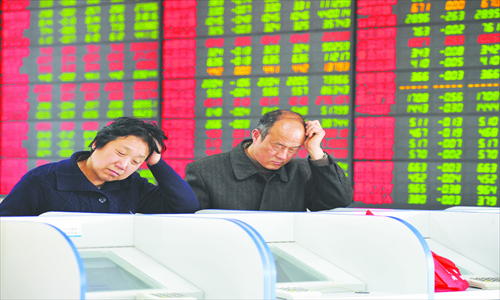
The Shanghai benchmark index was down by 1.68 percent at close of trading Monday, following media reports about the change at the CSRC.
Differing views
Concerns have been expressed about Guo's departure, with some saying that he was a reform pioneer. But others said he had made few achievements, despite his vigorous efforts while at the helm of the CSRC.
China still has a financial market system that is led by the central government, Han Fuling, professor of finance at the Central University of Finance and Economics, was quoted as saying Monday by news portal 163.com.
"Guo's reforms were like a storm sweeping the financial market, impacting commercial banks, State-owned enterprises and institutional investors - especially his new rule on initial public offering (IPO) reviews, which made it difficult for private equity firms to cash in on IPOs," Han said.
After Guo took the reins of the CSRC in October 2011, he tried to tackle insider trading, as well as battling the problem of false financial reporting. He also tried to encourage individual investors to invest in blue chip stocks, improve the delisting mechanism for companies with poor performance, and weed out bad candidates for IPOs.
"He launched bold reform measures, but he did not tackle the major issue," Yuan Guangming, an individual investor with 20 years of experience in the market, told the Global Times Monday.
"The major issue is how to make investors rich," Yuan said, noting that China's A-share market has become a financing paradise but investment hell, with newly listed companies draining funds from the market and causing losses for investors, even amid the success of China's economy.
The stock market has remained weak, despite Guo's efforts. The benchmark Shanghai Composite Index has slid 8 percent since the end of October 2011 when Guo took office, compared with a 21 percent gain in the Dow Jones Industrial Average and a 17 percent gain in the FTSE 100 over the same period.
Nonetheless, Guo has made the Chinese financial markets more dynamic and competitive, and relaxed a few regulations in order to encourage innovation within his short term, Chen Zhiwu, a finance professor at Yale University, said on his Weibo Sunday, noting that Guo has left a profound influence.
Unpopular measures
Stock market reform has entered a "deep water area," facing strong headwinds from vested interest groups and market players, Dong Dengxin, director of the Financial Securities Institute at Wuhan University of Science and Technology, told the Global Times Monday.
Guo had to compromise sometimes when facing opposition from stronger market players. One of his rules was to speed up the delisting of junk shares, but the rule will not come into effect until 2015.
The delisting rule upset many shareholders, and commercial banks are also unhappy to see a company they have supported being kicked out of the market, as there is a high possibility of credit default when a company is delisted. Local governments do not like it either, as listed companies serve as financing vehicles for local projects, as well as providing tax revenue and jobs.
A lack of tough laws had led to rampant insider trading and financial fraud in the capital markets, which forced Guo to tighten administrative reviews of IPOs in order to protect investors' rights. But critics said that the prolonged IPO review procedure led to a backlog of more than 800 firms waiting to get listed.
Guo also tried to introduce more institutional investors into the A-share market. Unlike Western stock markets, where institutional investors play a prominent role, individual investors account for 80 percent of the stock trading volume in China, causing greater volatility.
The sluggish A-share market is still recovering from the bursting of the market bubble in 2007, and is reflective of difficulties in economic restructuring, Dong noted.
Guo began to serve as deputy director-general of the Economic Research Center of the former State Planning Commission in September 1988, and became a member of the Party Committee of the Economic Restructuring Office of the State Council in March 1998.
He was elected as vice governor of Guizhou Province in July 1998.
In March 2001, he was named deputy governor and member of the Party Committee of the People's Bank of China, and then director and Party secretary of the State Administration of Foreign Exchange.
From March 2005, he served in several capacities, including being chairman and Party secretary of the China Construction Bank, and Party secretary of China Cinda Asset Management Co and China Jianyin Investment.
Stock market milestones
Nov 2011 The CSRC issued Requirements for Dividends from GEM Pre-listed Companies.
Nov 2011 Guo declared "zero tolerance on insider trading."
Mar 2012 The CSRC issued a revised version of Sales and Management of the Securities Investment Fund.
Apr 2012 The CSRC issued Guidance on Further Reform of the IPO System.
May 2012 Shanghai and Shenzhen stock exchanges issued pilot methods for private placement bonds for small and medium-sized businesses.
Jun 2012 Shanghai and Shenzhen stock exchanges announced delisting rules.
Oct 2012 The CSRC released Measures for Supervision and Administration of Non-listed Public Companies.
Nov 2012 The Ministry of Finance, the State Administration of Taxation and the CSRC jointly issued the Notice on Issues concerning Implementation of Differential Individual Income Tax Policies on Dividends and Bonuses of Listed Companies.
Dec 2012 The CSRC issued the Notice on Issues concerning Further Reform of the Fund Approval System.
Dec 2012 The CSRC issued Rules for Governance of Securities Companies.
Dec 2012 The CSRC issued Guidelines for Supervising Application Documents and Examination Procedures for Overseas Stock Issuance and Listing of Joint Stock Companies.
Mar 2012 The CSRC issued Interim Provisions on Launching Custody Business of Securities Investment Funds by Non-bank Financial Institutions.
Mar 2013 The CSRC released guidelines for the sale of securities investment funds through third-party e-commerce platforms by institutions.