Pope's inauguration raises hopes of dialogue
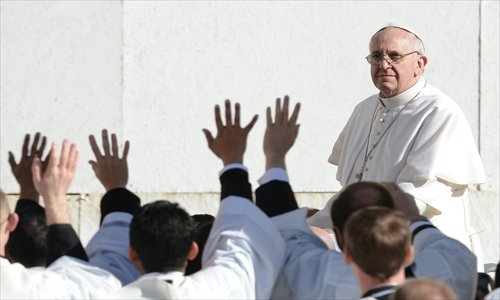
Pope Francis Tuesday was inaugurated in front of mass at St. Peter's Square, as analysts around the world assessed whether his papacy would bring changes to a Church mired in scandals and longstanding disagreements with China.
Around 1 million people were said to be in the square and along the Via della Conciliazione, and 130 world delegations also attended the ceremony. The square was crowded hours before the pope made his appearance.
Media reports have contrasted Pope Francis with Pope Benedict, saying that the new pope has a much warmer and more informal style. This has provided a welcome topic of discussion for the Church given its recent pedophilia and Vatileaks scandals.
"The new pope is expected to bring changes to the Roman Catholic Church and also represents an opportunity to improve the relationship with China," said Zhang Shengjun, a professor of international politics at Beijing Normal University.
"We all remember that Pope Emeritus Benedict sent [Chinese leaders] a greeting and a wish for the Chinese New Year. He publicly expressed this, with a wish for good government for the Chinese people," Fr. Lombardi, a Vatican spokesperson, said when responding to questions from the Global Times asking Vatican opinions about the Chinese leadership transition.
But Lombardi was cautious in his comments, saying that patience is needed to understand the current situation and any rushed evaluation would be out of place.
The Chinese foreign ministry made no comments on Tuesday but said Sunday that China expected the Roman Catholic Church would create conditions favorable to bilateral ties with a flexible and practical attitude.
The ministry has repeatedly urged the Vatican to sever its so-called diplomatic relationship with Taiwan and recognize the government of the People's Republic of China as the sole legal government representing China. But Taiwan leader Ma Ying-jeou's attendance at the ceremony once again stirred up heated controversies.
The Chinese Catholic Patriotic Association was unavailable for comment on Tuesday and some Chinese priests also expressed their reluctance to comment on the Vatican issue.
"Religion has played an increasingly important role in international relations and there's great room for the Vatican and China to cooperate in this field," Zhang said, adding that he is optimistic that the new pope will make changes.
Giving attention to the poor and hope for the future were the key points in the speech.
The pope must "open his arms to protect all of God's people and embrace with tender affection the whole of humanity, especially the poorest, the weakest, the least important," Francis said.
Zhao Yongsheng, a visiting scholar with the Institute of European Studies at the Chinese Academy of Social Sciences, told the Global Times that both China and the Vatican are facing similar challenges in safeguarding the rights of the poor.
"Many Catholics in China have assisted the Chinese government in its reform and opening up, during which people's lives were greatly improved. Though the Vatican is making efforts on the same issue, a lack of improvements and scandals are hurting the Church's authority," Zhao said, adding that choosing a pope from outside the European continent was a grand gesture in terms of opening up the church.
Chen Qijia, a professor on religion research at the Renmin University of China, told the Global Times that the key issue hindering the relationship between the two sides lies in the appointment of bishops from China.
"China insists on anointing bishops on its own, which is against the Vatican's will. Furthermore, the Vatican hasn't shown its willingness for a dialogue on this issue," said Chen, downplaying the prospect of a immediate revival in relations between the two nations.