Twits on the grasslands
The results of a straw poll among my friends about the idea of traveling to Mongolia were evenly divided in two camps. The first was an uncomprehending look followed by various surprised grunts. For these sad, unadventurous milquetoasts, Mongolia is a country one simply never contemplates going to, not because of danger but because of remoteness. The second was an outburst of excitement and encouragement. For these intrepid and audacious souls, Mongolia represents one of the boundaries of travel, a civilization that echoes through history and one of nature's wildest redoubts.
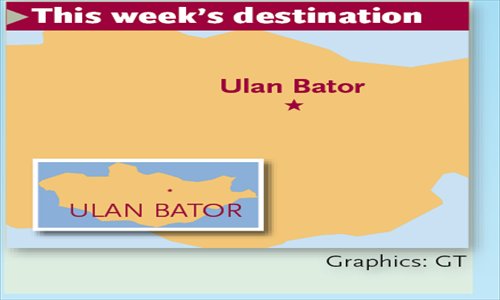
As my worthy American friend Liz and I chugged out of Ulan Bator in a rickety Russian minivan, accompanied by our guide Bolor and driver Arban, we passed the various stages of Mongolian urbanization. From the city's few fully built-up streets, we passed through shantytowns of corrugated iron, then slums of yurts housing the latest arrivals to the capital, then entered the grasslands.
Out on the plain
I know of no accurate way to convey the immensity and otherworldliness of the steppe. Thousands of miles of plains, dotted with the odd mountain range, sweep from the shores of Lake Baikal to the Gobi Desert. We were seduced not two hours after leaving the fairly nondescript Ulan Bator, in which we were told to stock up on essentials such as bottled water, snacks, and medical supplies. While there are towns of a few hundred people scattered across the Mongolian grasslands, they are few and far between, and a breakdown can see you stranded for a while.
We had arranged for an eight-day drive through central and western Mongolia. Our guide spoke functional English and was in charge of arranging our stays with various families along the way. When traveling in rural Mongolia, if you see a homestead with two yurts, one of them is set aside for guests. Park your vehicle some distance away, announce yourself by shouting "Nokhoi khorioroi" (Call off the dogs!) and proceed slowly to the door. That call is not a mere tradition, Mongolian farms deal with a number of wild animals and often own huge mastiffs which tourists are advised not to try and pet.
Ancient remains of an empire
Our first stop was near the ancient fortress of Karakorum, 400 kilometers west of Ulan Bator, the base from which Genghis Khan invaded China's Central Plains. Little remains of the fortress today, apart from a few sculptures and bas-reliefs, but the temple of Erdene Zuu stands watch nearby as a worthy guardian. The temple is surrounded by a wall of large, gleaming white stupas which stretch away across the plain. We stopped off at a rest camp nearby and approached Erdene Zuu near sunset, the dying rays lengthening our shadows along the road. Absolute silence reigned, and as the wind blew, a feeling of eerie wonder came over us at our first glimpse of the history of the ancient Mongols.
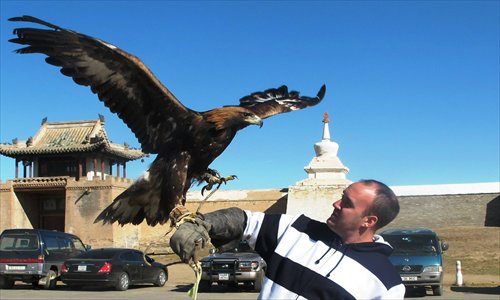
Near the temple, we visited a small market, where we spotted a woman standing over a golden eagle tethered to a log. As Liz approached to take a picture, the woman motioned to ask us if we wanted to hold it. Eagles are used in Mongolia for hunting, from rabbits to wolves, so it wasn't clear to us if it was entirely safe, but we jumped at the chance. After slipping on a thick felt sleeve, the woman lifted the eagle onto my arm. Having a very heavy raptor eyeballing you not an arm's length away is at once an awe-inspiring and pant-wetting experience. As I tried my best to keep its weight up, the woman made a signal at which the eagle deployed its wings and flapped them. I want to believe the sound I made was one of defiance and respect for the beast. I was assured by Liz it was more a mew of fright and alarm. She clearly lies.
The next day, we trekked on for a couple of hours into Arkhangai Province, stopping off briefly in the provincial capital of Tsetserleg, an endearingly quaint collection of pre-fabricated houses with multicolored roofs and yurts nestled under a large mountain. Driving out from there, we were truly in the grasslands, hundreds of miles away from any real city, though we were enrapt. The geographic diversity of Mongolia is stunning. Suddenly, Arban veered off the main road, down a little wooded lane, and we asked Bolor where we were going. He turned and pointed, simply saying, "Canyon."
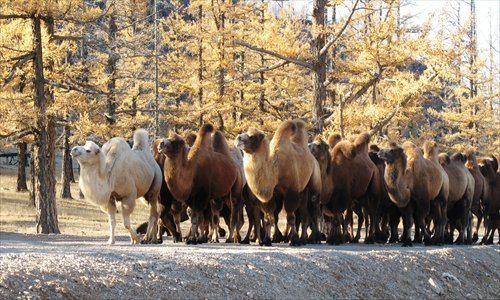
Bolor did not lie. For my first canyon, I was suitably impressed. Tearing the landscape in two, a river rushing through at its bottom, this canyon was dotted with little groups of yurts on its rim, families having set up home near the water source. We had heard much about the Mongolian predilection for yak, but the local herds were all of camels, a fact we discovered at the canyon when a lone herder on horseback rode past us, shepherding about 50 camels down the path to some unknown pasture.
Bunking with locals
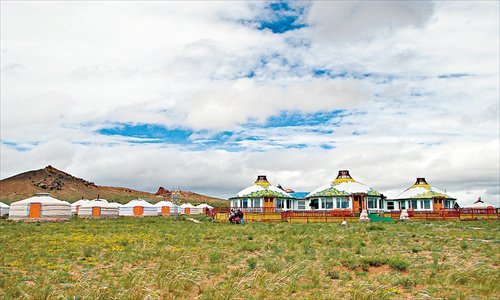
On our third day out, we reached the scenic Terkh White Lake where we were to stay for three nights with a family. A habitual stop-off for travelers, four yurts were lined up near the lake, while the family lived in another yurt on an elevated platform which also served as a look-out point. From the door of our yurt was a scene of breathtaking beauty. The Terkh White Lake is nestled between mountains, two of which run right down to its shores. Our camp was in a semi-circular plain caught between mountain and lakeside, with only one road leading away. The family's herd of yaks was dotted across the plain, with the dung of the living and the bones of the dead both crunching underfoot.
However, the wind whipping in off the lake coupled with our doubtful decision to visit Mongolia in October brings me to the only real hardship we had to endure. The temperature fell to -20 C at night, and Liz and I took turns waking every couple of hours to stoke the wood stove that takes up the middle of each yurt. We had cut up a ready supply of firewood before going to bed, but still, leaving our sleeping bags even when covered in seven or eight layers of clothing seemed a heroic task, one which Liz took to much more willingly and much less bitchily than I did.
Dinner had been a meat-eater's delight and the preparation was a revelation. The mother of the family placed some dried yak dung in the fire and added smooth rocks. Once they were heated, the red-hot stones were placed in a large cooking pot to which were added fresh chunks of yak and mutton. These would cook in the heat radiating off the stones. Once ready, the pot was placed in the middle of the table for us to eat with our hands, the delicious mutton coming right off the bone. Thick mutton dumplings called khushuur were also on hand with potatoes and carrots the only nod toward a balanced diet. This may seem like overly simple fare, but it was absolute perfection.
Call of the wild
The next morning, Liz and I took a walk to the lakeside for a spot of photography. When we turned back toward the camp, two of the local pack of mastiffs were loping toward us slowly, heads down. After a moment of worry, we stood our ground only to see them run up to us happily, wagging their tails. It turns out these huge dogs just wanted some affection, and they became our constant companions during our stay there. One of them was clearly hurt, half of its jaw ripped off and oozing pus. When we asked Bolor what had happened, he pointed to the mountain behind us and said: "Wolves." We felt slightly bad for nicknaming such beasts Serena and Fluffles, but the names stuck.
The next day saw Bolor and one of the family's sons meet us outside the yurt with horses, ready to take us for a ride to a nearby inactive volcano called Khorgo. This escapade again helped reinforce why Mongolia is a destination like few others. Accompanied by wolf-killing dogs, we rode slowly across a field of volcanic rock and ascended a steep path to the rim before clambering down jagged rocks into the wide crater upon being encouraged by Bolor. Had we been seriously hurt at any point, we would have been in real trouble, likely needing to be rescued by helicopter.
Heading back to the camp, we saw that another van had arrived. A curious figure sat next to one of the yurts, surrounded by the family and some of the neighbors. Dressed in traditional Mongolian garb, the man also sported a shawl of fur straps and reindeer-skin boots. He soon donned a mask and headdress, made of strips of black and yellow cloth, topped with a circlet of eagle feathers. Bolor told us this was a shaman who had been asked to come to read the fortunes of the local families and help cure their illnesses. We asked if we could also consult with the shaman, who agreed, although not without some initial reluctance. When my turn came, he made me kneel before him and bow deeply. Placing his head above mine, he alternated between feeling the back of my skull and hitting various spots on my back, sometimes quite strongly. He made a series of observations in a guttural voice which Bolor, crouching next to us, translated. According to the shaman, I was to forge an enduring connection with Mongolia, one that would last my entire life and see me return.
I don't know if I believe in shamanistic rituals, but after spending just over a week in a land that seems to have remained largely unchanged for a millennia - except for the odd motorbike or battery-powered tool - I concede he may have had a point.
Rules of Thumb
Why go? Mongolia is a rapidly changing country. This long-ignored land is now grabbing the attention of people around the world, and investments are pouring in. Although its culture will withstand the influx of guests, visiting the country in the next couple of years is advisable as mass tourism cannot be far behind.
When to go? Mongolia is cold for many months. From mid-September to early May, the weather makes many parts of the country troublesome, especially after November, when travel is inadvisable. The best period is July, when the Naadam festival sees Mongolians around the country engage in traditional sports such as archery and wrestling. Book early if you want to attend the major Naadam festivities in Ulan Bator, as tickets go very fast.