NLD eyes win in 2015 election
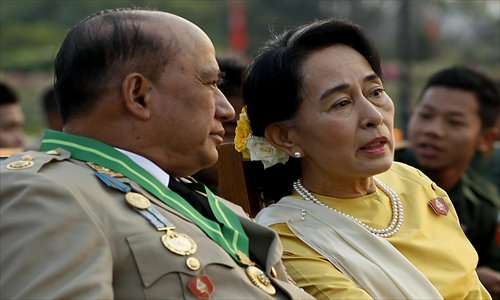
Myanmar's parliament last week approved a motion to set up a committee to review the 2008 constitution, a move that could become the first step to seeing opposition leader Aung San Suu Kyi contest the presidency in the next election.
The constitution, drafted under the previous military government, effectively bars Suu Kyi from running for president as it stipulates that any candidates whose spouses or children are citizens of a foreign country will be disqualified for presidency. Suu Kyi's late husband Michael Aris and their two sons are British.
Suu Kyi's National League for Democracy party (NLD) saw a resurgence recently after it was re-registered as a political party in January 2012. The party was declared dissolved in September 2010 for failing to register in accordance with the election laws, but Suu Kyi managed to win a seat in Myanmar's lower house of parliament in April 2002.
However, analysts said the opposition leader has to first address severe challenges posed by her aging and disorganized party and people's doubts over the NLD's ability to govern the country.
High expectations
The NLD held a landmark congress between March 8 and 10 in which Suu Kyi was re-elected as party chief. The NLD used the conference as a major step to prepare for the 2015 presidential election by injecting fresh blood into the party's leadership and strengthening unity in the NLD.
The congress was not open to reporters and few reports about the meeting were seen in Myanmar's official media.
But with new media rules set to come into effect on April 1, more private newspapers are going to be published in Myanmar and the NLD will definitely win more public attention, an executive of a Myanmar media outlet who asked not to be named told the Global Times.
There is growing public sentiment in Myanmar that a different party should come to power.
"Even some Chinese in Myanmar also wanted Suu Kyi to be elected as president in 2015 because they think she will be more impartial compared to the military government," Yang Yourong, secretary-general of the Chinese Mutual Help Association in Myanmar, told the Global Times.
Grave challenges
But analysts said that to win the 2015 presidential election, Suu Kyi and her NLD party have to first rejuvenate a leadership that is dominated by elderly activists who do not have much governing experience.
Simon Langbroek, head of the Consortium of Dutch NGOs in Myanmar, told the Global Times that one major reason why the NLD's congress was not open to reporters is that major differences remain between the younger and older generations of the party.
The biggest problem for the NLD is that it does not have enough reserves of talent, and some of its leaders had been kept in the prison for a long time and therefore do not have a good understanding of modern governance.
Khin Zaw Win, director of Yangon's Tampadipa Institute, told the Global Times that the priority for Suu Kyi is to rebuild the NLD's internal structure and reset the party's policies and principles, as the NLD is said to be very loosely organized and unable to even confirm how many members it has.
More importantly, many local NLD leaders in Myanmar were appointed directly by Suu Kyi but were unable to win support from locals, Zaw Win noted.
Practical strategy
However, Suu Kyi is now undergoing a pivotal stage in her career, from a democracy icon opposing the junta to a modern politician and opposition party leader. Such a change has led to increasing criticism and doubts over the Nobel laureate.
Suu Kyi is accused of keeping silence over the Rohingya issue and also faced with a backlash for her engagement with the military.
One NLD member who asked not to be named told the Global Times that some party members think the NLD should stick to its usual policies, but Suu Kyi prefers a more practical strategy.
When NLD parliament members were sworn into office last year, they refused to take the oath of loyalty to Myanmar's current constitution before some of its items were revised, he said. But they finally made compromises because Suu Kyi knows that reforms cannot be achieved overnight, the NLD member added.
Suu Kyi said what she seeks is not "retributive justice" but South African-style "restorative justice," which could contribute to Myanmar's national reconciliation.
Li Ning and agencies contributed to this story