Backwaters of Malaysia
For being perhaps the most developed country in Southeast Asia and after desperately selling itself as being "Truly Asia," Malaysia is still overlooked by travelers to the region. Tourists wrongfully believe that it does not have the fun factor of Thailand, the historical value of Cambodia or the raw natural beauty of Vietnam. I would argue that it can not only match the best that its neighbors offer but adds an unrivaled multicultural twist.
An early morning jaunt through the streets of Kuala Lumpur, one of the true crossroads of humanity, will turn up scenes straight out of a Graham Greene novel: Chinese stalls entice you to try strange but alluring culinary mixtures, authentic Indian restaurants stand surrounded by rainbow sari shops and Bollywood stores, while nearby a mosque plays the call to prayer as the smell of freshly baked loaves wafts over the street.
Yet, this seeming microcosm of Asia takes place in a hyper-modern setting where almost everyone speaks English. Yet many tick Kuala Lumpur off the list in a couple of days and use it as a convenient base to rally the old charm of Malacca, the beaches of Langkawi or to climb Mount Kinabalu on Borneo. I will not explore the attributes of Malaysia that the country's tourism bureau puts forward.
Lay of the land
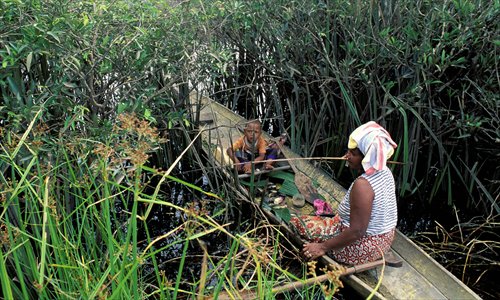
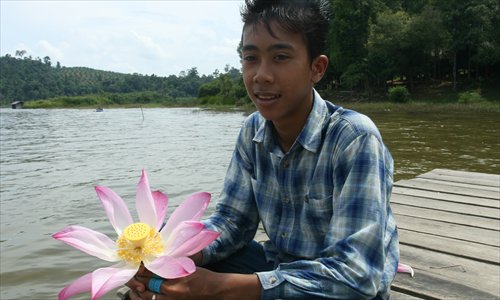
Let me take you to a quiet backwater, a lake nestled at the edge of a southern finger of the oldest jungle in the world, which spreads out from the Taman Negara National Park. Lake Chini, Malaysia's second-largest freshwater lake is really a string of 12 inter-connected lakes that flow into the Pahang River. With the jungle right on its shores, freshwater in abundance and the beauty of the lotus flowers that float on its surface, it is no wonder Chini was a target for settlers and conquerors early on.
If you talk to the Orang Asli, the indigenous people who remain dotted along its shores, they will tell you that Chini was the southernmost tip of the Khmer Empire (802-1431) that spread from Cambodia to old Malaya in the 12th century. Legends tell that an ancient Khmer city was flooded by its inhabitants to stave off invasion. It sank beneath the waters and still lies in some hidden depths of Lake Chini. Archaeologists have never found it, but perhaps the glittering remains of the Khmer Empire will one day add to the area's growing renown.
Driving to Chini by car is done through groves of palm trees, as many families live on one of Malaysia's prime economic resources, palm oil. The shouts of local kids may draw your eyes to a strange spectacle as teenagers engage in feats of ridiculous athleticism to spin-kick a small ball over a high net, without ever letting it touch the ground. This high-octane cross between soccer and volleyball is sepak takraw, played across Southeast Asia and featured prominently in the Asian Games. It may never make it to the Olympics but if you come across it, stop a while as it is truly mesmerizing to watch.
Setting off for adventure
We reached Lake Chini at dusk and found accommodation in a very small bungalow camp along the shore. We eschewed the recently built Lake Chini Resort for being outrageously expensive. Reviews I have read since then overwhelmingly say we made the right choice. What was meant to be a quiet evening on the lakeside turned out to be a raucous affair of barbecue and beer after the hotel owners decided to cook for us. Now, Malaysia is still an Islamic country and beer is not easy to find everywhere. Our group formed search parties that left to the north, east and south tasked with finding enough brews to continue the evening. This was partly successful after my group convinced a local grocer to sell us the two crates of Tiger he had stashed in the back. His disapproving scowl was tempered by the obvious query as to why he had beer in the back of his shop in the first place.
We bunked down with the local Orang Asli family, along with a variety of mosquitoes, flying ants and dogs (woe to those who run short of bug repellent) to awake to a cacophony of nature. The jungle runs up the shores of Lake Chini, and it came alive with sunup. The plan for the day was a boat trip across the lotus-covered lake itself and then a guided walk through the jungle.
We boarded a small eight-seater motorboat that by its sleekness and cleanliness was clearly the pride of the family. The bungalows were not their main selling point and they knew it. Their capacity to attract tourists was solely dependent on their ability to lead tours around Chini, and the way they maintained this boat showed their almighty reliance upon it. As it was early in the season, the lotus flowers had not finished blooming, but we could see their red petals beginning to peak above the surface or even blossoming under the water. When the sun hits at the right angle, the underwater flowers have the effect of turning the water a translucent red, adding to the ethereal feel.
Jungle journey
Our jungle hike was to be led by a very unlikely character. Anand was a rake-thin, elegant 50-something man, tailored with a button-down shirt, smart slacks, white socks and plimsolls. His explanation was that he saw no reason to dismiss his personal grooming habits just because he was in the jungle. The tracker, accompanying us with machete and dog to ward off any animals, looked much more the part. Taman Negara is still home to the Malayan tiger, the sun bear, leopards and boar, so we were grateful for the protection.
Although we didn't see any of these predators, not an hour into the walk did Anand pull us up short to point at a shallow depression in the earth. Crouching beside it, Anand declared this to be a tiger dung pit, where a Malayan tiger had done its business and overturned the earth to disguise the scent within the last day. The dog ferreted about curiously for a bit, and, while we had utter faith in its capacity to ward off the odd macaque monkey, we were less optimistic if it had to stare down a tiger.
Anand proved to be an encyclopedia in the jungle but had an odd attitude of showing his love for it. We asked him whether there were any freshwater sources for those living in the jungle outside of the lake. Anand smiled and gestured toward a small palm tree. Our tracker strode up to it and slashed the tree to the ground with a few sharp machete strikes. Seeing us slightly stunned at the fact that a simple question had seen a tree chopped down, Anand assured us this was a regular action for the thirsty jungle-dweller. The tracker chopped open the heart of the palm just under the crown to reveal a mass of soft, white tendrils just under the bark. Slicing some out for us, Anand demonstrated that these were full of rainwater that could be drunk as if from a straw before eating the delicious palm heart itself.
Continuing on, the jungle began to feel almost oppressive, the tracker hacking down vegetation as we passed while we made our way across rickety wooden slats over dark rivers. The scenery was beautiful but the constant tree cover and the occasional bout of rain made sure this was no casual walk. Meanwhile, the dog was having the time of its life, vanishing and reappearing suddenly far ahead or behind us.
Suddenly, we heard it begin to bark very loudly off the path to our left. Fearing it had been attacked, the tracker called to it but the barking simply continued for minutes on end. Anand advised us to turn back in case a predator was nearby when the barking was cut short with a sharp yelp. The dog slunk back through the undergrowth, looking somewhat confused and in pain. The tracker bent down and laughed, seeing a number of sharp quills sticking out of the dog's neck. It was no tiger or boar that had worried us, but our faithful hound's inquisitiveness had led it to brush up against that much smaller of jungle creatures, the porcupine.
Rules of Thumb
Why go: Malaysia's convenient location is bringing more and more tourists wishing to explore it. Lake Chini has now been discovered, and although tourist numbers remain comparatively low, it is worth knowing visitors may not have the lake to themselves much longer.
When to go: Malaysia is a tropical country with the usual dry and wet seasons. However, try to hit up Lake Chini in August or September when the lotus flowers are in full bloom. It really does ratchet up the area's charm.
Safety: The jungle around Lake Chini is still ... a jungle. Stay on marked trails at all times, wear high white socks to avoid leeches and to allow other people to spot them as they crawl up your legs. Malaria is becoming less of an issue in Malaysia and while many choose to eschew anti-malarial tablets, mosquito nets by night and healthy doses of repellent by day are an absolute must.