Do not put famous people on a pedestal
Liu Yang, China's first female astronaut who participated in the Shenzhou 9 space mission last year, was in the public spotlight again this week after a government official from her hometown sent her a passionate poem and dispatched a special team to ensure she had a constant power supply during her short visit in Anyang, Henan Province, during the recent Tomb Sweeping Festival.
The 3,000-word poem, written by a local member of China Writer's Association, was originally published on the local government's website on April 4 before it spread far and wide online. The part that was widely quoted and criticized as flattery was, "Yangyang, you smile to your parents, the national flag, the country's mountains and rivers and the center of the universe; your passion silently cries 'I am going up into the sky.'"
The Anyang Party secretary and mayor even went to the railway station to welcome Liu, and then the government organized a team to replace damaged wires outside her house and standby to guarantee the power supply during her stay.
The public condemned the local government of coddling so-called famous people for the sake of the city's image, ignoring the interests of ordinary residents. The media immediately revealed that some Anyang residents who petitioned at Tiananmen Square on April 1 were escorted back and punished, and the Anyang Party secretary was sacked for "seriously violating discipline" just three days after he welcomed Liu.
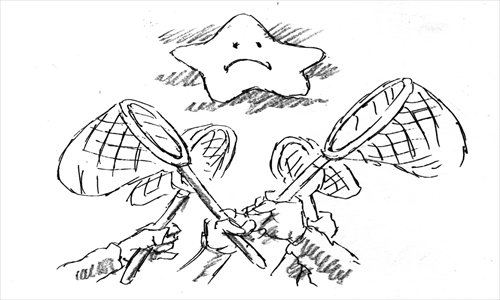
Absolutely, the government overreacted in welcome Liu, but favoring famous people is not just something the government does in China. Actually, the whole country is immersed in the insane worship of famous people.
The media plays a key role. A journalist wrote a very poetic and passionate story about Liu coming back to her hometown, rather than a plain news article. The whole story seemed to regard Liu as a divine being, and expressed the great pride of the whole city to have her back.
Sometimes the media even makes false claims, calling Chinese-Americans "China's pride." For example, the 2008 winner of the Nobel Prize for chemistry, Roger Yonchien Tsien, best known as Qian Yongjian in China, had to clarify that his nationality was American after Chinese media wrote that he was the nephew of Qian Xuesen, the father of China's rocketry program, misleading the public into believing he was Chinese.
You can just imagine how the public treat one of the real Chinese Nobel prize winners. Mo Yan, who won the Nobel Prize for literature in 2012, appealed to the public last week to leave his house and family alone. His house in Gaomi, Shandong Province, is now a famous scenic spot. Many tourists took away bricks, hoping to get some luck from them.
Nothing can really stop Chinese from worshipping famous people. When we cannot get close to them, we copy their style. The copycatting of clothes and bags of China's first lady at online shops is a good example of this.
Look at what we have done to famous people. Liu Yang has suddenly became a target by accepting an officials' present. Mo Yan's ordinary life was disturbed. If we cannot stop doing it, more innocent people will get hurt. Please leave the famous people alone!