Ancient legends provide new insights into Sino-Indian oceanic rivalry
The relationship between China and India has veered between rivalry and friendship since both countries emerged as modern states.
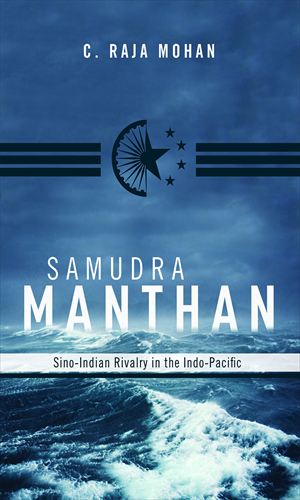
Today the oceans, not historically a strength of either nation, are the focus of rivalries and insecurities between the two. In his Samudra Manthan: Sino-Indian Rivalry in the Indo-Pacific (Carnegie Endowment for International Peace, 2012), C. Raja Mohan, a senior Indian strategist, commentator, and professor, dives into the waters of a relationship that will shape the region's future.
Mohan sees similarities in both Asian powers' pursuit of modern sea power. Traditionally continental states, structural and ideological factors continued to push them away from sea power until the 1980s. Since then, however, an increased dependence upon maritime traffic, combined with an acute awareness of perilous energy security driven by mass industrialization, has pushed both states toward a new naval expansion.
Both militaries, too, have been deeply influenced by the 19th century US theorist Alfred Thayer Mahan's advocacy of sea power, once a critical factor in causing his homeland to turn to the oceans. With external trade now a keystone of power and influence in both India and China, the need for an active naval role is stronger than ever.
Mohan provides a detailed analysis of naval expansion and technology on both sides, putting moves such as the Chinese quest for an aircraft carrier into institutional and global context. He looks, too, at the wider strategic goals, such as India's quest to remake itself into a significant Pacific power, rather than one limited only to its neighboring seas.
In a parallel chapter, he highlights China's ambitions in the Indian Ocean, previously seen by India as its natural backyard. The scope of both powers' naval reach, he notes, is creating new tensions and rivalries, but also new opportunities for cooperation.
In his suggestions for tackling these security dilemmas, Mohan points to the self-reinforcing cycle of India's perceptions of Chinese naval threat, which in turn fuel anti-Indian sentiment in China. Both sides hypothesize worst-case scenarios of the other's possible actions, fueling a vicious circle of rivalry.
Mohan hypothesizes three futures for the Indo-Pacific: cooperative security, a concert of great powers that maintains order, or the always dangerous great-power rivalry.
Finally, Mohan turns to the story of the Samudra Manthan, the Indian tale of the rivalry between the gods and demons for control of ambrosia. The tale turns on the actions of a third party, the all-powerful Vishnu.
Mohan uses this tale to point to the key role of the US, the Vishnu of this analogy, in this Sino-Indian rivalry.
Ultimately, Mohan argues, the future of the region will depend not only on the two Asian powers, but on US policies. It is, in his words, "a story…that has barely begun" and that will "test the political sagacity and strategic judgment of the leaders in Washington, Beijing, and New Delhi in the coming decade."