Holiday in Bahrain

When I first informed my Chinese friends that my next stop from Abu Dhabi, capital of the United Arab Emirates, was Bahrain, I was met with dubious expressions and questions of the practicality of flying "that far" for what would be only a short three-day stay.
"I'm not going to Bali (Paris). I'm going to Balin (Bahrain)," I stressed. It would be my last stop on an eight-day business trip in February. "It's only an hour flight from Abu Dhabi."
Well, they can be forgiven for their ignorance of this Gulf state. While streams of Chinese tourists have made it to the metropolises of Dubai and Abu Dhabi, Bahrain, with over 90 percent of its land covered in sand, is far less appealing as a tourist destination despite its rich culture.
After gathering as much information as possible from the Internet as well as advice from friends living in the UAE, my colleagues and I ventured to the country with a rough three-day itinerary. Between work obligations, we squeezed in our travel plans and made the most of our time there. By the end of our short stay, we not only experienced the rich Arabic heritage that Dubai lacks and visited natural landmarks characterizing the country's long history, but also got a glimpse of the burgeoning, lively entertainment scene that help tourists relax.
Getting to know the country
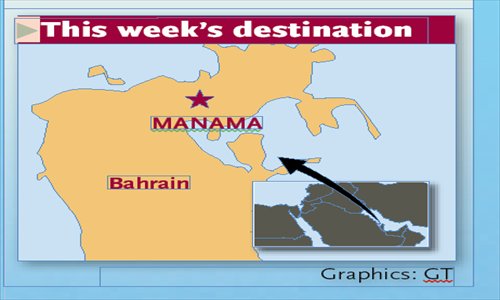
Located close to the Persian Gulf and east of Saudi Arabia, the Kingdom of Bahrain is an island country consisting of 33 islands. Bahrain means "two seas" in Arabic, referring to the natural springs rising from beneath the ocean which were used by the country's pearl divers when pearling was once the major source of income for locals.
Bahrain made headlines in 1932 when the first oil well in the Middle East was discovered in the country. The profits from the oil then propelled it to become the most developed country in the Gulf region. Now the oil is running out and the country's economy is being converted into banking and investment sectors.
Bahrain became the focus of world media two years ago when Shiite protesters clashed with the police of the Sunni-ruled government in the wake of the Arab Spring. The protest led to the death of a teenage boy who was shot accidently by police. Since then, protests have become recurrent and safety has become a big concern for many travelers.
We were there during the second anniversary of the uprising, and it was said there would be a large demonstration in the countryside not far from the capital city of Manama. Expecting a tense atmosphere before the demonstration, we were surprised to find relaxed city life and worry-free urbanites. It is absolutely safe for tourists, as we were assured by locals later on.
During the drive from the airport to downtown Manama, we were a bit disappointed that the glamor we saw in Dubai was gone. In its place were a plain desert and disorderly construction sites. In the city center, amid a few high-rise structures, a large part of the city is scattered with buildings that are decades old. But, as we learned before coming, modern Bahrain, which has undergone a series of social and political reforms since 2001, has grown into a more open and liberal place than the UAE or Saudi Arabia.
Alcohol is legal here, and locals are more approachable and friendly with visitors. In addition, Islam is not practiced as strictly as it is in Saudi Arabia. While taxi drivers in Dubai are almost all expatriates from countries like India, Pakistan and Bangladesh, the first taxi driver we met was a Saudi Arabian and the last one was a Bahraini, ending any stereotypes we had of a highly hierarchical society in which Bahrainis, like Emiratis, do not take menial jobs.
Cultural heritage
The earliest archeological relics of Bahrain date back 50,000 years ago. The country, at times ruled by Sumerians, Babylonians, Persians and Portuguese, still maintains its fair share of cultural heritage.
The Ahmed Al-Fateh Mosque, or the Grand Mosque, is the largest mosque in Manama, and one of the few that are open to tourists. In addition to being fascinated by the fine structure, we were taken in by the warmth our volunteer tour guide showed us, and her devotion to her religion made us extend our one-hour stay to almost three hours.
Located in Juffair, a neighborhood in Manama, the mosque can accommodate over 7,000 worshippers. Construction of the mosque began in 1984, and it opened to the public in 1988.
Using materials from different countries, the Grand Mosque has the world's largest fiberglass dome. The floors are covered with Italian marble and a greenish carpet from Scotland. The large chandelier hanging from the dome was made in Austria and is surrounded by handblown glass lamps made by French artisans. In addition to the flowery patterns of the dome, geometric shapes and patterns can be seen almost everywhere in the mosque, from the marble floors, to the carpet, to the teakwood doors.
When it is not in use for prayer, visitors can sit inside the hall for as long as they like. Our female guide, originally from Pakistan, not only sat down with us on the carpet and patiently answered our questions on points of the religion, like polygamy and veiled women, but also happily chanted the opening paragraphs of the Koran, before a large crowd of German visitors entered the prayer hall.
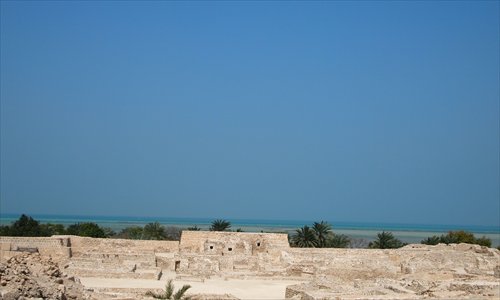
About a 30-minute drive from the mosque to the northern coast of Bahrain is the famous Qal'at al-Bahrain, or Bahrain Fort, and it sits atop an artificial mound.
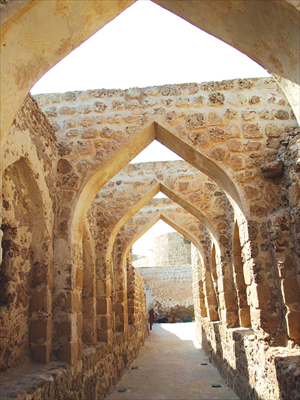
The medieval fortress was built under the order of the Portuguese in the 1500s, when they invaded Bahrain for its key position in protecting their trade routes in the region. Used mainly for military purposes back then, the outline of the military fortress is easy to make out among the preserved standing structures.
The 12-meter-high mound under the fort has undergone a series of excavations since the 1950s and was found to be the site of the capital of ancient Dilmun, dating back to 2300 BC, and contains seven stratified layers. Now a UNESCO World Heritage Site, about one-quarter of the structure has been unearthed, revealing residential structures and commercial and religious areas.
The tree, the well and the bridge.
Any trip to Bahrain must include three sites: the tree, the well and the bridge.
The tree refers to the Tree of Life, a single tree standing alone in the desert; the well refers to the first well in Bahrain that produced oil; the bridge is the King Fahd Causeway connecting Bahrain and Saudi Arabia. Though the three "must-sees" sounded exotic even to plenty of the locals we encountered, we nevertheless went ahead on our tight schedule.
The first well that pumped oil in the Middle East is preserved alongside running oil infrastructure in the desert. A stone tablet describes its significance and an oil museum has been built nearby. Unfortunately, the day we went, the museum was not open because the door keeper was away.
The well is nothing significant from its appearance, but to Bahrainis, it is the turning point in their history. With the discovery of oil, most people were able to lead a comfortable life, giving up the traditional and laborious pearl diving business.
After seeing the well, we drove further south to locate the mysterious tree. The Tree of Life is a particular specimen growing in the desert in the middle of Bahrain amid oil wells. Although it is labeled on almost every Bahrain guide or map, few give exact directions on how to get there. Without GPS in our car, we were nearly lost in the extensive desert and almost gave up halfway.
We did eventually find the tree under the scorching sun, and we were excited to find that two American tourists had also made the same tedious trip. Standing alone in the desert, the tree flourishes with robust branches and green leaves. A straw shed has been put up a few meters away, which we assumed was built as a reward for tourists who travel a long way there.
Legend has it that the tree is from Eden. Modern sources say it is a mesquite tree, commonly found in the desert. This type of plant, with its narrow, bipinnate leaves, is drought-tolerant and can draw water with its long taproot that goes as deep as 58 meters.
The causeway, a series of bridges that opened in 1986 after more than 20 years of construction, is the easiest of the three spots to travel to. It has become a vital bond between Bahrain and Saudi Arabia.
Along the 25-kilometer causeway, we saw the pleasant oceanic views off the coast of the Gulf of Bahrain. With an average of 52,450 passengers a day, traffic jams are likely to occur as people in Saudi Arabia travel to a more liberal place for relaxation. Security checkpoints are installed at the border, and we all agreed that travelers leaving Bahrain did so out of curiosity for the comparatively mysterious Saudi Arabia, where women travelers are allowed to enter only in the company of a male relative, husband, or local male sponsor.
Rules of Thumb
When to go: Bahrain features a tropical desert climate, and tourists are advised to stay away from the hot summer months, from early June to mid-September when the temperature can reach as high as 45 degrees. The weather in spring and fall is amicable and spring is also the perfect season for dolphin watching in the sea.
Where to stay: There is accommodation for various budgets in Manama and other regions in the country. Hotel booking websites such as booking.com offer a wide range of selections. Manama also has a very active online couchsurfing community. Members in the capital city gather almost every week and are happy to show tourists around.
Safety: Demonstrations and protests occur regularly in suburban areas with tires being burnt, and streets might be blocked up when they are about to take place. Tourists are advised to stay away from these events and should not take photos of participants, especially of women and children as this can get you into trouble.