Unearthing a sordid past
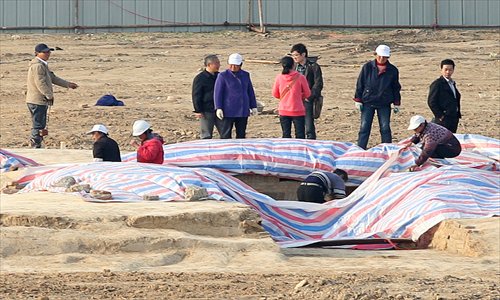
The ancient ruins of two tombs were discovered in Yangzhou of east China's Jiangsu Province, one of which has been confirmed to be the tomb of Yang Guang, also known as the Suiyang Emperor.
Yang was the second emperor of China's Sui Dynasty (581-618), ruling from 606 to 618. Yangzhou City Administration of Cultural Heritage held a press conference to release this great archeological discovery last Sunday.
The archeological work has not yet been completed as only one of the two tombs has thus far been fully excavated.
Located in Yangzhou's Hanjiang district, the tombs cover an estimated 20 to 30 square meters. They were described as "small to medium" in size, yet many precious heritages were found in the excavated tomb, including a tombstone discovered at the south end of the whole mausoleum.
The stone marker is seen as essential evidence in identifying the owner of the tomb. Although the carved characters are not all clear, experts are able to see the name and the year of death on the gravestone. It reads "daye 14 nian," equivalent to the year 618, the same year that Yang Guang died based on the existing historical records.
According to Shu Jiaping, director of Yangzhou heritage and archeology research institute, the structure of the reviewed tomb was 4.98 meters long and 5.88 meters wide and includes three main parts: the main coffin chamber, adjacent rooms, and tomb passages. In the tomb, archeologists also discovered a dozen items of pottery.
Other important evidence that can identify the owner of the tombs includes four gilded copper door knockers in the shape of animal heads and a gilded jade belt.
Shu said during the press conference that these treasures prove the owner of the tomb was not merely some government official, but that his status was very high.
There are no ruins of human bones or coffins found in the tomb. Shu explained that Yangzhou is a warm and humid place, which decomposes wood easily. The case of the tomb of Guangling Emperor in Han Dynasty (206BC-220AD) is not comparable because Guangling Emperor used the best wood for a coffin to last longer. Also, the tombs have been robbed and damaged throughout the years, so they are not in their original condition.
Suiyang Emperor is a controversial figure in Chinese history. He has many important historical accomplishments, including the completion of the Grand Canal and the creation of jinshike, an imperial examination system to select civil administration officials.
However, his several large construction projects (ships, roads, palaces and the Grand Canal), created a huge tax burden and his lavish lifestyle, especially during his late reign, proved disastrous for his people.
He was considered a tyrant and his government's bankruptcy resulted in the fall of the Sui Empire. Yang spent his last days in Jiangdu, where he was strangled to death by a high ranking general. The Sui Dynasty ended that same year (AD 618).
Zhou Xueying, a professor at Nanjing University History Department, told the Global Times that Suiyang's early reign made many positive contributions to Chinese history, especially his military expeditions, which helped unite the country.
Before this new discovery, the huge mausoleum (30,000 square meters) in Huaisi county, Hanjiang district, just about six kilometers away from the newly discovered underground mausoleum, had always been seen as the tomb of Suiyang Emperor.
In Qing Dynasty (1644-1911), Grand Secretariat Ruan Yuan determined the site to be Yang's tomb. He had the site restored and established a stone marker there.
Zhou said that such early determination of Yang's tomb was not accurate because it was not based on solid archeological evidence.
The owner of the other tomb that is still waiting for further excavation has not yet been identified. Experts speculate that it is the tomb of Queen Xiao, the wife of Yang Guang.
Historical records show that Li Shimin, second emperor of Tang Dynasty (618-907) ruling from 626 to 649, issued the order to move the body of Queen Xiao to be buried together with Yang Guang after Xiao's death.
More discoveries are expected and experts hope to employ new technologies to study the content on the gravestone. The content should include comments on Yang's life and policies - content that would be very useful for further study of this period in China's history.
Global Times