Will you leave me the home?
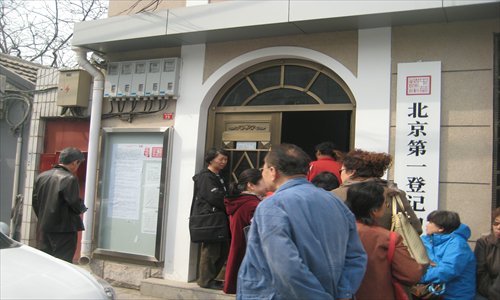
A big crowd of people with death on their minds are crowding into a newly opened office in Hepingmen, Xicheng district.
"If only I had come here a few days earlier! We didn't expect it to be so popular," says Ma Yu, 51, who came across town from Haidian district to No. 73 Xijiaominxiang Hutong to the registration center of China Will Bank (CWB), which opened on March 21.
The center provides free consulting, registration, safekeeping and delivery for wills to all Chinese aged over 60 and over.
Ma came to register for her 78-year-old husband who can't move around because of bad health. She wants to have his testament kept in the center's bank. The will distributes his property after death, leaving his bigger apartment to their two children, and the smaller apartment to Ma.
"We want to be prepared for any disputes over property when he dies, or even lawsuits," says Ma, whose husband has cardiovascular disease. "But we don't know if my husband will still be here by the day (of the appointment)."
The center is so popular that the appointments have been booked through to next year. Ma's appointment is on July, 16, 2014.
"We open at 9:30 am, and once, a person finally made it to the front of the line at about 3 am," says Chen Kai, director of the center, jointly founded by NGOs China Aging Development Foundation and Beijing Sunny Senior Health Fund.
Keep your will in a bank
Chen told Metro Beijing that the procedure at the center is to make an appointment, bring in the original copy of a will to register, and take the wills to the bank vaults to preserve them. Lawyers provide non-profit consultations to the clients.
The center can only handle 40 requests every day. It also make appointments with about 200 people lining up at the center and another 100 people through the hotline every day. "We'll open more centers in the future, and the appointments will be moved up," says Chen.
The center plays a different role from notary offices. "Notary offices help making a will and notarizing it, but what we do is keep and deliver wills, since the clients already have a will," Chen explains.
Chen says the wills can also be made in digital recordings in the center, and door-to-door service might also be possible in the future.
"We'll have more centers built in Beijing within 2013, and in other cities too," says Chen. In the future, the procedures will be simplified, services will be provided to all ages, and a national network will be built, Chen adds.
Who gets the home?
The most complicated problem, and also the problem that old people care most about, is how to deal with their homes, says Liu Aiming, a volunteer lawyer from Jingde Law Firm working at the center, who specializes in inheritance law. "There can be many problems in making and carrying out a will, especially for people with complicated family relations, such as remarried families."
Chen noticed that many of the old people don't tell their children about the contents of their will. "Letting the children know now will cause changes in family relations. And any changes of the will in the future can cause troubles," says Chen.
Wearing a pair of sunglasses, a mask and a hat, Mao Lin, 61, a retired teacher, showed up at the door of the registration center this Monday.
Mao didn't want to be seen or recognized by anybody, because she doesn't want her son or neighbors to know she came.
Mao has already written her will, leaving the house to her husband, and had the will notarized. This time, she came to the center to seek advice and properly dispose her savings.
"My son shows no filial obedience to me, so I won't leave him anything," says Mao, noting that her 34-year-old son hasn't spoken to her for 17 years since she divorced her ex-husband. "He gives me the cold shoulder because I am not wealthy. I feel bitterly disappointed, because nowadays children are too practical," says Mao.
Another person whose children broke his heart is waiting on a bench outside of the center in a pair of green military pants.
The 84-year-old man, surnamed Zhao, is a veteran who survived the World War II, and then survived cancer. Zhao has three children. "Their houses are all bigger and nicer than my apartment, but they still want mine," says Zhao, noting that none of them came to visit when he was sick.
"Nowadays, instead of supporting us, many young people rely on their parents, so we want to give our legacy only to those who take good care of us," says Zhao, who will give his house to his home nurse.
Some people choose to leave their property to their nurses, or even pets.
Last rites
Besides dealing with houses and money, other common things that wills cover include how do dispose of the body and final rites. In Zhao's will, he wants to donate his organs after death.
"I don't want any ashes, or any ceremonies, so these old bones won't be wasted or cause any inconveniences to anybody," says Zhao.
"One devoted Buddhist stated that his body should be handled by Buddhist ceremonies," says Chen, adding that they haven't met any client yet who wants to donate their property to charity.
The most common errors in a will are taking a spouse's shared property as one's own, restricting the spouse's rights of re-marrying, and having no quantitative criteria on children's obligations as auxiliary conditions, says Chen.
Although the center hasn't had a foreign client, a large proportion of their clients have children who are immigrants or have a foreign passport. "We are building a more convenient procedure, so that we'll be authorized to act on behalf of our clients and their children, saving them the trouble of going back and forth from abroad," says Chen.
Chen says that studies show the current total amount of wealth in China that needs to be re-distributed when people die is as much as $1.14 trillion each year, which makes establishing the proper use of wills a big social problem.
"Executing wills properly is very important, and this center is a unique, credible solution," says Liu.
"We recommend that everybody, rich or poor, make a will."