Maritime rights predominate as country opens up strategy
China's eighth white paper on the country's armed forces reveals a lot of information that has never been published previously. But many experts from other countries do not feel very satisfied with these contents, because they request more details and try to figure out the methods that China uses in giving the figures for its military spending.
This white paper is a big step China has taken for military transparency. However, due to different values, Western countries are unlikely to be content about China's military transparency. In fact, compared with some Western countries, China has done well in terms of military transparency, especially shown in that it makes no secret of its strategic concepts and principles.
China's military is increasingly becoming transparent. However, it's impossible for China to reveal information that is related to its core interests. China has its right to decide whether to publish relevant details or not.
When analyzing the new challenges and missions that China has to face, the white paper points out that "the Asia-Pacific region has become an increasingly significant stage for world economic development and strategic interaction between major powers." The paper singles out two major powers that could dynamically affect China in the region, namely the US and Japan.
As the sole superpower in the world, the US has played a very important role in the international arena, especially in the Asia-Pacific region. Sino-US relations are interdependent, but doubt and mistrust still exist between the two countries. Both are on the alert about the other's military deployment and possible military actions.
The US pivot to Asia has stirred up the Asia-Pacific region. With respect to China's territorial disputes with neighboring countries, such as Japan and the Philippines, the US has not helped China and other countries involved to deal with the disputes properly, but added fuel to the disputes. China has to pay special attention to this US strategy in the Asia-Pacific region.
China's concerns over Japan are a different thing. The disputes between China and Japan result from history. Japan is eager to seek an image of "political power," but this is tarnished because of the country's militarism during World War II. After the end of the war, Japan has always exerted its political influence through economic means. Nevertheless, with the economic recession, the right-wingers of Japan want to use aggressive political methods to flex muscles and improve Japan's situation in the international community. These are very dangerous actions.
China needs a peaceful environment for economic development. So building up strong military power is the best way to deter others and maintain peace in the Asia-Pacific region.
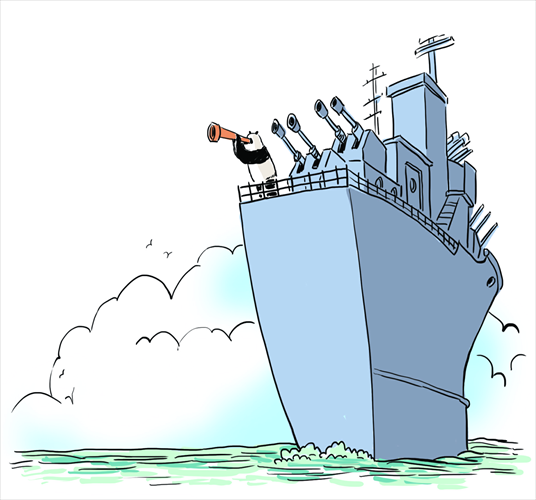
In this paper, China attaches great importance to maritime interests and to build a strong navy.
In modern times, China has lagged far behind many powers which have devoted much of their strength to developing maritime strategy. Thus, this time "safeguarding maritime rights and interests" is written in the white paper.
Safeguarding maritime rights can help defend sovereignty and territorial integrity. The ocean itself is of great significance for the economic development of China. Rescue missions and protecting transport routes such as sea lines have also become necessary tasks for China's security forces.
But at the same time, China has to have a clear and right way to define the maritime interests that it needs to protect.
There is no doubt that China should safeguard its core maritime interests. However, it is harmful for China to shoulder heavy and unnecessary responsibilities and let itself fall into a passive position.
In terms of building a stronger navy to defend the maritime power, China must focus on its national strength in order to have a maritime policy that is suitable for the national situation.
This article was compiled by Global Times reporter Zhao Nan based on an interview with Zhu Mingquan, professor of Center for American Studies at Fudan University.zhaonan@globaltimes.com.cn