Arts fest scores top opera talent
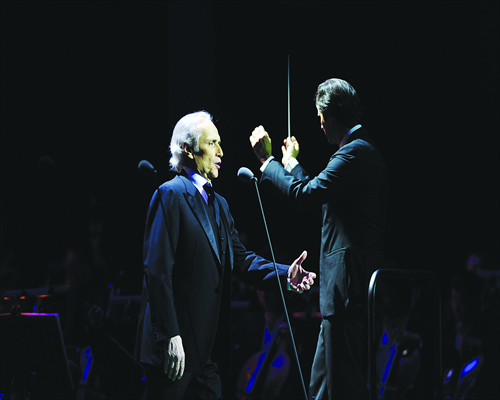
In the world of opera, it seems that age is no barrier to performing. At least, this is the case for the 67-year-old Spanish tenor José Carreras, one of the Three Tenors who still perseveres in performing on stage despite his age and physical collapse in the late 1980s.
To Chinese audiences, Carreras is a familiar artist, thanks to his increasing exposure in China in the recent decade, together with the development of the country's opera and audiences' appreciation taste of it.
And now, with this year's Meet in Beijing Arts Festival kicking off this Saturday, Carreras will meet Chinese audiences again as the opening performer of Asia's largest spring art event.
Lasting from April 27 to May 30, the festival now has become a cultural brand for Beijing. This year, more than 60 performing troupes from 20 countries will attend the festival to present 50 theater performances and 100 outdoor concerts in public spaces - musicians from countries including Russia, Cuba and Poland are set to perform in places such as Chaoyang Park or Tongzhou Canal Park. There will also be a series of art exhibitions.
And as usual for the 13-year-old festival, each year the opening performance is given only by those who have an international reputation. This year, coinciding with the 40th anniversary of establishing official ties between China and Spain, the festival invites Carreras who will present his solo concert on the opening day at the National Centre for the Performing Arts (NCPA).
"Since I first came to China in 1998, I can't remember how many times I've been here, almost one time per year," said Carreras at a news conference in Beijing on April 23, "and those increasing experiences here enable me to feel Chinese audiences' increasing enthusiasm and understanding of Western and classical music."
'Velvet voice'
Since winning the "Voice of Verdi" singing contest in Italy in 1971, Carreras has been acclaimed in his opera career for possessing a "velvet voice," which best interprets those works of Giuseppe Verdi (1813-1901) who along with Richard Wagner, is one of the two most influential operatic composers of the 19th century.
And to present the best of his performance in Beijing this time, Carreras brings his company conductor David Giménez, who has cooperated with the tenor for 19 years and has conducted world leading symphony orchestras including Wiener Philharmoniker (in Vienna) and the London Symphony Orchestra.
"He has many improvisational plays on stage which amazes audiences from time to time," said Giménez about his long-time partner at the news conference.
While most audiences no longer expect Carreras to be able to hit a high-C note, the more mellow tone in his voice perhaps now allows him to better present those expressive and lyric librettos.
Chinese style
"I've been admiring his romantic and lyric style of performing operas since I started to learn opera," said Wang Li, a young Chinese soprano who will cooperate with Carreras to perform a Chinese song "My Beijing, My Home" at the latter's concert this Saturday. "This is a popular Chinese song, so I'll accommodate to the popular way of singing," said Carreras.
"Chinese songs have their special characteristics, the passion, sadness and expressiveness are incorporated in melodies which always inspire me," he said at the conference.
For Chinese audiences, the fact that Carreras often sung his own version of the traditional folk song "In That Distant Place" when he performed in China in the past decade, has brought them a Western interpretation of the song.
"Besides the Chinese song, we'll also sing 'Don't Ever Forget Me' together, and through our cooperation this time, I want to introduce the Chinese style of bel canto to the world, since the Chinese language in opera makes a great difference to Western traditional operas," said Wang.
Besides the duet with the Chinese soprano, Carreras will also perform Nabucco, the first signature work of Verdi, as this year marks the 200th anniversary of the composer's birth. "Considering Chinese audiences' taste for music, we've also selected a group of other different styles of operas to present," Carreras said.
Those include "Fly! Serenade" by Italian composer Francesco Paolo Tosti (1846-1916), "Oh My Dear Daddy" by Giacomo Puccini (1858-1924) and "The Doll's Song," an episode from The Tales of Hoffman.
Hitting the high notes
With the physical impossibility of maintaining the high notes consistently, performing opera for Carreras now is more like a perfect emotional display to audiences.
"To be an excellent opera singer, a naturally talented voice is important, but one also needs to keep learning, to accomplish different combinations of emotions and then communicate with audiences," said Carreras.
For the art of opera, which has developed in the West for hundreds of years, Chinese learners are still immature.
"In recent years, with more and more students learning overseas and leading domestic academies, like the Central Conservatory of Music, improving their teaching standard, the gap with Western opera performing is narrowing," said Wang.
To boost the country's opera development, China has made lots of effort in both the construction of performance facilities and in the training of practitioners.
The NCPA, which opened in 2007, aims to keep China on a par with leading international opera houses like the Metropolitan Opera House in New York in the US.
It now has a full program of operatic performances, whether they are original productions, or in cooperation with the world's leading operatic performers.
Each year, besides the regular three-month opera festival, which usually lasts from April to July, featuring dozens of classic Western opera productions (like Othello and The Flying Dutchman this year) and Chinese local operas (like Honghu Lake and Xi Shi), it also invites world leading opera singers, like Placido Domingo's upcoming performance in late May.
"Chinese opera's development is being recognized by the world, now I'm able to perform in the NCPA, it's an honor to me," said Carreras.