Neo-Nazi murder trial opens
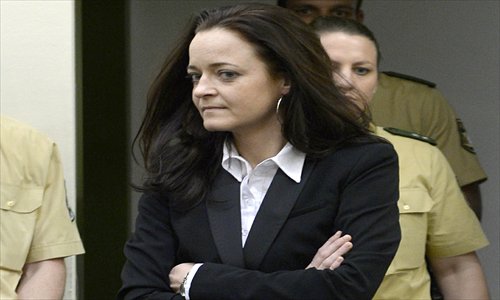
A woman accused of being at the heart of a neo-Nazi killer cell went on trial Monday in a case that has shocked and shamed Germany and prompted calls for a security services overhaul.
The random discovery of the gang in late 2011 embarrassed authorities, exposing deep security flaws and raising uncomfortable questions about how the cell went undetected for 13 years in a country proud of owning up to its Nazi past.
Dozens of anti-racist protesters shouted slogans outside as Beate Zschaepe, 38, entered the heavily-guarded Munich courtroom, appearing relaxed with her arms folded.
She is charged with complicity in the murders of eight ethnic Turks, a Greek immigrant and a German policewoman between 2000 and 2007 as a founding member of the National Socialist Underground (NSU).
Dubbed the "Nazi moll" by media, she is also accused of involvement in 15 armed robberies, arson and attempted murder in two bomb attacks.
Her lawyers deny she was directly involved in the murders.
Four men joined Zschaepe in the dock on charges of supporting the NSU.
Germans were stunned to learn in November 2011 that foreign criminal gangs were not behind the unsolved murders, as long suspected by police and the media, but home-grown racist killers.
The case only came to light after Zschaepe's alleged accomplices, Uwe Mundlos and Uwe Boehnhardt, were found shot dead in an apparent murder-suicide.
Zschaepe then allegedly blew up their shared home in eastern Germany and later surrendered to police.
A DVD later emerged with a film in the style of a "Pink Panther" cartoon in which the group claimed responsibility for the attacks.
An investigation into the handling of the case revealed oversights and missteps by police and domestic intelligence services and a realization that the right-wing extremist threat had been grossly underestimated by all involved.
The head of domestic intelligence resigned in July after staff admitted shredding files relevant to the case, and a parliamentary committee has been set up to look into what went wrong.
The scandal also exposed a web of contacts between the secret services and the far-right in which the state systematically exchanged cash for information, raising questions about possible collusion.
Zschaepe entered the courtroom before the hearing got under way. Proceedings were adjourned for five minutes while the defendant talked to her lawyers after it emerged that Zschaepe had objected to chief judge Manfred Goetzl.
Her lawyers accused him of bias in ordering the defense team to undergo security checks on entering the courtroom over the possibility of objects or messages being brought to defendants, while prosecutors, police and other parties are not required to be searched.
AFP