Full speed ahead
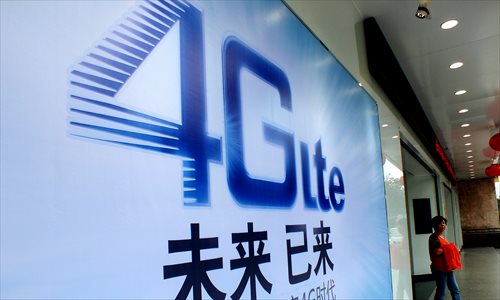
Though 3G is still a new concept for many Chinese people, China Mobile - the world's largest telco - is actively building and touting a faster 4G network at full throttle.
The 4G LTE (long-term evolution) platform, developed by the 3GPP (3rd Generation Partnership Project), is the new standard for mobile communications, widely expanding on the domains of earlier 2G and 3G networks.
While US and European markets are based on the FDD-LTE (frequency division duplex-LTE) platform, Chinese consumers are looking toward TD-LTE (time-division LTE), a homegrown platform co-developed by China Mobile together with other telecom equipment makers in China and abroad, including ZTE, Datang Telecom, and Nokia Siemens Network.
The theoretical peak download rate of 4G reaches 1 gigabite per second, compared with 100 megabites per second on the 3G network, allowing it to deliver faster download speeds and offer a better user experience when watching high-definition videos online, said Xiang Ligang, a telecom expert and CEO of industry information portal cctime.com.
Data from US market research firm IHS iSuppli indicate that the number of global 4G users is expected to surge by 181 percent to 206 million by 2013, up from 2012's 73 million, and suggest that the growth rate of 3G users will decline to less than 35 percent in 2013.
The 4G craze has become the newest trend in the global telecom industry and with support from the government and telecom carriers, China is likely to soon enter the era of 4G technology, Xiang told the Global Times Tuesday.
China Mobile has shown its 4G ambitions in a most determined way. The company has recently launched TD-LTE trial networks and built 20,000 base stations in 15 pilot cities including Shanghai and Guangzhou, and it plans to construct networks in over 100 cities to reach a total of more than 200,000 TD-LTE base stations by the end of 2013.
"We are currently preparing for a TD-LTE terminal tender bidding and plan to purchase more than 1 million terminals by the end of 2013," Zhang Xuan, spokesperson for China Mobile, told the Global Times Wednesday, refusing to reveal further details.
A big slice of the cake
The tender will surely attract many handset makers' attention and participation given the optimism over the country's 4G market, and many companies intend to be the first to release a 4G mobile phone in the market, Zeng Tao, a senior telecom analyst at Horizon Research Consultancy in Shanghai, told the Global Times Tuesday.
"In the second half of this year, we will release a mobile phone marketed as Optimus G Pro according to China Mobile's TD-LTE standard. The device supports FDD-LTE as well," a PR representative from LG Electronics' mobile phone operation in China told the Global Times.
He added that most of the firm's peers have already developed TD-LTE devices and the company will surely not miss out on this promising market.
With all the anticipation over a 4G network in China, some domestic brands may be shifted out due to the lack of advanced hardware or technology required to smoothly run 4G applications, Wang Jun, an industry analyst with Analysys International, told the Global Times Tuesday. LG predicts that 4G technology is likely to bring about some changes to the market structure of the current handset sector.
Changes may also occur within the domestic telecom industry, and China Mobile is likely to reverse its downward trend in the 3G market through the 4G launch, noted Xiang.
The government has tasked the company with popularizing TD-LTE and TD-SCDMA (time division-synchronous code division multiple access, a homegrown 3G standard) platforms, as it suffered a decline in 3G market shares because popular foreign mobile brands, including Apple, refuse to adopt the homegrown 3G standard, said Li Dongsheng, CEO of TCL Group, on his Sina Weibo on May 5.
Companies like Apple prefer to cooperate with the other two carriers who have adopted 3G standards - WCDMA (wideband code division multiple access) and CDMA (code division multiple access) - widely used in other countries' networks, remarked Zeng.
Unlike 3G chips that support a single standard, TD-LTE and FDD-LTE coexist on 4G chips, leaving mobile device producers no excuse to resist the homegrown 4G standard as they did in the 3G world, said Xiang.
TD-LTE is likely to become available on the new generation of the iPhone and China Mobile, which is richer in capital and users than its peers, allowing it to lead the domestic 4G sector expected in June, echoed Zeng.
But it will take at least five years to see changes in both the country's telecom and handset industries, given that the market is still not mature enough for large-scale use of 4G, he noted, adding that domestic users are likely to start noticing the importance of 4G services in 2017 and the current trend still favors 2G in China.
As of March, China Mobile had 726 million subscribers, only 16 percent of which were 3G users. Meanwhile, China Unicom's 3G users accounted for 35 percent of total subscribers, and the number of China Telecom 3G subscribers reached 78 million, 46 percent of the total users.
It is a big challenge for telecom carriers to persuade so many 2G users to start using 4G networks, noted Zeng.
Government license crucial
Both China Mobile and TD-LTE terminal makers are ready to dive into the world of 4G networks, but the government's 4G license is a crucial precondition.
The government plans to issue 4G licenses within the year, Miao Wei, China's Minister of Industry and Information Technology, said in March 2013.
Xi Guohua, chairman of China Mobile, revealed in March 2013 that the best issuing time will be the end of 2013.
Xiang speculated that the release date is likely to arrive early on May 17, World Telecommunication and Information Society Day, given that many countries have developed 4G networks and the three domestic telecom carriers all expect the license to be issued as soon as possible.
As of March, a total of 67 countries worldwide had deployed 156 commercialized LTE networks and 666 LTE terminals have been launched around the world, 221 of which were smartphone-based, according to the Global mobile Suppliers Association (GSA).
Until recently, China Unicom and China Telecom had no impetus to develop their 4G networks, as the two companies have already invested a lot in building 3G networks and so far have not recouped the investment, Xiang noted. He added that they will be forced to do so now, otherwise China Mobile will be way ahead of the game.
Without a doubt, China Mobile will get the TD-LTE license, enabling the company to have advanced 4G deployment, but the other two may get either the TD-LTE or FDD-LTE license, he noted.
IHS iSuppli predicted in its February report that the number of China's 4G users will leap from 1 million in 2013 to 440 million in 2017, with 52 percent held by China Mobile, 22 percent by China Telecom, and 26 percent by China Unicom.